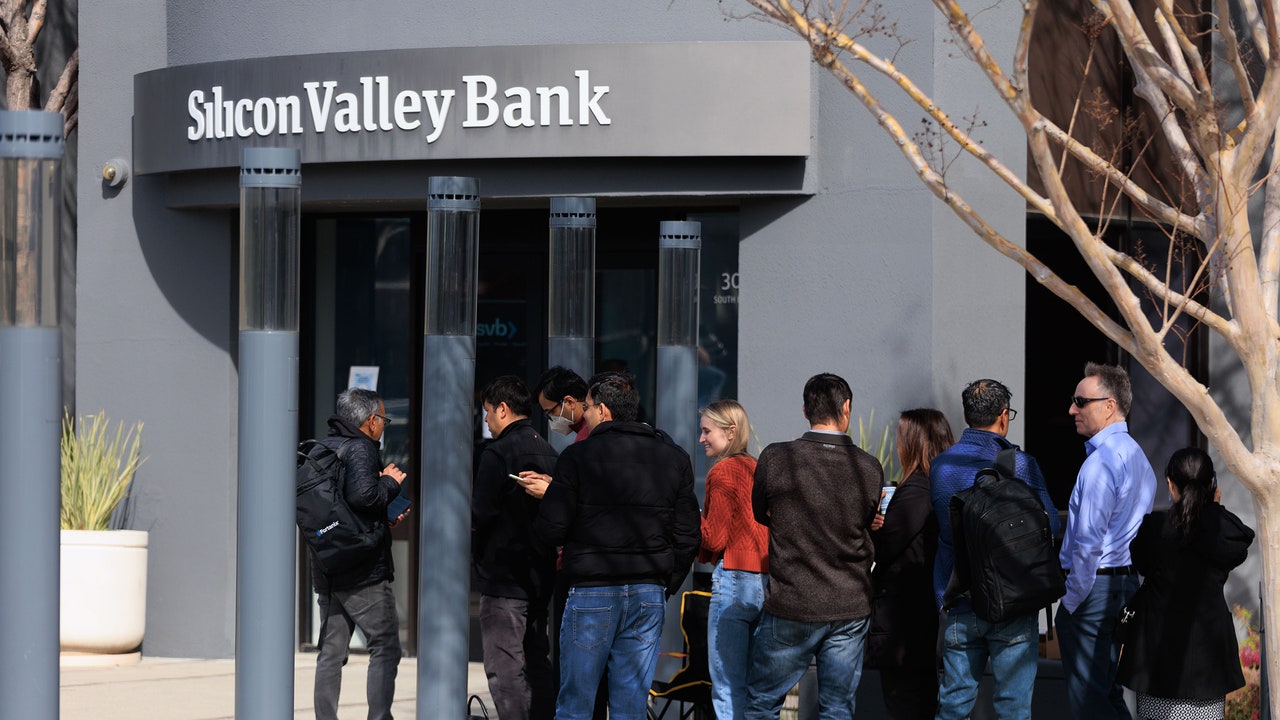

Bank failures raise question of whether to raise FDIC insurance levels

Bank failures raise question of whether to raise FDIC insurance levels

Recent bank failures have shined a highlight on a thorny dilemma: Is it time to overhaul the federal deposit insurance policy application?

The failures of Silicon Valley Financial institution and Signature Lender past thirty day period uncovered weaknesses in the system, including much too many uninsured deposits at some institutions and the propensity of jittery depositors to transfer funds at the drop of a hat.

Gone are the times captured by grainy Depression-era newsreels when anxious buyers experienced to stand in lengthy strains exterior of branch offices in hopes of receiving their dollars back again. Now, depositors can spark lender operates by clicking a handful of buttons on their mobile telephones. The speed of customer reactions results in new pressures for the deposit-insurance technique, as it marks its 90th anniversary.

This could warrant substantial adjustments for how the Federal Deposit Insurance coverage Corp. and its credit score union counterpart, the Nationwide Credit rating Union Administration, oversee their applications. Really should the essential insurance plan of $250,000 for each depositor go up, be left alone or even get reduced? How should the banking field pay out for this protection? Ought to various styles of prospects acquire different therapy?

The past concern is intriguing since regional banking institutions this sort of as Silicon Valley cater to a great deal of smaller businesses, lots of of whom exceed the FDIC limit masking no much more than $250,000 in deposits for a consumer at a provided lender (however customers can acquire extra insurance coverage if they break up their cash applying many ownership arrangements this kind of as joint accounts or retirement accounts).

Insurance policies for $250,000 in deposits is “way more than sufficient for most households,” stated Thomas Philippon, a finance professor at New York College. But it may possibly not be include a enterprise needing to fulfill payrolls, obtain equipment or make other massive transactions.

In a modern webinar debate on the subject, he prompt furnishing various insurance plan amounts for diverse forms of customers — smaller organizations as opposed to households, for instance, or business enterprise transactional accounts versus continuous-balance savings accounts.

Additional:Spring cleansing your retirement accounts, subscriptions and credit rating report can save time and cash

The webinar discussion was sponsored by the Brookings Institution’s Hutchins Centre on Fiscal and Financial Plan and the University of Pennsylvania’s Wharton Initiative on Monetary Policy and Regulation.

Ought to deposit insurance policy have any limits?

Deposit insurance plan has enhanced in matches and starts around the decades, mainly lately to $250,000 during the fiscal disaster of 2008 from the prior stage of $100,000, where it had remained considering the fact that 1980.

Prasad Krishnamurthy, a professor at the College of California Berkeley University of Regulation, favors elevating the $250,000 cap to an unspecified amount. New choices by regulators to cushion uninsured depositors from losses properly render the $250,000 restrict moot anyway, he argued.

Uninsured depositors at Silicon Valley Bank and Signature Financial institution failed to get rid of dollars, but enabling that to come about brought about a $20-billion hit to the FDIC’s insurance policies fund, with repayment of the expenditure to appear from better rates or costs levied on the banking sector. Treasury Secretary Janet Yellen invoked a particular rule that prolonged insurance policies to deposits previously mentioned $250,000 at the two banking institutions.

“Whether we like it or not, deposit coverage for the ‘uninsured’ does in point exist,” Krishnamurthy stated.

Even though Yellen’s go did address uninsured deposits at Silicon Valley Bank and Signature Financial institution, there is certainly no assurance long term lender failures get the exact remedy, observed Patricia McCoy, a Boston College legislation professor.

“Our latest tactic results in uncertainty” among the bankers as to whether or not their uninsured depositors would be made total in the party of a different failure, McCoy said. “This uncertainty is a great thing,” she argued, supporting to preserve bankers from having reckless risks that could sow the seeds for “more and worse economical crises in the upcoming.”

Moreover, she stated, relocating to a system of limitless deposit insurance coverage could expense even a lot more for banking institutions essential to spend more deposit insurance plan rates, and it would have to have far more regulation. “Can the U.S. afford whole deposit insurance policies, and who would pay back?” she requested.

Need to regulators permit uninsured depositors reduce revenue?

The large the greater part of Silicon Valley Bank’s deposits, around , were uninsured. The bank was an outlier in this regard, but other financial institutions also have significant chunks of deposits that a failure would threaten, Philippon famous. About  of all deposits had been uninsured at the stop of 2022, in accordance to FDIC facts.

Substantially of the discussion above the banking program boils down to whether the Federal Reserve, Treasury Division and other regulators ought to enable the cost-free marketplace sort out its problems, even if those people troubles spill in excess of into the broader money procedure and economic climate. Ethical hazard is the tendency of bankers or other people to ignore challenges if they think they’re protected or insulated from the implications.

Uninsured depositors require to take in some losses in the event of long run lender failures (as they have in some prior failures) for the technique to do the job.

“If you want to send a signal to the marketplace that some costs are likely to be imposed on uninsured depositors, you have to make that risk credible at some stage,” Krishnamurthy explained.

Access the writer at russ.wiles@arizonarepublic.com.

Should You Buy the Bank Stocks Right Now?

Should You Buy the Bank Stocks Right Now?
  • (:45) – Should really You Be Jumping Into The Banking Market?

  • (6:20) – Tracey’s Top Inventory Picks

  • (19:30) – Episode Roundup: JPM, C, BAC, WFC, PNC, UCBI, OSBC

  • Podcast@Zacks.com


Welcome to Episode #324 of the Price Investor Podcast.

Every week, Tracey Ryniec, the editor of Zacks Benefit Investor portfolio, shares some of her major benefit investing guidelines and stock picks.

The banks have bought off just after the collapse of Silicon Valley Bank very last month and keep on to drift decreased. Wall Street is avoiding the banking companies at all fees. And that contains all 3 of the big banking categories: the “too significant to fail” large four, the regional banking institutions and the hundreds of community banking institutions.

But are points really that dire in the total field? Or are some banking companies now values?

1st quarter earnings reports will be essential. Investors will need to tune into the meeting calls of their beloved banking institutions since there need to be a whole lot of thoughts, and solutions, about what is going on with deposits, financial loans and any distress that might exist.

5 Bank Shares: Values or Traps?

1.       JPMorgan Chase (JPM)

JPMorgan Chase falls into the “too major to fail” category of banks. It has a marketplace cap of $376 billion.

Shares of JPMorgan Chase are down 4.9{1668a97e7bfe6d80c144078b89af180f360665b4ea188e6054b2f93f7302966b} calendar year-to-day. Earnings are envisioned to increase 6.2{1668a97e7bfe6d80c144078b89af180f360665b4ea188e6054b2f93f7302966b} in 2023 to $12.84 from $12.09. JPMorgan has beat on earnings the past 2 quarters.

Is JPMorgan a offer? It trades with a P/B ratio of 1.4. With banks, a P/B ratio of 1. is thought of low-priced but 2. is viewed as totally valued.

JPMorgan will guide off the first quarter earnings season on Friday, Apr 14, 2023.

2.       Citigroup Inc. (C)

Citigroup is also a person of the “too significant to fail” banks. It has a industry cap of $90 billion.

Shares of Citigroup are up 1.5{1668a97e7bfe6d80c144078b89af180f360665b4ea188e6054b2f93f7302966b} 12 months-to-day. Earnings, however, are anticipated to drop 17.4{1668a97e7bfe6d80c144078b89af180f360665b4ea188e6054b2f93f7302966b} in 2023 to $5.87 from $7.11. It will join JPMorgan in reporting earnings on Apr 14, 2023.

Citigroup is low-priced. It has a P/B ratio of just .48. That is very well beneath the 1. amount that signifies worth.

Will you be listening in on Citigroup’s initial quarter conference contact?

3.       The PNC Financial Expert services Group, Inc. (PNC)

PNC Fiscal is a single of the bigger regional banking companies, headquartered in Pittsburgh. It has a market cap of $49 billion.

Shares of PNC Monetary have fallen 22{1668a97e7bfe6d80c144078b89af180f360665b4ea188e6054b2f93f7302966b} 12 months-to-date as the regional financial institutions have been hit more challenging than the too-major-to-fall short banks. Earnings are envisioned to increase in 2023, nonetheless. Analysts expect earnings development of 3.3{1668a97e7bfe6d80c144078b89af180f360665b4ea188e6054b2f93f7302966b} to $14.42 from $13.96 very last calendar year. But will it be equipped to do so right after the banking crisis?

PNC Economical trades with a P/B ratio of just 1.07, which indicates it’s affordable.

Will you be tuning in to PNC Financial’s initial quarter earnings report on Apr 14, 2023?

4.       United Neighborhood Banks, Inc. (UCBI)

United Community Banking companies is a regional southeast bank headquartered in Ga. It has a marketplace cap of $3.2 billion.

Shares of United Local community Banks have fallen 17.7{1668a97e7bfe6d80c144078b89af180f360665b4ea188e6054b2f93f7302966b} yr-to-date. Earnings, however, are anticipated to rise 11.3{1668a97e7bfe6d80c144078b89af180f360665b4ea188e6054b2f93f7302966b} to $2.96 from $2.66 final year.

United Local community Banks has had a rocky earnings shock file in the latest quarters as it has missed three out of the past 4 quarters. It reviews earnings on Apr 18, 2023.

With a P/B ratio of 1.1, is United Local community Financial institutions a benefit?

5.       Previous Next Bancorp, Inc. (OSBC)

Irrespective of a current market cap of just $598 million, Old Next Bancorp still falls in the regional bank category. It is the third most significant lender in the Chicagoland region.

Shares of Old Next Bancorp are down 16.5{1668a97e7bfe6d80c144078b89af180f360665b4ea188e6054b2f93f7302966b} 12 months-to-date. Earnings, even so, are predicted to rise 35.6{1668a97e7bfe6d80c144078b89af180f360665b4ea188e6054b2f93f7302966b} to $2.21 from $1.63. It has conquer the earnings estimate a few out of the final 4 quarters and will report earnings again at the end of April.

Outdated 2nd Bancorp has a P/B ratio of 1.3 which is not the most affordable of these 5 shares, but is continue to closer to the “value” stage of 1..

Is Previous Next Bancorp a value or a entice?

What Else do Invest in and Hold Buyers Need to Know About the Lender Shares?     

Pay attention to this week’s podcast to come across out.

[In full disclosure, Tracey owns shares of OSBC in her personal portfolio and in Zacks Value Investor portfolio.]


Want the hottest recommendations from Zacks Investment decision Research? Now, you can down load 7 Greatest Shares for the Up coming 30 Days. Simply click to get this free report

JPMorgan Chase & Co. (JPM) : Totally free Stock Investigation Report

Citigroup Inc. (C) : Cost-free Stock Evaluation Report

The PNC Money Services Team, Inc (PNC) : No cost Stock Analysis Report

Aged Next Bancorp, Inc. (OSBC) : Free of charge Inventory Investigation Report

United Local community Financial institutions, Inc. (UCBI) : Totally free Inventory Examination Report

To study this article on Zacks.com click on right here.

Zacks Financial investment Analysis

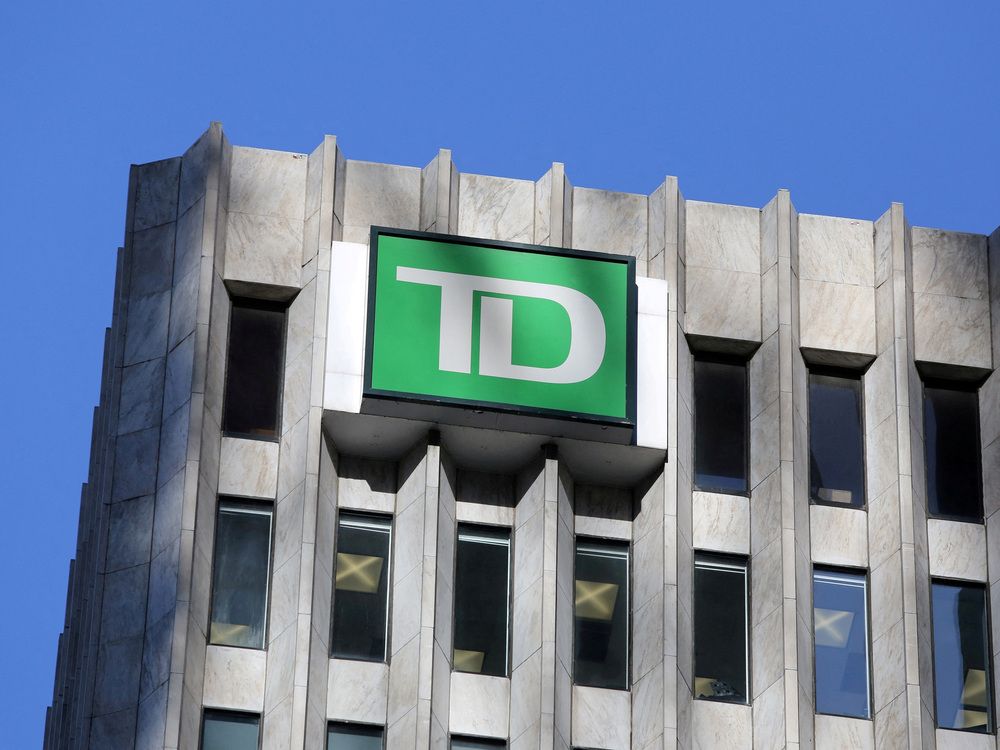
TD Bank biggest sector short anywhere in the world

TD Bank biggest sector short anywhere in the world

Worries about TD’s exposure to Canada’s housing slowdown and ties to U.S. market

Article content

Turns out, the biggest short in the banking industry anywhere in the world isn’t in Switzerland or Silicon Valley, but rather, in the relatively tame financial centre of Canada.

Advertisement 2

Article content

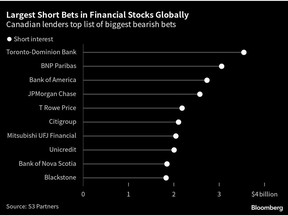
In recent weeks, short sellers have upped their bearish bets against Toronto-Dominion Bank, and now have roughly US$3.7 billion on the line vis-à-vis Canada’s second-largest lender, according to an analysis by S3 Partners. That’s the most among financial institutions globally and puts TD ahead of the likes of France’s BNP Paribas SA and Bank of America Corp.

Article content

Part of it has to do with the general skittishness toward the banking sector after three U.S. regional banks failed and Credit Suisse was forced into a shotgun wedding with UBS Group AG. And there are few signs Canadian lenders have any of the liquidity issues that investors have zeroed-in on recently. But analysts also point to worries about TD’s exposure to the country’s housing slowdown, as well as its ties to the U.S. market through its stake in Charles Schwab Corp. and a planned regional bank acquisition.

Article content

Advertisement 3

Article content

“Short sellers have been actively shorting into a declining banking sector,” said Ihor Dusaniwsky, S3’s managing director of predictive analytics.

TD didn’t immediately respond to requests for comment from Bloomberg.

Granted, short interest as a percentage of TD’s shares available for trading, or float, remains relatively low at 3.3 per cent and up from 2.8 per cent a year ago. By that measure, TD is third among the top 20 U.S. and Canadian financial companies.

TD’s position atop the list of biggest bank shorts comes as it seeks to close a $13.4 billion deal for First Horizon Corp., which would expand its foothold in the U.S. TD is widely expected to renegotiate the deal after the recent bout of turmoil among U.S. regional banks drove share prices lower in March.

Advertisement 4

Article content

As a result, traders are “playing with short interest for TD more than normally” because the bank has become a merger arbitration play, according to Daneshvar Rohinton, a portfolio manager at Industrial Alliance.

Housing bubble

Rohinton says some short sellers also have zeroed-in on TD because of its roughly 10 per cent stake in Charles Schwab — which recently lost US$47 billion in market value as it came under scrutiny over its unrealized bond losses — as well as TD’s position in Canada’s housing market, where variable-rate mortgages are common and consumer insolvencies are on the rise.

Advertisement 5

Article content

“TD sits uniquely in the middle of two broad headwinds,” Rohinton said. “The fears around Canadian housing will be projected onto TD.”

So far, the TD short has been a winner. In March, shares of TD tumbled 11 per cent, which was the biggest decline in the S&P/TSX Banks Index. The decline wiped out $18.1 billion from the bank’s market value. Nevertheless, S3’s Dusaniwsky cautions that short-seller profits can evaporate just as fast, particularly when they are the result of a broad-based rally.

“Outsized short-selling like we saw in the banking sector are usually knee-jerk reactions to market turmoil and can reverse as quickly as they occur,” he said.

—With assistance from Alexandra Semenova.

Bloomberg.com

Comments

Postmedia is committed to maintaining a lively but civil forum for discussion and encourage all readers to share their views on our articles. Comments may take up to an hour for moderation before appearing on the site. We ask you to keep your comments relevant and respectful. We have enabled email notifications—you will now receive an email if you receive a reply to your comment, there is an update to a comment thread you follow or if a user you follow comments. Visit our Community Guidelines for more information and details on how to adjust your email settings.

Join the Conversation

Wall Street push for bank rescues clashes with Washington realities

Wall Street push for bank rescues clashes with Washington realities

By Pete Schroeder and Saeed Azhar

WASHINGTON/NEW YORK (Reuters) – The banking crisis set off by the swift collapse of Silicon Valley Bank has exposed a sharp disconnect among Washington and Wall Road. Bankers want more quickly, far more aggressive action to shore up the market, whilst the Biden White Dwelling and regulators argue they’ve carried out what they can inside of the boundaries of the regulation.

Some critics are asking irrespective of whether the Biden administration could have contained the crisis with aggressive steps at the start out.

“Policymakers have finished some points that are practical, but they have not damaged out the big bazooka yet and we have not passed the stage of significant vulnerabilities,” explained Edward Campbell, co-head of the multi-asset team at PGIM Quantitative Methods. “They are likely to have to do a lot more.”

Regional Financial institution stocks have been hammered because SVB’s collapse, led by To start with Republic. Analysts and buyers stress that devoid of far more govt intervention, fleeing depositors may possibly destabilize smaller and mid-sized banking institutions.

Some officers in the Biden administration, guided by the public rebuke of bailouts in the 2008 money crisis, say they will secure depositors and the system, but do not intend to rescue person banking institutions or place taxpayers at possibility.

The tensions in between Wall Road and Washington revolve close to three major details: the Federal Deposit Insurance Corporation’s (FDIC) failure to come across a buyer for SVB the Biden administration’s messaging around supporting depositors and its emphasis on stricter rules for the banking sector as an alternative of further more reduction.

Discovering A Purchaser FOR SVB

The failure of the nation’s 16th most significant financial institution caught regulators off guard. The FDIC shuttered the lender in the middle of a Friday, rather of waiting around for markets to near.

That weekend, the administration guaranteed all SVB deposits and commenced an emergency liquidity facility for banks, but located no consumer.

“I just cannot think about beneath what set of situations the FDIC could have believed it was a improved end result to permit the auction to fail,” reported Senator Monthly bill Hagerty, a Tennessee Republican who was briefed by the FDIC. “We would be working with a bank in spot appropriate now, as opposed to a broken procedure,” he explained.

The FDIC did not commence chatting to prospective prospective buyers or permit banking institutions to evaluation SVB’s funds until later on on Saturday, according to two field resources.

An FDIC spokesperson declined to comment on the sales system.

Senate Banking Committee Chairman Sherrod Brown, an Ohio Democrat, claimed his discussions with leading U.S. regulators instructed there had been a possibility for a personal customer but “apparently, the thanks diligence meant that both they backed out or the FDIC did not imagine they were being capable.”

1 govt resource pointed out that the FDIC can only pursue the minimum expensive specials for its deposit insurance fund, which limitations choices for a prompt sale.

The FDIC is predicted to announce subsequent actions for SVB’s property this weekend.

DEPOSIT MESSAGING

Led by Treasury Secretary Janet Yellen, the administration sought to reassure depositors that their dollars is safe and sound, though navigating technological and lawful restrictions, and producing very clear they do not intend to bail out ailing banking companies.

U.S. Treasury Secretary Janet Yellen takes questions on the Biden administration's plans, following the collapse of three U.S. lenders including Silicon Valley Bank and Signature Bank, as she testifies before a Senate Finance Committee hearing on U.S. President Joe Biden's proposed budget request for fiscal year 2024, on Capitol Hill in Washington, U.S., March 16, 2023. REUTERS/Mary F. Calvert

U.S. Treasury Secretary Janet Yellen usually takes inquiries on the Biden administration’s designs, pursuing the collapse of a few U.S. loan companies like Silicon Valley Bank and Signature Bank, as she testifies right before a Senate Finance Committee hearing on March 16, 2023. REUTERS/Mary F. Calvert

Marketplaces whipsawed on Yellen’s remarks this week, battling to decode how much the administration would go to shield depositors and the banking program.

The administration says it is carrying out all it can to secure depositors, without putting taxpayer cash at risk or bailing out banks.

“We will use applications we have to give the American persons self esteem that their deposits will be harmless,” White Home press secretary Karine Jean-Pierre stated Thursday.

A Treasury spokesperson also pointed out that deposits have stabilized at regional financial institutions and in some conditions “modestly reversed.”

The banking marketplace alone is not united on how to reassure depositors.

“Certainly, individuals would like to see much more out of the Biden administration,” said Chris Brown, a lobbyist with the firm Mindset in Washington and former Property Economic Services Committee staffer. Even so, “what they would like to see operates the gamut,” he reported.

Much more Aid OR REGULATION?

The banking field is searching for sweeping aid to relaxed marketplaces, even though Washington is discussing how to stop the next disaster.

“My feeling ideal now is that regulators believe every thing is less than control,” claimed Todd Phillips, a previous FDIC legal professional.

President Joe Biden has asked for laws to make it much easier to claw back shell out and income from stock gross sales for executives at failed financial institutions. The Federal Reserve is expected to ramp up procedures for regional financial institutions.

“It is apparent we do want to reinforce supervision and regulation. And I presume that there will be suggestions … and I program on supporting them,” Fed Chairman Jerome Powell explained Wednesday.

(Reporting by Pete Schroeder and Saeed Azhar more reporting by Chris Prentice David Morgan, Andrea Shalal, Heather Timmons and Paritosh Bansal modifying by Megan Davies, Heather Timmons and Suzanne Goldenberg)

Silicon Valley Bank and the Dangers of Magical Thinking

Silicon Valley Bank and the Dangers of Magical Thinking

In 2015, in the midst of a furious lobbying hard work on behalf of the banking sector, the C.E.O. and founder of Silicon Valley Bank, Gregory Becker, submitted a statement to the Senate Banking Committee that now reads like a thing out of a dark comedy. “SVB, like our mid-sized financial institution peers, does not current systemic danger,” he wrote. “We do not interact in market place making, securities underwriting or other worldwide financial investment banking functions. We also do not engage in intricate derivatives transactions or dealing, offer you complicated structured products, or take part in other functions of the type that contributed to the fiscal crisis.” He went on to emphasize to the senators anxious about the safety of the economic process how completely unexciting his corporation was its principal business was traditional banking: taking funds from depositors and lending it to providers that had been developing and also to the buyers in all those companies—activities that are essential to building work opportunities.

The context bordering Becker’s assertion exemplifies the corruption that plagues our regulatory method. In 2010, Congress handed an eight-hundred-and-forty-8-site bill identified as the Dodd-Frank Wall Avenue Reform and Shopper Security Act in reaction to the 2008 money crisis. One particular of the key aims of the legislation was to spot limits on the sorts of chance-getting routines that had contributed to the disaster. The money industry lobbied aggressively to weaken the monthly bill prior to it passed, and was profitable on numerous fronts. Then, when the monthly bill grew to become legislation, the press continued to weaken it additional. In 2018, soon following the Donald Trump-led Republican Celebration pushed as a result of a tax-reduce package that greatly lowered corporate taxes and disproportionately benefitted rich executives and traders, Congress permitted a further bill that loosened the Dodd-Frank guidelines. The bill lifted the threshold about which financial institutions would be necessary to post to further restrictions and oversight, from fifty billion dollars in assets to two hundred and fifty billion. The moment the monthly bill passed, a lot of banking institutions under the threshold did not need to have to perform mandated strain exams to see how they would manage during adverse financial conditions it also decreased the amount of hard cash that these banking institutions essential to have on hand in scenario of hiccups in the sector and they were no for a longer time necessary to have a system to promptly shut down without having disrupting the relaxation of the economical method, should really an unspeakable disaster arise. The lobbyists’ arguments, which ended up echoed by lots of associates of Congress (Democrats as nicely as Republicans) having funds from the businesses that the lobbyists represented, were being that the improved limitations were being suffocating modest-town banks with needless costs and requires that made it tricky for them to contend. In reaction to a lot of statements like the one that Becker sent to the Senate Banking Committee, the bill, termed the Financial Development, Regulatory Reduction, and Buyer Defense Act, was signed into legislation in May of 2018.

Just two months in the past, Silicon Valley Bank’s shares plummeted much more than sixty for every cent. Becker held a meeting contact with the bank’s clientele and urged all people to stay quiet. The following working day, the Federal Deposit Insurance Corporation declared that it was having over Silicon Valley Financial institution right after depositors rushed to withdraw their revenue and the bank didn’t have plenty of obtainable dollars. It was a typical operate on the lender of the sort depicted in the film “It’s a Superb Lifetime,” and the next-largest lender failure the U.S. has ever seen. In just the next number of days, Signature Bank was seized by regulators for comparable factors. A number of times just after that, regulators assisted set up a rescue of First Republic Lender the disaster at Initially Republic is continue to ongoing, and its stock was halted many times on Monday simply because it was slipping so rapid. People are concerned about where the worry could spread subsequent. Senator Elizabeth Warren, a single of the most incisive critics of banking-market procedures, partly put the blame on our political system, whereby mighty industries such as the banking process can strain associates of Congress to do their bidding. “No 1 should really be mistaken about what unfolded over the earlier handful of days in the U.S. banking technique,” she wrote in an Op-Ed in the Periods. “These new lender failures are the immediate final result of leaders in Washington weakening the fiscal guidelines.”

Warren is proper in placing the blame on Washington. But accountability also lies with a culture of magical thinking that permeates the economic planet, wherever those people working big, successful companies feel to think that the achievement of their firms is thanks completely to their extraordinary enterprise capabilities fairly than to luck and other exterior factors. In this mind-set, executives are unsuccessful to take into account the likelihood that the exceptionally favorable circumstances they are experiencing at 1 time may one working day change. “Businesses consider challenges, and from time to time those dangers outcome in the failure of the institution,” Kathryn Choose, a legislation professor at Columbia University who studies lender regulation, said. Despite the fact that, she additional, in the scenario of S.V.B., the actuality that the federal government had to phase in swiftly and get incredible steps details to a regulatory and supervisory failure as very well.

To be positive, the outdated, pre-2018 banking needs could have lessened the crisis for Silicon Valley Financial institution, by likely forcing the lender to ponder different situations and to do the math to see what would happen if fascination charges were being to maximize sharply in a relatively quick interval of time, and by mandating that the bank retain a lot more hard cash on hand as a cushion in case it fell under anxiety. But, as very long as Becker and the many others managing the financial institution were being focussed on intense revenue maximization, and thought that the revenue-maximizing ecosystem of around-zero curiosity fees was not matter to adjust, the bank was generally very likely to operate into critical difficulties.

Conventional banking, as Becker describes it, plays a critical role in our culture. At its core, it entails getting in deposits, gathering that funds, and then lending it to businesses that need to have it to improve. A vital section of the work of working a financial institution is controlling these various pools of dollars and producing absolutely sure that the stability of income coming in as deposits and likely out as loans is just suitable, so that if a person arrives in a single day wanting to choose revenue out of their account, the money is there. Curiosity fees have a remarkable effects on the money calculus of a financial institution supervisor. The problem is built even additional sophisticated when banks just take a depositor’s dollars and invest it instead than lend. In this case, Silicon Valley Financial institution invested a large chunk of its deposits in lengthy-dated Treasury bonds. Normally, this would be just one of the safest investments a single can make. When interest rates go up, however, more recent Treasury bonds shelling out better fees are well worth far more, and the older types decrease in value. This generates a dollars crisis if way too a lot of depositors want their dollars back all at the moment and the lender is forced to liquidate a bunch of bonds that are worth less than they paid out for them. As S.V.B.’s tech customers began having difficulties to increase venture-funds funds, they withdrew their deposits from the lender to meet their income requires, forcing a liquidity-strapped S.V.B. to promote billions of federal government bonds at a almost two-billion-greenback decline.

Choose likened new situations to the price savings-and-mortgage disaster of the nineteen-eighties, which happened beneath a very similar set of instances. Discounts-and-financial loan establishments, which are also referred to as thrifts, specialised in issuing home loans to individuals shopping for residences, in essence using deposits from prospects and then lending them out as lengthy-phrase preset-level housing loans. When, in the early nineteen-eighties, desire charges began to rise steeply, partly in response to inflation, the value of the home loan financial loans declined and the S. & L.s confronted a related problem to S.V.B.: depositors asked for their cash back, and thrifts did not have it to give them.

“It’s challenging to get your intellect all over, but it is main to banking,” Decide said. “For everyone common with the business, this is the most vintage hazard that exists.” All financial institutions battle with taking care of these challenges, and getting diversified is 1 way to minimize them. But, Decide observed, there are also instruments that exist in the current market now that did not in the nineteen-eighties which let financial institutions to hedge this danger. So considerably, it’s unclear why Silicon Valley Financial institution did not make ample use of these applications.

Analysis: Bank panic raises specter of 2008, may bring lasting change

Analysis: Bank panic raises specter of 2008, may bring lasting change

WASHINGTON, March 18 (Reuters) – The lightning speed at which the banking sector descended into turmoil has shaken world wide marketplaces and governments, reviving eerie memories of the fiscal disaster. Like 2008, the effects might be extensive long lasting.

In the area of a 7 days, two U.S. banking institutions have collapsed, Credit rating Suisse Team AG (CSGN.S) wanted a lifeline from the Swiss and America’s most significant financial institutions agreed to deposit $30 billion in another ailing company, 1st Republic Financial institution (FRC.N), in a bid to improve self confidence.

Evoking recollections of the frenzied weekend specials to rescue banks in the 2008 money crisis, the turmoil prompted monumental action from the U.S. Federal Reserve, U.S. Treasury and the non-public sector. Identical to 2008, the original worry does not appear to have been quelled.

“It does not make any perception immediately after the actions of the FDIC and the Fed and the Treasury (final) Sunday, that folks are continue to worried about their banks,” said Randal Quarles, the former top banking regulator at the Federal Reserve. He now faces renewed criticism over his agenda at the Fed, where by he oversaw efforts to decrease rules on regional banks.

“In an before world, it would have calmed items by now,” Quarles mentioned.

The collapse of Silicon Valley Financial institution, which held a substantial selection of uninsured deposits over and above the $250,000 Federal Deposit Insurance coverage Corporation (FDIC) confirmed restrict, shook self-confidence and prompted prospects to withdraw their cash. U.S. bank clients have flooded banking giants, which includes JPMorgan Chase & Co (JPM.N), Bank of America Corp (BAC.N) and Citigroup Inc (C.N) with deposits. That has led to a crisis of self-assurance and steep selloff in lesser banking institutions.

“We do a great deal of contingency organizing,” claimed Stephen Steinour, chief govt of Huntington Bancshares Inc (HBAN.O), a lender dependent in Columbus Ohio. “We started out to do the ‘what if scenario’ and appeared at our playbooks.”

As financial institutions grapple with short-term shocks, they are also assessing the extended phrase.

The swift and spectacular occasions have essentially transformed the landscape for banking institutions. Now, huge banking institutions may possibly get more substantial, scaled-down banking institutions could pressure to hold up and far more regional loan companies may shut. In the meantime, U.S. regulators will search to raise scrutiny on midsize companies bearing the brunt of the strain.

U.S. regional banking companies are anticipated to fork out better rates to depositors to keep them from switching to greater creditors, leaving them with bigger funding prices.

“People are actually moving their revenue all over, all these banking companies are going to appear essentially distinct in 3 months, six months,” explained Keith Noreika, vice president of Patomak World Companions and a former Republican Comptroller of the Forex.

2008 ALL More than Once more?

The latest disaster may truly feel frighteningly familiar for people who skilled 2008, when regulators and bankers huddled in closed rooms for days to craft options. Thursday’s financial institution-led $30 billion increase to To start with Republic also reminded people today of the 1998 field-led try to rescue Prolonged-Time period Funds Administration, exactly where regulators brokered a offer for field giants to pump billions into the ailing hedge fund.

With this most up-to-date stress, there are distinctions.

“For any person who lived via the world economic disaster, the earlier 7 days is sensation hauntingly familiar,” Josh Lipsky, senior director of the Atlantic Council’s GeoEconomics Middle and a previous IMF adviser wrote in a blog write-up. “If you search past the surface, it’s apparent that 2023 bears minor similarity to 2008.”

In 2008, regulators experienced to contend with billions of bucks in poisonous mortgages and intricate derivatives sitting on lender guides. This time, the dilemma is a lot less elaborate as the holdings are U.S. Treasuries, writes Lipsky.

And this time, the industry is essentially wholesome.

Whilst Congress and regulators whittled absent at safeguards for regional banking companies above the many years, there are more durable benchmarks for the most significant world-wide banks, many thanks to a sweeping established of new restrictions from Washington in the 2010 Dodd-Frank fiscal reform regulation.

That stability was on exhibit Thursday, when the greatest firms agreed to place billions in deposits at Very first Republic, successfully betting the business would continue to be afloat. Even so, the organization stays less than pressure, with its stock value slipping 33{1668a97e7bfe6d80c144078b89af180f360665b4ea188e6054b2f93f7302966b} the day after the cash infusion.

“Banking companies are essentially healthier than they had been pre-[2008 crisis] due to the fact they have not genuinely been authorized to do just about anything at all in terms of truly having true underlying credit rating challenges in their belongings,” mentioned Dan Zwirn, CEO of Arena Traders in New York.

Now bankers and regulators are grappling with an unexpected set of difficulties. Deposits, extended noticed as a trusted source of bank money, have now occur into dilemma.

And individuals who watched SVB’s speedy collapse marvel what position social media, now omnipresent but niche back again in 2008, may have played in persons pulling out dollars.

“$42 billion in a working day?” explained 1 senior business formal who declined to be named, referring to the enormous deposit flight Silicon Valley Bank noticed right before its failure. “Which is just insane.”

REGULATORY LENS

The previous disaster improved the banking field, as large companies went underneath or were bought by many others and Dodd-Frank was enacted. Identical attempts are now underway.

“Now the regulators know that these financial institutions present a higher possibility to our general financial state than they assumed they did. And I’m confident they will go back again and raise regulation to the extent they can,” reported Amy Lynch, founder and president of FrontLine Compliance.

A divided Congress is not probably to advance any comprehensive reforms, in accordance to analysts. But bank regulators, led by the Fed, are signaling they are possible to tighten up present procedures on scaled-down companies at the middle of the latest crisis.

At the moment, regional banking institutions under $250 billion in property have less complicated funds, liquidity and anxiety testing demands. Individuals principles could raise in intensity soon after the Fed concludes its evaluation.

“They certainly have to, it’s not even need to, they should rethink and change their methods and the guidelines that were adopted,” reported Saule Omarova, a law professor who President Joe Biden once nominated to lead the Office of the Comptroller of the Forex.

The latest disaster has also set huge banks back again on Washington’s radar, potentially erasing years of function by the business to escape the tarred popularity it carried from the 2008 crisis.

Outstanding big lender critics like Senator Elizabeth Warren are criticizing the market for pushing less difficult principles, in unique a 2018 law permitting midsize financial institutions like Silicon Valley Financial institution to keep away from the most vigorous oversight.

Other policymakers are reserving ire for regulators, asking yourself aloud how SVB could have finished up in these types of a dire situation whilst watchdogs have been on the position.

The Federal Reserve ideas to perform an internal evaluate of its supervision of the bank. But there are expanding calls for an impartial search. On Thursday, a bipartisan group of 12 senators sent a letter to the Fed, indicating it was “gravely about” supervisors did not determine weaknesses in advance of time.

“SVB is not a very challenging bank,” claimed Dan Awrey, a Cornell Legislation professor and bank regulation qualified. “If huge and not-advanced simply cannot get the correct supervision, that then raises the issue: who on Earth can we control?”

Reporting by Pete Schroeder and Saeed Azhar, additional reporting by Matt Tracy, Nupur Anand and Douglas Gillison enhancing by Megan Davies and Anna Driver

Our Benchmarks: The Thomson Reuters Trust Concepts.