
FirstCash Holdings: A Rising Star in the Finance Industry

FirstCash Holdings: A Rising Star in the Finance Industry

In the realm of finance, one corporation has recently caught the focus of investors and investigation companies alike: FirstCash Holdings, Inc. (NASDAQ:FCFS). The company’s the latest acquisition by &Initial Lender & Have confidence in has affirmed its position as a powerful contender within the current market.

In accordance to Initially Financial institution & Trust’s most latest 13F submitting with the Securities and Exchange Commission, the fund has obtained 2,385 shares of the company’s inventory, valued at close to $207,000. This move implies assurance in the opportunity expansion and profitability of FirstCash Holdings.

Moreover, traders who held inventory on or just before Tuesday, February 14th were being paid out a quarterly dividend of $.33 per share on Tuesday, February 28th. This represents an annualized dividend payout ratio of 24.58{1668a97e7bfe6d80c144078b89af180f360665b4ea188e6054b2f93f7302966b} and a generate of 1.42{1668a97e7bfe6d80c144078b89af180f360665b4ea188e6054b2f93f7302966b}. This kind of payouts are reflective of FirstCash’s balance inside its field.

The economical outlook for FirstCash continues to garner interest from analysis firms across the world. Barclays has decreased their focus on value on shares of FirstCash from $110.00 to $108.00 but maintains an “overweight” rating on the inventory. Meanwhile, Stephens has upgraded their ranking from “equal weight” to “overweight” and amplified their goal selling price from $105.00 to $120.00 for FirstCash shares.

Notably, Credit rating Suisse Group began masking shares in December of very last 12 months, issuing a “neutral” ranking with a target value of $88 for each share on the stock.

At present boasting a consensus rating of “Hold,” in accordance to Bloomberg facts, analysts have awarded FirstCash an typical price goal value of $97.20—underscoring broad anticipations for lengthy-term progress in this promising sector.

In summary, it is crystal clear that FirstCash Holdings is proving alone a sturdy and worthwhile existence within just its market as a result of acquisitions these as those built by &To start with Lender & Have confidence in and its stable dividend payouts. Analysts have demonstrated faith in the company’s potential for monetary success, earning it very clear why this stock proceeds to pique trader desire.

FirstCash Holdings Inc: Institutional Investment decision Strengthen and Inner Restructuring Increase Concerns


FirstCash Holdings, Inc. (NASDAQ:FCFS) has been earning waves recently with updates on their company’s stock, value and affairs. Above the study course of the final couple months, FirstCash has seasoned a series of augmentations to major institutions’ shares. Allworth Economical LP elevated its stakes in shares by 49.5{1668a97e7bfe6d80c144078b89af180f360665b4ea188e6054b2f93f7302966b}, even though Covestor Ltd knowledgeable a strengthen of 87.3{1668a97e7bfe6d80c144078b89af180f360665b4ea188e6054b2f93f7302966b} throughout the very first quarter which has marked FirstCash as an interesting acquisition option for institutional buyers these kinds of as Harel Insurance policy Investments & Money Expert services Ltd who bought a stake in fourth quarter.

Quadrant Funds Group LLC observed gains of 32.4{1668a97e7bfe6d80c144078b89af180f360665b4ea188e6054b2f93f7302966b} through the 3rd quarter and most lately Brown Brothers Harriman & Co obtained a significant new stake in the agency for $77,000 in the first quarter.

Inspite of beneficial institutional financial commitment alterations to its situation inside of the economical sector landscape nonetheless, FirstCash has recently gone through some inside restructuring at Director level. On January 19th this calendar year, Director Douglas Richard Rippel bought 42,127 shares amounting to $3,715,601.40 leading to issue amid shareholders relating to inside affairs evolving in the corporation.

Even though share prices opened favourably on Friday 7 April at $93.26 (NASDAQ), specialists predictions could possibly effectively outcome in what is viewed as an unpredictable long run for both day traders looking to make fast gains and very long term buyers concentrating upon small-hazard tactics provided that FCFS income fell limited of predicted anticipations in February this calendar year irrespective of boosting quarterly internet margins from past year cycle increase of over 49{1668a97e7bfe6d80c144078b89af180f360665b4ea188e6054b2f93f7302966b}.

With Q2 benefits continue to pending it is clear that even with payouts remaining constant in direction of stockholders who profited from quarters earnings (specifically individuals whose stock was recorded ahead of this pay out day but immediately after record holding compliance) might have resulted in some feeling uneasy about prospective customers relocating forward right until wider spreads or clearer messages on FCFS profits reviews can verify foundations of trader likely functioning alongside development and positioning investments in the aggressive money marketplace.

Should You Buy the Bank Stocks Right Now?

Should You Buy the Bank Stocks Right Now?
  • (:45) – Should really You Be Jumping Into The Banking Market?

  • (6:20) – Tracey’s Top Inventory Picks

  • (19:30) – Episode Roundup: JPM, C, BAC, WFC, PNC, UCBI, OSBC

  • Podcast@Zacks.com


Welcome to Episode #324 of the Price Investor Podcast.

Every week, Tracey Ryniec, the editor of Zacks Benefit Investor portfolio, shares some of her major benefit investing guidelines and stock picks.

The banks have bought off just after the collapse of Silicon Valley Bank very last month and keep on to drift decreased. Wall Street is avoiding the banking companies at all fees. And that contains all 3 of the big banking categories: the “too significant to fail” large four, the regional banking institutions and the hundreds of community banking institutions.

But are points really that dire in the total field? Or are some banking companies now values?

1st quarter earnings reports will be essential. Investors will need to tune into the meeting calls of their beloved banking institutions since there need to be a whole lot of thoughts, and solutions, about what is going on with deposits, financial loans and any distress that might exist.

5 Bank Shares: Values or Traps?

1.       JPMorgan Chase (JPM)

JPMorgan Chase falls into the “too major to fail” category of banks. It has a marketplace cap of $376 billion.

Shares of JPMorgan Chase are down 4.9{1668a97e7bfe6d80c144078b89af180f360665b4ea188e6054b2f93f7302966b} calendar year-to-day. Earnings are envisioned to increase 6.2{1668a97e7bfe6d80c144078b89af180f360665b4ea188e6054b2f93f7302966b} in 2023 to $12.84 from $12.09. JPMorgan has beat on earnings the past 2 quarters.

Is JPMorgan a offer? It trades with a P/B ratio of 1.4. With banks, a P/B ratio of 1. is thought of low-priced but 2. is viewed as totally valued.

JPMorgan will guide off the first quarter earnings season on Friday, Apr 14, 2023.

2.       Citigroup Inc. (C)

Citigroup is also a person of the “too significant to fail” banks. It has a industry cap of $90 billion.

Shares of Citigroup are up 1.5{1668a97e7bfe6d80c144078b89af180f360665b4ea188e6054b2f93f7302966b} 12 months-to-day. Earnings, however, are anticipated to drop 17.4{1668a97e7bfe6d80c144078b89af180f360665b4ea188e6054b2f93f7302966b} in 2023 to $5.87 from $7.11. It will join JPMorgan in reporting earnings on Apr 14, 2023.

Citigroup is low-priced. It has a P/B ratio of just .48. That is very well beneath the 1. amount that signifies worth.

Will you be listening in on Citigroup’s initial quarter conference contact?

3.       The PNC Financial Expert services Group, Inc. (PNC)

PNC Fiscal is a single of the bigger regional banking companies, headquartered in Pittsburgh. It has a market cap of $49 billion.

Shares of PNC Monetary have fallen 22{1668a97e7bfe6d80c144078b89af180f360665b4ea188e6054b2f93f7302966b} 12 months-to-date as the regional financial institutions have been hit more challenging than the too-major-to-fall short banks. Earnings are envisioned to increase in 2023, nonetheless. Analysts expect earnings development of 3.3{1668a97e7bfe6d80c144078b89af180f360665b4ea188e6054b2f93f7302966b} to $14.42 from $13.96 very last calendar year. But will it be equipped to do so right after the banking crisis?

PNC Economical trades with a P/B ratio of just 1.07, which indicates it’s affordable.

Will you be tuning in to PNC Financial’s initial quarter earnings report on Apr 14, 2023?

4.       United Neighborhood Banks, Inc. (UCBI)

United Community Banking companies is a regional southeast bank headquartered in Ga. It has a marketplace cap of $3.2 billion.

Shares of United Local community Banks have fallen 17.7{1668a97e7bfe6d80c144078b89af180f360665b4ea188e6054b2f93f7302966b} yr-to-date. Earnings, however, are anticipated to rise 11.3{1668a97e7bfe6d80c144078b89af180f360665b4ea188e6054b2f93f7302966b} to $2.96 from $2.66 final year.

United Local community Banks has had a rocky earnings shock file in the latest quarters as it has missed three out of the past 4 quarters. It reviews earnings on Apr 18, 2023.

With a P/B ratio of 1.1, is United Local community Financial institutions a benefit?

5.       Previous Next Bancorp, Inc. (OSBC)

Irrespective of a current market cap of just $598 million, Old Next Bancorp still falls in the regional bank category. It is the third most significant lender in the Chicagoland region.

Shares of Old Next Bancorp are down 16.5{1668a97e7bfe6d80c144078b89af180f360665b4ea188e6054b2f93f7302966b} 12 months-to-date. Earnings, even so, are predicted to rise 35.6{1668a97e7bfe6d80c144078b89af180f360665b4ea188e6054b2f93f7302966b} to $2.21 from $1.63. It has conquer the earnings estimate a few out of the final 4 quarters and will report earnings again at the end of April.

Outdated 2nd Bancorp has a P/B ratio of 1.3 which is not the most affordable of these 5 shares, but is continue to closer to the “value” stage of 1..

Is Previous Next Bancorp a value or a entice?

What Else do Invest in and Hold Buyers Need to Know About the Lender Shares?     

Pay attention to this week’s podcast to come across out.

[In full disclosure, Tracey owns shares of OSBC in her personal portfolio and in Zacks Value Investor portfolio.]


Want the hottest recommendations from Zacks Investment decision Research? Now, you can down load 7 Greatest Shares for the Up coming 30 Days. Simply click to get this free report

JPMorgan Chase & Co. (JPM) : Totally free Stock Investigation Report

Citigroup Inc. (C) : Cost-free Stock Evaluation Report

The PNC Money Services Team, Inc (PNC) : No cost Stock Analysis Report

Aged Next Bancorp, Inc. (OSBC) : Free of charge Inventory Investigation Report

United Local community Financial institutions, Inc. (UCBI) : Totally free Inventory Examination Report

To study this article on Zacks.com click on right here.

Zacks Financial investment Analysis

TD Bank biggest sector short anywhere in the world

TD Bank biggest sector short anywhere in the world

Worries about TD’s exposure to Canada’s housing slowdown and ties to U.S. market

Article content

Turns out, the biggest short in the banking industry anywhere in the world isn’t in Switzerland or Silicon Valley, but rather, in the relatively tame financial centre of Canada.

Advertisement 2

Article content

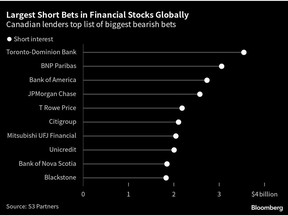
In recent weeks, short sellers have upped their bearish bets against Toronto-Dominion Bank, and now have roughly US$3.7 billion on the line vis-à-vis Canada’s second-largest lender, according to an analysis by S3 Partners. That’s the most among financial institutions globally and puts TD ahead of the likes of France’s BNP Paribas SA and Bank of America Corp.

Article content

Part of it has to do with the general skittishness toward the banking sector after three U.S. regional banks failed and Credit Suisse was forced into a shotgun wedding with UBS Group AG. And there are few signs Canadian lenders have any of the liquidity issues that investors have zeroed-in on recently. But analysts also point to worries about TD’s exposure to the country’s housing slowdown, as well as its ties to the U.S. market through its stake in Charles Schwab Corp. and a planned regional bank acquisition.

Article content

Advertisement 3

Article content

“Short sellers have been actively shorting into a declining banking sector,” said Ihor Dusaniwsky, S3’s managing director of predictive analytics.

TD didn’t immediately respond to requests for comment from Bloomberg.

Granted, short interest as a percentage of TD’s shares available for trading, or float, remains relatively low at 3.3 per cent and up from 2.8 per cent a year ago. By that measure, TD is third among the top 20 U.S. and Canadian financial companies.

TD’s position atop the list of biggest bank shorts comes as it seeks to close a $13.4 billion deal for First Horizon Corp., which would expand its foothold in the U.S. TD is widely expected to renegotiate the deal after the recent bout of turmoil among U.S. regional banks drove share prices lower in March.

Advertisement 4

Article content

As a result, traders are “playing with short interest for TD more than normally” because the bank has become a merger arbitration play, according to Daneshvar Rohinton, a portfolio manager at Industrial Alliance.

Housing bubble

Rohinton says some short sellers also have zeroed-in on TD because of its roughly 10 per cent stake in Charles Schwab — which recently lost US$47 billion in market value as it came under scrutiny over its unrealized bond losses — as well as TD’s position in Canada’s housing market, where variable-rate mortgages are common and consumer insolvencies are on the rise.

Advertisement 5

Article content

“TD sits uniquely in the middle of two broad headwinds,” Rohinton said. “The fears around Canadian housing will be projected onto TD.”

So far, the TD short has been a winner. In March, shares of TD tumbled 11 per cent, which was the biggest decline in the S&P/TSX Banks Index. The decline wiped out $18.1 billion from the bank’s market value. Nevertheless, S3’s Dusaniwsky cautions that short-seller profits can evaporate just as fast, particularly when they are the result of a broad-based rally.

“Outsized short-selling like we saw in the banking sector are usually knee-jerk reactions to market turmoil and can reverse as quickly as they occur,” he said.

—With assistance from Alexandra Semenova.

Bloomberg.com

Comments

Postmedia is committed to maintaining a lively but civil forum for discussion and encourage all readers to share their views on our articles. Comments may take up to an hour for moderation before appearing on the site. We ask you to keep your comments relevant and respectful. We have enabled email notifications—you will now receive an email if you receive a reply to your comment, there is an update to a comment thread you follow or if a user you follow comments. Visit our Community Guidelines for more information and details on how to adjust your email settings.

Join the Conversation

SVB roiled fintech but there’s still a pot of gold at the end of the rainbow: founder

SVB roiled fintech but there’s still a pot of gold at the end of the rainbow: founder

Silicon Valley Bank’s implosion has roiled the banking industry, but one fintech founder contends that the collapse underscores the need to have for important alterations in financial companies.

“I was lately listening to Elizabeth Warren, expressing that all banking has to be tremendous safe, like a drinking water pipe, and that banking should not be pleasurable, interesting, and modern,” explained Kristy Kim, co-founder and CEO of substitute credit card company TomoCredit. “I found myself pondering that which is so erroneous.”

She additional: “Sure, if our banking and credit techniques were being astounding to begin with, that may possibly be legitimate. In fact, like in her example of the water pipes, there are so quite a few parts without the need of effectively-constructed water pipes, just like there are so numerous most likely amazing younger folks without having accessibility to credit history. So, in my mind, there is a great deal of get the job done to be accomplished and we can’t be complacent.”

To be absolutely sure, you can find a ton of lousy news for fintech ideal now,—from Stripe’s shrinking valuation to Block’s (SQ) small-vendor difficulties. Having said that, you can find still evidence that fintech financial investment is chugging together. In 2022, VC deal exercise in fintech was larger than it was in the two 2019 and 2020, in accordance to information from PitchBook.

Kim, in the meantime, claimed that in her see the technique however necessitates an overhaul – and it would seem like investors are on board. “These methods are archaic,” she explained.

U.S. Senator Elizabeth Warren (D-MA) speaks to reporters before attending the weekly Democratic caucus luncheon at the U.S. Capitol in Washington, D.C., U.S., November 29, 2022. REUTERS/Sarah Silbiger

Enemy of fintech? U.S. Senator Elizabeth Warren (D-MA) in Washington, D.C., past fall. REUTERS/Sarah Silbiger

TomoCredit was launched in 2018, and due to the fact the business has elevated more than $130 million in funding from investors like Hyphen Money and Gold Household Ventures, as effectively as from financial companies giants like Morgan Stanley (MS) and Mastercard (MA). San Francisco-dependent TomoCredit features a credit card that helps individuals with poor credit rating, or none at all, establish credit and clients can utilize for a Tomo card, even without credit score heritage.

“I believe the banking disaster, in a way, is an possibility for fintech, for the reason that this shows that the banking and credit rating sector is in no way perfect,” stated Kim. “I imagine it’s very good to be skeptical from below, and preserve finding home to make improvements to and do items in different ways.”

A headshot of Kim, provided by TomoCredit.
Kristy Kim, co-founder of TomoCredit: “I found myself contemplating that which is so wrong.”(TomoCredit)

‘There’s just nowhere to go’

On the other hand, without the need of SVB, early stage fintechs are dropping a critical husband or wife, stated Kim. She and TomoCredit actively chose to function with SVB a yr back, having a $100 million warehouse facility, or credit history line, with the financial institution. Kim, who’d explored working with other banking companies, was fired up about SVB exclusively for its exclusive fintech skills.

“For fintech especially across the board, I truly feel like we’ve arrived at some variety of scale,” stated Kim. “SVB gave TomoCredit and other fintech businesses validation – we ended up equipped to finish thanks diligence, prove we had reliable business models. This can be a definitely great chance for us to continue on constructing with that validation, and we just have to uncover that new money company, altering just a little bit.”

When SVB collapsed, TomoCredit briefly but wholly lost obtain to that credit score line, and today the long run of that account remains unclear.

So, it can be not around but for TomoCredit and SVB, but the relationship is definitely up in the air. Even in the earliest days of SVB’s collapse, she was obtaining get to out from other banking institutions that wished to get the job done with her. Nonetheless, a few years back, that would not have essentially been the scenario. For a lot less-set up fintechs, SVB was the financial institution that took a opportunity on them. So, without SVB, the boundaries to entry in fintech are increased than at any time, said Kim.

“For an early stage firm that is about to start, it is heading to be tricky,” she said. “For occasion, if I were being about to launch TomoCredit this year, I’d be definitely screwed. There is just nowhere to go… From a selfish standpoint now, it can in fact be a competitive advantage for Tomo, simply because it’s wiped out options for a copycat to come out this year or future.”

Allie Garfinkle is a Senior Tech Reporter at Yahoo Finance. Comply with her on Twitter at @agarfinks and on LinkedIn.

Simply click below for the most recent trending stock tickers of the Yahoo Finance system.

Browse the most up-to-date economic and company news from Yahoo Finance.

Down load the Yahoo Finance app for Apple or Android.

Abide by Yahoo Finance on Twitter, Facebook, Instagram, LinkedIn, and YouTube.

Court Decisions Regarding BIPA Affect the Financial Industry

Court Decisions Regarding BIPA Affect the Financial Industry

Course motion plaintiffs’ firms — spurred on by a important recent growth of out there damages for biometric privateness fits — have begun targeting the economic industry. The Illinois Biometric Facts Privateness Act (BIPA) is the most expansive biometric privateness regulation in the place, and has strict specifications for organizations accumulating, storing or using biometric knowledge (including voiceprints, fingerprints and facial scans). Pursuant to BIPA, plaintiffs’ attorneys have pursued hundreds of class motion lawsuits in latest years against corporations operating in Illinois or collecting Illinois residents’ biometric info. In February 2023, the Illinois Supreme Court docket issued two decisions that ratcheted up available damages by extending the statute of restrictions to 5 yrs and holding that each individual occasion of accumulating or applying biometric details (alternatively than just the initial instance for each individual plaintiff) constitutes a compensable injury.

Until finally a short while ago, fiscal institutions have mainly been able to navigate the explosion of BIPA litigation by way of an express statutory exception supplying that BIPA does not “apply in any fashion to a economical institution nor an affiliate of a economic establishment that is topic to Title V of the federal Gramm-Leach-Bliley Act (GLBA) of 1999 and the policies promulgated thereunder” (the “GLBA Exemption”). 740 ILCS 14/25(c).

Even with the GLBA Exemption, plaintiffs’ attorneys have lately observed traction focusing on the tactics of distributors financial firms use for identification verification (e.g., utilizing facial scans or voiceprints) and arguing that the corporations on their own should also be on the hook for alleged BIPA violations. In Davis v. Jumio Corp., No. 22-CV-00776, 2023 WL 2019048 (N.D. Ill. Feb. 14, 2023), the courtroom rejected a movement to dismiss filed by a vendor offering identification verification for customers of a cryptocurrency trade, keeping in aspect that the seller was not secured by the GLBA Exemption and that the trade, which retained the seller, could also be on the hook for violations.

Plaintiffs’ attorneys’ tactics in Davis and related instances make crystal clear that financial institutions will have to evaluate and fully grasp their practices (and their vendors’ practices) for accumulating, handling, and storing biometric information and facts, as missteps could outcome in major legal responsibility. Further, heading forward, financial companies should negotiate strong indemnity provisions with their biometric sellers, and figure out their oversight obligations concerning vendors’ handling of biometric data.


©2023 Katten Muchin Rosenman LLP
Countrywide Law Assessment, Volume XIII, Range 93

2022 Industry Threat Recap: Finance and Insurance

2022 Industry Threat Recap: Finance and Insurance

The finance and insurance policy sector proved a major target for cybersecurity threats in 2022. The IBM Stability X-Force Threat Intelligence Index 2023 identified this sector ranked as the 2nd most attacked, with 18.9{1668a97e7bfe6d80c144078b89af180f360665b4ea188e6054b2f93f7302966b} of X-Power incident reaction conditions. If, as Shakespeare tells us, past is prologue, this sector will most likely continue to be a focus on in 2023. Finance and insurance policies ranked as the most attacked sector from 2016 to 2020, with the producing sector the most attacked in 2021 and 2022.

What are the Top Threats?

The X-Power risk report found that backdoor assaults in the finance and insurance sector were the most normally noticed action on aim, producing up 29{1668a97e7bfe6d80c144078b89af180f360665b4ea188e6054b2f93f7302966b} of attacks. In reality, backdoor attacks —  the compromise of units or data by remotely negating or bypassing protection steps — had been the most widespread style of attacker motion that X-Drive incident responders managed. The up coming top attack kinds for this sector, both of those at 11{1668a97e7bfe6d80c144078b89af180f360665b4ea188e6054b2f93f7302966b}, had been ransomware (code that blocks obtain to data or techniques until finally cash is paid out) and maldocs (files, like phrase processing files, spreadsheets or PDF files that execute destructive code when interacted with).

Why do cyber criminals use these kinds of assaults against the finance and insurance coverage marketplace? For the reason that they operate. These attacks rely on user carelessness and distraction, making it possible for an attacker to achieve an opening. Backdoor compromises normally materialize as a result of unpatched vulnerabilities or lacking security actions. Ransomware and maldoc assaults come about when a particular person clicks on a pretend hyperlink or opens an attachment they should not. In point, the report uncovered that in this sector, the top rated infection vector was spear phishing attachments, used in 53{1668a97e7bfe6d80c144078b89af180f360665b4ea188e6054b2f93f7302966b} of attacks. The exploitation of public-dealing with apps came in next location at 18{1668a97e7bfe6d80c144078b89af180f360665b4ea188e6054b2f93f7302966b} of attacks. This is when criminals acquire advantage of a weak point in an net-struggling with computer or method. Clicking on spear phishing links came in third as the original accessibility vector in 12{1668a97e7bfe6d80c144078b89af180f360665b4ea188e6054b2f93f7302966b} of conditions.

Study the Menace Index

Geography and Cybersecurity Intertwine

There’s also a geographic issue to threats executed in the finance and insurance sector. Europe observed the highest volume of attacks (33{1668a97e7bfe6d80c144078b89af180f360665b4ea188e6054b2f93f7302966b}) against this sector, with Asia-Pacific a shut next place at 31{1668a97e7bfe6d80c144078b89af180f360665b4ea188e6054b2f93f7302966b}. Why these two regions? Initial, Russia’s war in Ukraine had an influence. There is a cyber legal aspect to modern warfare, and this war opened a fault line in cyber crime. Threat actor groups resided in both international locations, and equally have dispersed across Europe in the wake of the conflict. These felony groups, which in the past usually worked with each other, now frequently fight each other. Numerous European firms obtain by themselves in the middle of that conflict.

In Asia-Pacific — specially Japan — there was a spike in Emotet malware in 2022 just after a temporary hiatus all over 2021. The X-Power danger report notes that spam strategies, driven by Emotet, appeared throughout many sectors, with most circumstances happening in manufacturing and finance and insurance.

The Defensive Posture Demanded for Cyber Resilience

The X-Force menace report notes that finance and insurance coverage corporations have a tendency to be additional together in equally digital transformations and cloud adoption development relative to other industries. Yet another indicator of maturity is the prevalence of the CISO position in this sector. A 2022 World CISO Survey uncovered that more than two-thirds of CISOs were at corporations with annual income of $5 billion or far more, and they worked most normally in money services and technological know-how and telecom. The maturity in this sector normally means that attackers have to perform tougher to properly execute assaults in opposition to these corporations. Which is a achievable clue as to why criminals have set their sights on other sectors in the latest decades.

How precisely do digital transformation and cloud adoption create a defensive posture? It will come down to resilience and velocity. Businesses at the mature phase of electronic transformation are nimbler and much better ready to cope with disruption at a speedier clip, irrespective of whether from source chain woes or ransomware demands. Pace and overall flexibility are important when working with cyber criminals, as they have managed to execute their assaults a lot quicker than at any time. The report notes that ransomware attacks at the time took criminals two months to execute in 2019. By 2021, that timeline shrank to 4 times. As assaults come a lot quicker, businesses have to have a proactive strategy to cybersecurity.

Cyber resilience is element of that technique. Cyber cleanliness — the actions and procedures organizations put in spot to sustain the well being of their units and the protection of their end users — is part of that. Getting rid of the silos concerning security and enterprise has also been required to attain resilience. Remaining vigilant to threats, specially those people aimed at your sector, is important for producing a adaptable defensive posture that can repel threats and, when necessary, stand up to them.

How Rules and Criteria Have an effect on the Finance and Insurance Sector

Staying informed of evolving and rising threats, as nicely as how to defend in opposition to them, is a important thought, no issue your company sector. Turning into a community target of a breach does reputational and money injury. Even so, in the finance and insurance policy sector, maybe extra than any other, mandated restrictions and marketplace-approved benchmarks enjoy an outsized position. These requirements area an more burden. Just about all cybersecurity rules effects finance and insurance plan companies specifically, and have now, for decades, serving as a harbinger for other sectors. Let us evaluation just a sampling of the criteria and rules that affect this sector:

  • PCI DSS: The Payment Card Industry Facts Security Normal governs how companies of all sizes and sectors manage credit rating card transactions. It aims to guard debit and credit score card transactions from breaches. Started in 1999, it’s not a new standard, but it is one that is frequently up to date.
  • SOX: The Sarbanes-Oxley Act is a U.S. legislation enacted in 2002 that governs financial reporting.
  • GLBA: The Gramm-Leach-Bliley Act is also recognized as the Monetary Modernization Act of 1999. This act involves that economic institutions describe each how they share and safeguard their customers’ private information.
  • PSD2: The Payment Products and services Directive was an EU legislation from 2009 that outlined EU guidelines for electronic payments like direct debit, credit rating playing cards, mobile and on the web transactions, and credit rating transfers. Its goal was to make payments concerning EU nations around the world secure. In 2018, the next Payment Expert services Directive (PSD2) added additional customer defense and stability. It also regulates newer modes of on-line and cellular payments.
  • New SEC principles: The Securities and Exchange Commission proposed cybersecurity guidelines in 2022 that affect how money solutions firms cope with cybersecurity. They hope to finalize the principles someday in 2023.

Vigilance in 2023

As the IBM Stability X-Power Risk Intelligence Index 2023 tends to make plain, cyber threats are not diminishing. In truth, they are having a lot more widespread, resourceful and swift. As a CISO within just the finance and insurance sector, the report’s writers give three steps you can take:

  • Monitor your property. Know what you are defending, its likely charm to cyber criminals and when assets are extra or subtracted.
  • Know your adversaries. Who is coming right after you and why? How sophisticated are they and how will they test to exploit you?
  • Regulate visibility. Affirm that you can see into your info sources and know what would show the presence of an attacker. Then outline how you would carry on to prevent the attack and lessen disruption.

Down load the report for far more insights and suggestions and a complete watch of the present menace landscape.