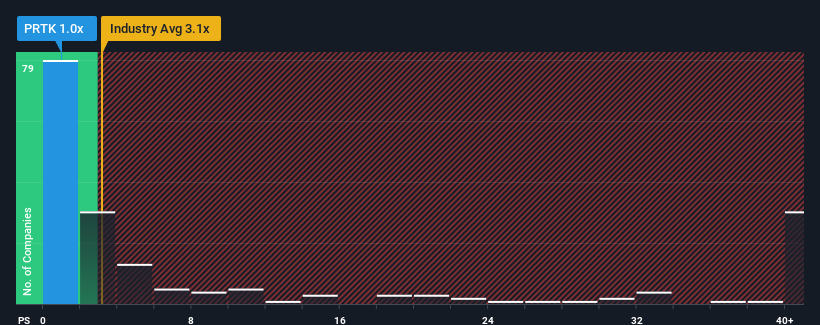
Paratek Pharmaceuticals, Inc. (NASDAQ:PRTK) shareholders would be thrilled to see that the share price tag has had a wonderful month, putting up a acquire and recovering from prior weakness. Getting a wider view, although not as solid as the previous thirty day period, the full year get of is also pretty sensible.
In spite of the agency bounce in price tag, Paratek Prescribed drugs may well still glimpse like a potent obtaining opportunity at existing with its value-to-revenue (or “P/S”) ratio of 1x, contemplating just about 50 percent of all businesses in the Prescribed drugs sector in the United States have P/S ratios increased than 3.1x and even P/S bigger than 15x usually are not out of the common. Nonetheless, we would need to have to dig a little deeper to establish if there is a rational basis for the remarkably minimized P/S.
What Does Paratek Pharmaceuticals’ P/S Imply For Shareholders?
Paratek Prescribed drugs surely has been doing a good work currently as it is really been expanding income additional than most other businesses. 1 likelihood is that the P/S ratio is low simply because traders imagine this potent income efficiency could possibly be significantly less spectacular going forward. If not, then current shareholders have cause to be very optimistic about the future route of the share price tag.
Is There Any Profits Development Forecasted For Paratek Prescription drugs?
In order to justify its P/S ratio, Paratek Pharmaceuticals would will need to make anemic growth which is significantly trailing the sector.
If we evaluation the final yr of profits development, the enterprise posted a marvelous raise of 23{1668a97e7bfe6d80c144078b89af180f360665b4ea188e6054b2f93f7302966b}. Spectacularly, a few 12 months revenue development has ballooned by a number of orders of magnitude, thanks in section to the last 12 months of profits advancement. Hence, it can be truthful to say the revenue progress recently has been fantastic for the organization.
Searching forward now, income is expected to climb by per yr throughout the coming 3 years according to the a few analysts next the enterprise. Which is shaping up to be materially decreased than the per annum development forecast for the broader sector.
With this in thing to consider, its obvious as to why Paratek Pharmaceuticals’ P/S is falling small sector friends. It appears most buyers are expecting to see minimal potential expansion and are only ready to pay a minimized amount for the stock.
What Does Paratek Pharmaceuticals’ P/S Necessarily mean For Investors?
Even just after this sort of a powerful value go, Paratek Pharmaceuticals’ P/S continue to trails the relaxation of the industry. Generally, we’d warning in opposition to reading through much too a great deal into cost-to-profits ratios when settling on financial commitment conclusions, nevertheless it can expose loads about what other market place individuals assume about the company.
As we suspected, our examination of Paratek Pharmaceuticals’ analyst forecasts unveiled that its inferior earnings outlook is contributing to its lower P/S. Shareholders’ pessimism on the income prospective clients for the company would seem to be the key contributor to the depressed P/S. The firm will want a transform of fortune to justify the P/S soaring better in the foreseeable future.
Have suggestions on this posting? Involved about the content?Get in touch with us immediately. Alternatively, e mail editorial-team (at) simplywallst.com.
This posting by Just Wall St is standard in mother nature. We give commentary based on historical details and analyst forecasts only using an impartial methodology and our articles or blog posts are not meant to be financial information. It does not represent a suggestion to obtain or offer any inventory, and does not choose account of your targets, or your financial circumstance. We intention to carry you extensive-expression focused analysis pushed by basic knowledge. Take note that our evaluation could not element in the most current price tag-sensitive organization announcements or qualitative content. Simply Wall St has no place in any stocks outlined.
Be a part of A Compensated Person Analysis Session
You will get a US$30 Amazon Reward card for 1 hour of your time whilst supporting us develop superior investing resources for the individual traders like by yourself. Signal up in this article
The pharmaceutical company that makes Wegovy slimming jabs is funding the expansion of weight-loss services across England as it seeks to boost sales of its obesity drugs, the Observer can reveal.
Novo Nordisk is paying the salaries of staff on NHS obesity teams and financing the launch and redesign of services, including giving £206,000 to a health partnership to transform its treatment of obesity. The Danish firm also has financial links to the co-chair of an NHS England weight management advisory group, and paid her almost £50,000 in lecture, consulting and other fees in just two years.
Novo Nordisk’s funding arrangements are under the spotlight after an Observer investigation in March found it had paid £21.7m to UK health organisations and professionals in three years before the approval of its Wegovy injections for NHS use.
In some cases, recipients of the funding went on to praise Wegovy or support its approval for use on the NHS without always making their links to Novo clear. This weekend, the National Institute for Health and Care Excellence (Nice) said an internal inquiry had found that some of those who advised it on the use of Wegovy in the NHS had not properly declared their interests.
Now further documents reveal how Novo Nordisk has been granted a potential role in shaping obesity treatment through partnerships with NHS trusts, pharmacies and GPs to provide training and funding.
In one case, the company is paying £206,000 to an integrated care system to help it “transform” its specialist obesity services and “reduce unnecessary barriers” to treatment.
Novo’s money is paying for two “dedicated” staff members and “independent facilitation support” for a partnership with Mid and South Essex NHS trust and local councils, which aims to provide a blueprint for transforming other weight loss services across the country.
In another partnership, Novo Nordisk has agreed to fund a weight management nurse specialist to work at the Somerset NHS foundation trust, which it has also partnered with to design an online weight management course for patients.
A separate initiative with the National Pharmacy Association aims to “upskill pharmacists” in obesity medicine and help them launch new weight management services. Novo is providing support with “financial tracking and ensuring delivery of outcomes” and funding to develop resources for the two-year project.
Novo Nordisk also has close links to the co-chair of an NHS England advisory group on specialist weight management services. Prof Rachel Batterham was appointed to the unpaid NHS role in 2021 despite a longstanding relationship with the company. Disclosure UK records – which detail payments to healthcare professionals such as consulting, lecture and conference fees – show she was paid £16,306 in “service fees” by Novo in 2020 and £33,560 in 2021. She was also an investigator on a Novo Nordisk-sponsored trial of its Wegovy (semaglutide) injections and subsequently described the treatment as a “gamechanger”.
NHS England is understood to have been aware of Batterham’s link to Novo when it appointed her to the group, which was set up to advise on the allocation of resources, post-Covid recovery and the possible expansion of specialist weight-loss services. It said the group had not yet provided any formal advice due to delays receiving funding, and had not formally requested declarations of interest.
The National Institute for Health and Care Excellence said an internal inquiry had found that some of those who advised it on the use of Wegovy in the NHS had not properly declared their interests. Photograph: Paul Lawrenson/Alamy
Batterham, who received an OBE last year for her services to people affected by obesity, said she was “no longer working with Novo Nordisk”, having ended her paid consultancy work with the company in December,and had always been transparent about her affiliations, including disclosing her conflicts of interest to NHS England. She added that her “globally recognised research” had focused on “all aspects of weight-management” and that she worked with the NHS and companies “to help improve and grow our collective clinical understanding”.
There is no suggestion the partnerships break any rules, which permit industry payments to the health sector provided they are transparently declared and comply with policies on bribery and anti-corruption. Wegovy injections have been safety-tested and approved for NHS use, with studies suggesting they can help people lose 15{1668a97e7bfe6d80c144078b89af180f360665b4ea188e6054b2f93f7302966b} of body weight. More than a quarter of adults in England are classed as obese, and expanding specialist services could help more people access vital treatment.
But critics say the arrangements could give Novo Nordisk a role in shaping services that use its weight-loss drugs, raising questions about conflicts of interest. A document about its partnership with the National Pharmacy Association is explicit about the potential benefits, saying in a section titled “benefit to Novo Nordisk” that “an increase in the availability of weight-management services may result in an increase in the prescribing of anti-obesity medications”.
David Rowland, director of the Centre for Health and the Public Interest thinktank, said “clear safeguards” were needed to “prevent the financial interests of pharmaceutical companies from polluting services provided to patients”. He said health organisations were often struggling for funding but needed to consider the “trade-offs” carefully. “If companies are not seeing prescriptions of a particular drug, where does that leave them in terms of their interest in funding these services?” he added.
Dr Margaret McCartney, an expert in conflicts of interest in healthcare and senior lecturer at the University of St Andrews School of Medicine, said drug firms should “not be anywhere near the design of NHS services or decisions about cost-effectiveness” and called for “independent scrutiny”. She said international evidence showed that financial conflicts of interest can lead to “more expensive and poorer quality healthcare”.
It is not the first time concerns have been raised about Novo’s links to health organisations. In January, the Royal College of Physicians (RCP) received a complaint from a doctor who said the college’s association with a Novo Nordisk-funded fellowship scheme gave it a “veneer of respectability”. The year-long programme, which was supposed to launch this June, would have seen fellows paid £60,000 by Novo to work in NHS obesity teams, with aims including “leading the establishment of new weight management services”. The RCP said Novo’s relationship with fellows would have been “arm’s length”, and that it “played no part in drafting the fellowship job description or in the selection of the centres or the candidates”.
Concerns are also understood to have been raised within the Royal College of GPs (RCGP), which received more than £400,000 from Novo Nordisk between 2019 and 2021, according to Disclosure UK records, and launched an obesity “leadership programme” with the company in 2021.
A key benefit for Novo of that collaboration – which aimed to train 20 GPs to become leaders in obesity care and was financed with £154,229 of corporate funds – was that it could “enhance Novo Nordisk’s reputation nationally”, documents show. The RCGP said it worked with a “variety of partners” to support obesity care, adding that it had a “strict sponsorship policy” and that its resources for GPs did not promote any particular drugs.
In recent days, both the royal colleges have cut ties with Novo and returned outstanding funding after its two-year suspension by the Association of the British Pharmaceutical Industry (ABPI) over “serious breaches” of industry code. Novo had sponsored webinars for health professionals that amounted to a “disguised promotional campaign” of another of its weight-loss drugs, the ABPI said on 16 March. “Having considered the case and requesting a further detailed audit of Novo Nordisk’s compliance processes, the ABPI board decided to suspend Novo Nordisk from ABPI membership,” it said.
Wegovy, a brand name for semaglutide, is designed to suppress appetite. Photograph: Jim Vondruska/Reuters
This weekend, Novo Nordisk said details of its health service partnerships had been “unfairly presented” and that they were “standard industry practice within the industry code … in line with work other pharmaceutical companies do to support the NHS and healthcare organisations”. It added: “We disclose all partnerships, contracts, grants, donations and sponsorships to UK-based professionals and organisations transparently.”
Organisations that partnered with Novo told the Observer the funding had not influenced decision-making. Mid and South Essex integrated care system said its project was now under review and did not include “any decision-making around use of medicines”. Somerset NHS Foundation Trust said Novo had no influence over “purchasing, prescribing and dispensing” decisions, and the trust had “a robust conflicts of interest policy”. The National Pharmacy Association said it had vetted all materials used in its project with Novo and they did not recommend any particular product or treatment.
In a separate development, an investigation by Nice this weekend concluded that two organisations that advised its committee assessing Wegovy for the NHS failed to fully disclose payments from Novo. Nice said the Association for the Study of Obesity and the Royal College of Physicians breached its policy. An expert who gave evidence, Prof John Wilding, did not.
The RCP said it should have volunteered details of funding from Novo but that it had not influenced its evidence, and said it was now looking at steps to increase transparency.
The ASO said it would seek “clarity” about the watchdog’s findings, adding that it had “always acted with good intention” and “put the outcomes of people living with obesity at front and centre”. It previously said it had properly disclosed funding from Novo.
Nice said the breaches “did not involve the individuals who developed Nice’s recommendations”. “The failures to declare all interests did not have a material effect on the outcome on the guidance Nice produced,” it added.