Burton, New Harmony, Patagonia, REI Co-op, W.L. Gore & Associates, and OIA come jointly by way of OIA’s Local climate Motion Corps to Decarbonize the Textile and Attire Sector
BOULDER, Colo., Feb. 14, 2023 /PRNewswire/ — Burton, New Harmony, Patagonia, REI Co-op, and Gore’s Fabrics Division (Gore) – 5 associates of OIA Local climate Motion Corps – and OIA are delighted to launch the results of a joint-commissioned study relating to the feasibility of electrifying the textile and clothing market. The study outlines considerable prospects to employ tactics that help you save corporations income and minimize supply chain emissions. Patagonia served as the primary sponsor of the review which OIA assisted to facilitate. This collaborative undertaking is the most current in a series of ways the industry is taking to mitigate the impacts of the local climate crisis.
Burton, New Stability, Patagonia, REI Co-op, and Gore’s Materials Division (Gore) – 5 members of OIA Local weather Motion Corps – and OIA launched the final results of a joint-commissioned study with regards to the feasibility of electrifying the textile and apparel marketplace. The major findings of the research reveal that shifting to industrial heat pumps can guide to considerable vitality reductions, lessened CO2 emissions, and lower fees compared to traditional techniques.
The research, Electrification of Heating in the Textile Field: A Techno-Economic Assessment for China, Japan, and Taiwan, explored the opportunity energy financial savings, CO2 emissions reductions, and fees for electrification engineering pathways. The main conclusions of the examine reveal that shifting to industrial warmth pumps can lead to significant strength reductions, decreased CO2 emissions, and lessen fees compared to traditional systems. The research also presents several essential suggestions for the textile market and policymakers to scale up electrification in the textile and attire market and speed up carbon emissions reductions.
“A person of the largest challenges in lessening greenhouse gasoline emissions in our clothing and textile provide chains is thermal electricity – steam and hot drinking water for heating processes in factories. Can we use a little something other than coal, normal fuel, or other fossil fuels? Our examine demonstrates how there is an opportunity to decarbonize thermal heating procedures in clothing and textile factories in a way that cuts down emissions, vitality, and value around time,” mentioned Sarah Rykal, Senior Manager of OIA’s Weather Action Corps. “This is the 1st study of its form, and we are thrilled to now be sharing these conclusions with suppliers in China, Japan, and Taiwan to enable boost sustainability on a broader scale. These results effect the whole fashion sector, not just the out of doors industry.”
Burton, New Stability, Patagonia, REI, Gore, and OIA worked with the industrial decarbonization consulting business World wide Efficiency Intelligence to conduct the research. The objective was to acquire essential insights into minimizing emissions in the clothing industry’s supply chain by shifting from carbon-intense thermal heating procedures at the moment powered by fossil fuels to far more economical, cleanse electrified processes where by reduced- or zero-carbon electricity is made use of. The study centered on the textile market with a specific emphasis on tier 2 factories – facilities in which elements are generated and concluded ahead of likely into finished goods – in China, Japan, and Taiwan, and applies to other geographies.
“Electrification of approach heating will perform a very important part in the deep decarbonization of the textile industry and apparel source chain when tied to renewable energy. Nevertheless, it appears to be like not lots of supervisors and engineers in the textile and apparel businesses are informed of this big opportunity. There is definitely a need for a lot more perform in this location,” reported Ali Hasanbeigi, Ph.D., Investigation Director at Worldwide Effectiveness Intelligence and direct researcher for this analyze.
“Our world offer chain is the resource of most of our carbon emissions, so we ought to work with manufacturing unit companions to renovate how we make goods and reduce the damage carried out in our title,” said Kim Drenner, Head of Supply Chain Environmental Impression at Patagonia. “We joined REI, New Stability, Gore, and Burton to collaborate with the OIA on this examine, so the scientists have been capable to deal with a numerous selection of factories and stakeholders. This analysis is a action ahead simply because it presents tangible, expense-effective strategies for suppliers and brands to stop their reliance on fossil fuels. We search ahead to helping carry out these enhancements.”
The collaborators have also hosted stakeholder engagement actions to notify stakeholders of the investigate conclusions and empower them to undertake clean up warmth procedures that will lessen greenhouse gas emissions in the textile and apparel sector. The study effects have been published on GEI’s web page.
The global textile industry is one of the largest sectors in the world. It consists of a host of different products, ranging from clothes, garments, yarn, fabrics, cotton, and more. According to research from Grand View Market Research, the sector was worth a whopping $993 billion in 2021 and grew to $1 trillion by 2022 end. From then until 2030, the firm believes that the industry will grow at a compounded annual growth rate (CAGR) of 4{1668a97e7bfe6d80c144078b89af180f360665b4ea188e6054b2f93f7302966b} to be worth an estimated $1.4 trillion by the end of the forecast period. In terms of composition by products, the cotton sector is the largest sub segment of the textile industry. The research firm believes that cotton accounted for a strong 39{1668a97e7bfe6d80c144078b89af180f360665b4ea188e6054b2f93f7302966b} of the total market revenue in 2021, with America, China, and India being the largest cotton producers in the world. Apart from cotton, wool was also a big part of the industry, as it accounted for 13{1668a97e7bfe6d80c144078b89af180f360665b4ea188e6054b2f93f7302966b} of the market and was used primarily in winter products such as jackets and blankets. Regionally, Asia Pacific is the largest sector as it accounted for close to 50{1668a97e7bfe6d80c144078b89af180f360665b4ea188e6054b2f93f7302966b} of the total revenue. For North America, the U.S. is the largest textile country, as it produces significant amounts of cotton and textiles as well as imports large amounts of products.
These days, sustainability is an important topic in the textile, garment, and fabrics industry. Since the bulk of global textile production takes place in developing countries, and the products are also bought by firms in the developed world, customers and firms are concerned about the conditions in which the products are produced. Developed nations are growing wary of brands that do not stick to ethical practices. For example, ‘sweatshops’ use exploitative labor practices to ensure that they can produce cheap products and deliver them faster than competitors – a crucial competitive factor when it comes to fast fashion where designers change their products within months and then brands push the products out to the market as soon as possible.
Still, these sweatshops aren’t limited only to developing countries, as numerous examples are also found in some of the most developed countries in the world, including the United States and the United Kingdom. In fact, as Forbes points out, sweatshops in Los Angeles have workers who work as much as 12 hours a day and are paid 3 cents a piece for items that can retail for as high as $75. Unsurprisingly, laborers that are employed in these shops are also undocumented immigrants, which makes it hard for the U.S. government to track them and easy for the firms to pay them low wages and no benefits without fearing any legal recourse. Taking action against the firms that use these sweatshops also becomes complicated as some people fear that boycotting the firms will lead to a loss of employment and wages for the workers as well.
Sustainability is also receiving growing interest when it comes to the textiles that are manufactured. On this front, a wide variety of both new and old sustainable fabrics are being developed. One of the more prominent examples of these is Soy Protein Fiber (SPF) which is also known as Soy Fabric. This particular fabric traces its roots back to the legendary Henry Ford, who is widely credited to having invented soy fabric. In fact, the late Mr. Ford was so enamored with the material that in his later years he would mostly wear garments that were made through this material in order to popularize soybean production in America. SPF is popular as an environmentally friendly product since it uses waste products from soybean production to make garments, while traditional garment production involves using toxic chemicals that end up harming their surroundings. Another novel sustainable textile is Algae Fiber, which – as the name suggests – converts Algae into fiber by mixing it with cellulose.
Globally speaking, the textile industry is dominated by Asia. In fact, the industry has also contributed to the meteoric rise of Bangladesh. At the time of its independence from Pakistan in 1971, Bangladesh was the world’s second poorest nation. However, in just a handful of decades, the country is now the second largest economy in South Asia – with the progress being fueled primarily by textile production. Globally, some of the largest textile and oldest firms are Sinopec Yizheng Chemical Fibre Company Ltd., Shadong Jining Ruyi Woolen Textile Co. Ltd., Paramount Textile Ltd., and Successori REDA S.p.A.
We used several different sources to compile our list of the top countries in garments and fabric manufacturing. Unlike for products such as tobacco and beef, these rankings are harder to sift out as it’s generally firms that source them instead of the ordinary consumer that purchases them. Our research allowed us to narrow down 26 countries that have been praised for their products. Each time a country appeared in a source, it was assigned a single point, those commended for ethical practices were assigned two points, and ties between them were resolved through garment exports. Sources consulted are the quality control firm ATI, New York Spaces, digital marketplace Manufy, FASHiNZA Magazine, textile sourcing company Rag Sourcing, B2B website network Just Style, and Reddit (1,2,3). For countries that export the most garments, head on over to 12 Countries that Export the Most Fabrics/Garments.
Countries That Produce the Best Fabrics/Garments
12. Portuguese Republic
Insider Monkey’s Score: 2
Garment Exports in 2021:$12.8 million
The Portuguese Republic is a European country with a GDP per capita of $42,067. While it is not a dominant player in the global textile industry, Portugal is known for its strong focus on sustainable textiles. The country has a large number of both environmentally friendly and ethical factories. For instance, the Portuguese factory consortium Friendly Factories is made up of 30 factories that ensure workers are working by choice and under conditions mandated by European Union laws. Additionally, some well known sustainable textile companies are ASBX, Create Fashion, and Tryport.
11. Kingdom of Morocco
Insider Monkey’s Score: 2
Garment Exports in 2021:$297 million
The Kingdom of Morocco is a North African country. Textile is an important portion of the Moroccan economy and has seen strong growth over the past few years. Its close proximity to Europe makes it one of the continent’s ten largest textile export partners, with exports growing by a strong 31{1668a97e7bfe6d80c144078b89af180f360665b4ea188e6054b2f93f7302966b} in the first quarter of 2022 alone. Some well known Moroccan textile firms are Vita Couture, Fashion Lixus, and Soft Tech.
10. Kingdom of Spain
Insider Monkey’s Score: 2
Garment Exports in 2021:$297 million
The Kingdom of Spain is another prosperous European nation with a long history dating back thousands of years. In the textile world, like Portugal, Spain is littered with sustainable textile companies. Additionally, apparel manufacturing is one of Spain’s largest industries, with thousands of factories in the country. Spanish brands such as Industria de Diseño Textil, S.A. (BME:TX.MC)’s ZARA are leaders in the global fashion scene.
9. Federal Republic of Germany
Insider Monkey’s Score: 2
Garment Exports in 2021:$578 million
Germany is one of the most developed countries in the world and Europe’s largest economy. It is also another European country that focuses on sustainable textile manufacturing, with German consumers paying attention to the ‘Green Button’ label on products which certifies them for not having relied on exploitative labor. As a whole, the textile manufacturing sector also employs hundreds of thousands of workers all over Germany.
8. People’s Republic of Bangladesh
Insider Monkey’s Score: 2
Garment Exports in 2021:$600 million
The People’s Republic of Bangladesh is a rising star in the textile world. Its textile industry holds a historic place in the country’s history and has been producing products since the 1600s when Bangladesh alone accounted for half of the Dutch Empire’s textile imports from Asia. Bangladesh has centuries old traditions of textile weaving, and brands such as Aarong and Remi Holdings are known all over the world. The country was the world’s third largest garments exporter in 2021.
7. Republic of Poland
Insider Monkey’s Score: 3
Garment Exports in 2021:$188 million
The Republic of Poland is a Central European country that benefits from its location in the textile industry as this allows it to export its products all over Europe. Poland’s total textile exports stand at more than $10 billion, and its largest trading partner is Germany, which accounts for almost half or $4.5 billion of the exports. Some of the country’s most well known textile manufacturers are Kamus, M-Corp, BFIELD, and GlocalPartner.
6. United States of America
Insider Monkey’s Score: 3
Garment Exports in 2021:$265 million
The United States of America, or the U.S., is the only superpower in the world. Its corporate and industrial sectors is one of the most developed in the world, which has also led to America having a strong history in the textile, garments, and fabrics industry. The U.S. textile and garments industry shipped $65 billion of products in 2021, with total exports standing at $28 billion. Some large American textile companies are the American Textile Company (ATC), Levi Strauss & Co. (NYSE:LEVI), and WestPoint Home, Inc.
Encouraging cotton growing helps excel textile industry
Encouraging cotton growing helps excel textile industry
FAISALABAD (APP) – With the country facing a severe economic crunch, the government is mulling multiple options for economic revival including boosting exports to strengthen depleting foreign exchange reserves and generating employment opportunities to overcome growing poverty.
As the textile industry had been the key player in exports over the decades, paying special heed to this sector by providing a congenial environment could pave the way to capture more international markets and earn revenue.
Enhanced cotton growing is of vital importance for this sector as it encompasses a bigger chain of operations from farming to textiles mills and then to end users’ products showcased at fashion apparel outlets.
This chain of operations not only benefits industrialists but also a major chunk of our populace linked to the agricultural sector. But unfortunately, cotton growing diminished with the passage of time after the installation of Sugar Mills in cotton-growing areas, especially in South Punjab and Sindh provinces.
Pakistan Cotton Ginners Association (PCGA), in its recent fortnightly report on cotton arrivals, has put the production figure at 4.7 million bales till Feb 1, 2023, which is almost 35 per cent below than last year.
“If we reach five million bales this year by end of next month, it would be around 50 per cent below than the official production assessment of 11 million bales for 2023”, informed PCGA Chairman Chaudhry Waheed Arshad.
“If we have to survive with our textile industry, we must frame result-oriented policies focusing on both the farmers and the industrialists,” he stated.
Chaudhry Waheed Arshad recommended measures like announcing support prices, declaring specific cotton zones, and introducing high-yielding, climate-smart and pests-resistant cotton varieties and mechanized farming techniques to get desired results.
“Agriculture is our mainstay and cotton is our lifeline. Therefore, strengthening this sector and announcing special incentives for cotton growers would definitely improve economic growth and the country’s exports,” he stated.
Chaudhry Waheed said that less cotton growing was harming ginning industry because if produce is less then mill owners can import cotton for their needs but what about ginners? “There are 1300 ginning factories countrywide with only 400-500 units remaining operational normally. But, at present only 154 factories are working.”
He claimed that the country has lost 2.4 million acre cotton area to other crops during the last 15 years and “if this trend continues, it would be a severe blow to the cotton-based industries. Therefore, we need to employ the full potential of this sector.”
He was confident sooner or later agriculture sector would attain the status of an industry and farmers must be well prepared to harvest its benefits.
According to the Trade Development Authority of Pakistan (TDAP), Pakistan is the 8th largest exporter of textile products in Asia with the 4th largest producer and the third largest consumer of cotton. Textile is 46 per cent of Pakistan’s total manufacturing sector that provides employment to 40 per cent of the total labour force.
Khawaja Usman, a noted industrialist owning spinning units has said that usually, the textile sector needs 16 million cotton bales annually to add value and export a variety of products to the international market.
“However, the temporary closure of some textile units due to the global recession troubled the economy.
Therefore, local textile sector requirements would revolve around 12-13 million bales this year,” he predicted.
He said if production finally turns out to be five million bales in 2023, the textile sector would need to import seven million bales to meet its requirements. “Therefore, the textile sector had already finalized contracts for import of required cotton bales.”
Khawaja Usman stressed incentivizing the farmers to grow cotton in more areas, and the industry to enable it to compete in the international market as he regretted the fall of cotton production by 16 per cent to merely 8.6 million bales in 2020 from 10.2 million bales in 2019, is not encouraging.
The TDAP officials quoting Pakistan Bureau of Statistics data have also revealed that Pakistan earned over US$15 billion (15400 million dollars) in the financial year 2021 up from over US$ 12.5 billion (12526 million dollars) in 2020 from cotton and textile products. According to their statistics although exports of various textile products registered an increase, export of raw cotton nosedived by 95 per cent in FY 2021 with the main factor being lower production than expectations.
Vice President, of the Multan Chamber of Commerce and Industry, Asim Saeed Sheikh has also claimed that local cotton production was usually falling short to meet the needs of the textile sector, except for 2011 when Pakistan touched the highest mark of 14.7 million bales.
“Many cotton-growing farmers shifted to sugarcane crops over the years resulting in diminishing produce. Above this, we also witnessed torrential rains and flooding this year that swept away large cotton areas,” he said. “This would obviously prove to be a major challenge for cotton growers and allied industries.”
According to climate change research, poor seed quality, heat waves, viruses, pests and the increasing trend of farmers switching to other profitable crops for some quick profits reduced cotton production.
Therefore, it is high time to fully concentrate this segment of the economy to steer the country out of the economic crunch, boost exports and earn foreign exchange to bridge trade and current account deficits
‘ ;
var i = Math.floor(r_text.length * Math.random());
document.write(r_text[i]);
Ronny Kibet a Cotton farmer picking ready cotton at his farm in Koitilial village in Aror ward,Elgeyo Marakwet County on February 2,2022. [Christopher Kipsang,Standard]
Improving upon the high-quality of cotton seed has been fronted as 1 of the ways the region can revitalise the struggling textile industry.
The Kenya Institute for General public Coverage Investigate and Evaluation (Kippra) also recommends the incorporation of cotton advancement programmes into counties’ built-in advancement ideas.
This, Kippra says, will be certain cotton farming is perfectly sourced.
In a publication talking about the standing of the second-hand economy in the state, textiles amid them, Kippra notes how the substantial opportunity of this sector in Kenya is hiccupped by the undersupply of cotton.
As these, the country has grow to be dependent on imports of second-hand clothes with 183,830 tons remaining shipped in 2021.
Knowledge shared by Kippra in the publication titled Rejuvenating Community Production in the Context of Secondhand Overall economy, Kippra states that cotton developing in the place is accomplished by compact-scale farmers on land averaging a person hectare (per farmer) and is primarily intercropped with other foods crops.
It notes that there are about 40,000 compact-scale cotton farmers now as in contrast to 200,000 in the mid-1980s.
“The believed once-a-year usage of cotton by the textile mills is approximated at 8,000MT (41,200 bales), and the great demand to fulfill national necessities is 26,000MT (140,000 bales),” claims Kippra. “These stats clearly show that the substantial probable of the textile marketplace is curtailed by undersupply of cotton raw components.”
Major good reasons for the undersupply, it adds, are the constraints faced by cotton farmers, such as the decline in seed cotton generation, minimal high-quality of cotton seeds leading to declining yields, and rather higher prices of generation thanks to reduced efficiency.
The level of popularity of polyester, which is much more durable and fewer high priced to develop than cotton, and the importation of 2nd-hand clothes are also to blame.
“To assure high quality cotton seed, it is needed to enhance cotton seed investigation and improvement by making sure that the Kenya Agricultural Livestock and Research Organization(Kalro) is adequately funded for this objective,” states Kippra.
Kippra also needs neighborhood textile apparel industries, and cotton-escalating counties to include improvement programmes for the crop into their County Built-in Improvement Strategies (CIDP).
“The textile business is also experiencing increased enterprise expenditures these types of as superior electricity expenditures, which are eroding their market competitiveness,” Kippra notes.
The publication paperwork that Kenya has 52 textile mills that change (cotton) fibre into yarn, but only 15 are operational.
“Due to low labour productivity and lower technology, functioning textile mills use only 45 for each cent of their ability,” Kippra states.
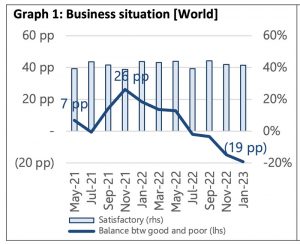
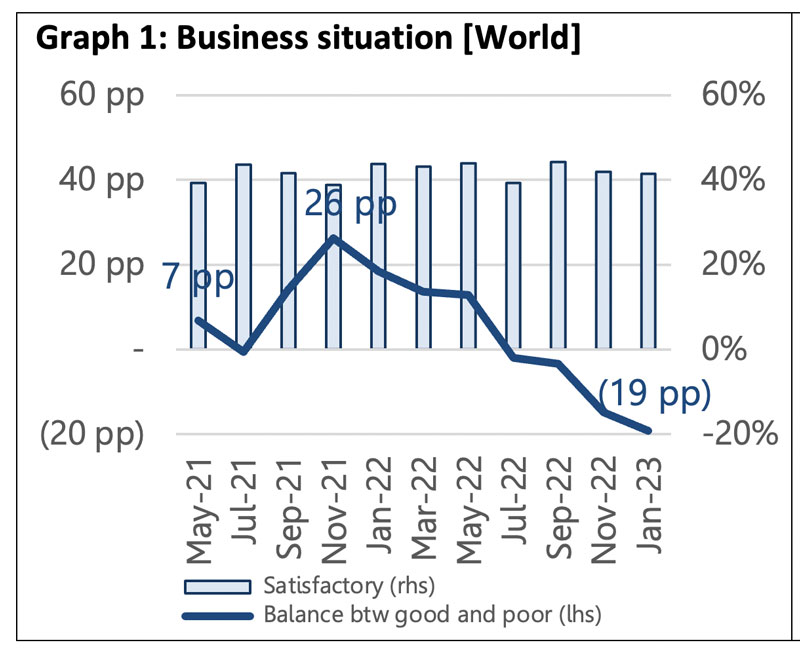
ZURICH — February 7, 2023 — The business situation is at a new minimal position considering the fact that ITMF started off the World wide Textile Business Survey in 2021. Large inflation and soaring curiosity rates are the main recent drivers of the global overall economy, but the core challenge of the textile source chain in 2023 are large inventories at the brand name and retail amount. With the opening of economies all around the entire world soon after the COVID crisis, buyers experienced the prospect to spend the funds they could not all through 2020 and in the 1st 50 percent of 2021. As a result, need soared, and models and shops enhanced orders to meet up with this pent-up demand from customers. With inflation soaring, specifically following the Russian invasion of Ukraine in February 2022, desire for client items slowed even though inventories remained extremely large.
Respondents to ITMF’s 18th GTIS survey confirm that get consumption has continually decreased since November 2021. In January 2023, the indicator was detrimental in all locations and segments except for North & Central The us and fiber producers. The latter saw orders rise for the initially time because final summer season. The previously high worldwide order backlogs also steadily lessened from 3.1 months in March 2022 to 2.4 months in January 2023, largely thanks to brand and retailers’ restraint to put orders. The dampening consequences of the earlier supply chain disruption even further aided lowering purchase backlogs by strengthening worldwide trade flows which led to slight rise of the potential utilization rate around the globe (primarily pushed by fiber producers and spinners).
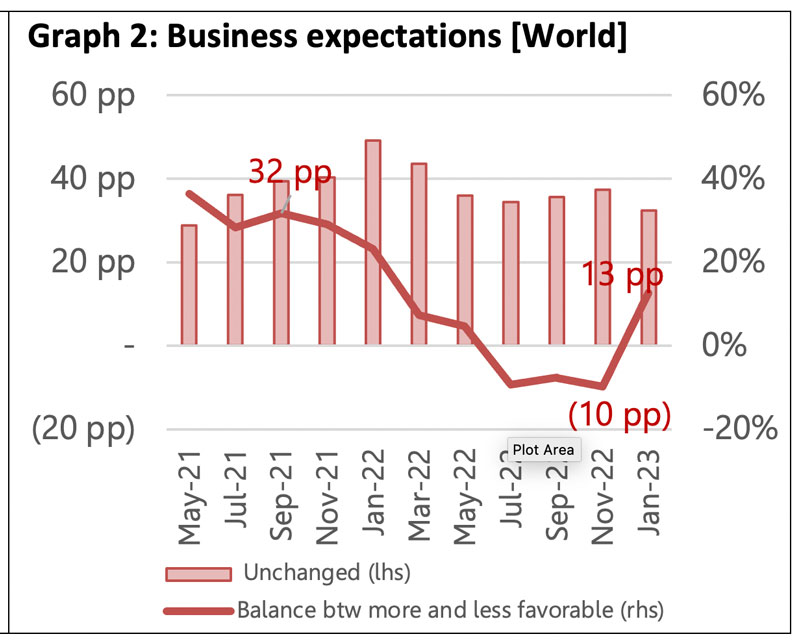
Anticipations in six months-time have soared and respondents are globally favourable about business enterprise in June 2023. Textile makers hope a better circumstance owing to two essential aspects. Very first, the world is now in a a lot greater electrical power situation with a relative mild winter season in Europe and energy charges in Europe and Asia (especially for gas) dropping back to amounts observed in advance of Russia’s invasion of Ukraine. 2nd, the sudden end of the Zero-Covid-plan in China with a swift opening of the borders is promising to fortify demand in China as properly as abroad (far more tourists and imports of merchandise). Almost everything else getting equal, the world-wide financial state will see a increased growth stage than anticipated and this will benefit the global textile market.
We are at a essential instant in heritage. The environment feels significantly unstable, unsure, advanced, and ambiguous. A series of intersecting global crises is impeding business operations. The ongoing Covid-19 pandemic, the war in Ukraine, simmering geo-political tensions, social unrest, local climate catastrophes, soaring expenses, and disrupted supply chains are creating it challenging for firms to navigate. Mounting scrutiny and regulation from policymakers all around the globe are further more exacerbating challenges.
No organization, nation or even area can take care of these complications alone. Collaboration is the only way forward. At previous month’s Planet Economic Forum’s Yearly Conference satisfy in Davos, Switzerland, environment leaders ended up endeavoring to react collectively to the intricate and interlinked challenges we confront. Convening on the concept of ‘cooperation in a fragmented world’, they know such systemic problems need coordinated remedies.
In the same way, the manner sector need to unite to address its certain social and environmental issues. As one particular of the planet’s most polluting industries, it has significantly function to do. For attire makers, stores and brands this need to be a yr of collaboration, not conflict, of development, not platitudes.
Seismic adjustments are coming our way. In response to the weather crisis, new public policies will put escalating calls for on all areas of operations. In these situations, the only way we make development is if providers set aside their differences, pay attention to each individual other and find widespread ground to shared alternatives that reward all, and not just some.
In 2023, we have a few urgent troubles to get over jointly:
Collective action to lower emissions
Very first, we require to agree on reducing our emissions in line with the goals of the Paris Settlement and commit to taking motion. In exercise, this signifies the entire style industry need to established Science-Based Targets (SBTs). They are greatly recognised as the most clearly defined pathway for businesses to minimize emissions. Sad to say, the vogue sector has been gradual to adopt them.
To date, only 24{1668a97e7bfe6d80c144078b89af180f360665b4ea188e6054b2f93f7302966b} of our users have accredited SBTs in location. As our membership organisation represents around 50 percent of the manner sector – such as some of the world’s major makes – and exists to permit optimistic social and environmental impacts at scale, this lower uptake demonstrates the urgent will need for substantially a lot quicker progress. In an effort to deal with this, we launched a new Decarbonisation Method to assist and drive the sector to do the job toward urgent, and important emissions reduction. The Software will aim on collaboration, member guidance and delivering instruments and advice to make reaching these targets achievable.
Strategic partnerships to tackle the info gap
Next, brands, suppliers and brands need to collaborate to fill the present gaps in sustainability data. Without it, there is no credible way forward. To access essential local weather and human rights aims, each and every enterprise need to initially understand its present status. Usually, there is no way of understanding what action to acquire. That’s why independent, scientifically accurate and standardised knowledge is important.
In excess of the past decade, the SAC, jointly with our associates, has collected a wealth of confirmed data to evaluate the cradle-to-grave environmental impacts of textiles, resources, add-ons, and final solutions. This improved transparency has enabled people within just the business to make educated choices. The knowledge is not ever entire, but it is evolving. Some critical gaps continue to be that will have to be urgently filled we want to see NGOs, info professionals and foremost market manufacturers and producers coming collectively to solve this.
Harmonised legislation for a typical tactic
Finally, we need harmonised legislation for the components, textiles and equipment utilized to make clothes and footwear, as properly as for ultimate trend items. As a remarkably sophisticated intercontinental market, with supply chains commonly crossing continents, the attire sector can only significantly reduce its social and environmental impacts in just a crystal clear, strong and standardised framework.
We need a widespread language to explain sustainability, together with a method for calculating environmental footprints that are recognised throughout the world. It’s the only way organisations can undertake reputable sustainability measurements that provide the basis for honest sustainability statements. It’s how we battle greenwashing.
We are dwelling via turbulent moments, but we are in this collectively. Enormous systemic improve only takes place when we are all concerned. Our market – with its enormous creativeness, innovation, knowledge and capacity to collaborate pre-competitively – has the potential to be an illustration for other people.
There is however so considerably to be carried out and time is working out. The conclusions we make together in the 12 months in advance will have profound impacts for generations to appear. To ensure a greener, cleaner and fairer long term, they will have to be the right kinds. For clothing, I believe that indicates environment SBTs, filling vital sustainability data gaps, and harmonising international legislation. All those are this year’s vital methods toward generating an field that leaves the globe in a greater location than when we arrived, and it is apparent to me that we will have to tackle this together.