India holds a 4{1668a97e7bfe6d80c144078b89af180f360665b4ea188e6054b2f93f7302966b} share of the worldwide trade in Textiles and Clothing. India is a person of the largest producers of cotton and jute and 2nd biggest producer of silk in the planet. As for every the “make in India” report, 95{1668a97e7bfe6d80c144078b89af180f360665b4ea188e6054b2f93f7302966b} of the world’s hand-woven cloth arrives from India. Indian textile and apparel products have a background of fantastic craftsmanship throughout the full worth chain, starting off from fibre, yarn, and cloth to attire with substantial worldwide appeal. Over-all, about 25{1668a97e7bfe6d80c144078b89af180f360665b4ea188e6054b2f93f7302966b} of the volume of its garment creation goes into export marketplaces, leaving 75{1668a97e7bfe6d80c144078b89af180f360665b4ea188e6054b2f93f7302966b} for domestic intake.
The Indian textile and apparel industry is evolving and predicted to grow even further at 10{1668a97e7bfe6d80c144078b89af180f360665b4ea188e6054b2f93f7302966b} CAGR from 2019-20 to reach US$ 190 billion by 2025-26. The marketplace is a person of the most considerable contributors to the overall economy, with a 5{1668a97e7bfe6d80c144078b89af180f360665b4ea188e6054b2f93f7302966b} contribution to the gross domestic merchandise (GDP). It is also the second largest employer right after agriculture, offering direct employment to 45 million persons and 100 million folks in the allied sector. Each individual calendar year the market absorbs a large amount of youthful specialists who analyzed Style or Textiles as a career selection. But above the past several a long time, we have observed a switching pattern of marketplace recruitment for vogue or textile gurus. Let’s have a glimpse at some of the emerging traits.
Operating in a collaborative space
In the textile and apparel marketplace, the skills and competencies that employers are on the lookout for in recruitment have transformed significantly about the very last couple of a long time. Aside from domain-distinct awareness and abilities, businesses continually concentration on managerial competencies, knowledge analytics, crucial pondering, and dilemma-fixing. Workforce range is obtaining acceptance for collaboration, and the emphasis is provided to an surroundings that is agile, adaptive, and encourages continuous iterations. Millennials are displaying desire to operate for vogue businesses that inspire innovation, experimentation, and possibility-taking. They want to associate with businesses that respect diverse thoughts and have an unrelenting concentration on data-pushed determination-generating.
It has been noticed that some of the superior vogue or textile organizations are adopting a collaborative approach with academia by featuring an internship or reside marketplace job ahead of deciding upon pupils for placement. Many moments, pupils are also obtaining sponsorship choices for graduating assignments, and the venture outcome can help pupils qualify for a work. This kind of collaborative techniques aid both equally students and the employing business to have a improved comprehending of every other’s anticipations. It assists college students have a superior orientation of the work position, an being familiar with of the firm profile, and, last but not least, positively reflecting on career retention.
Redefining hiring tactics
The two many years of the pandemic have recalibrated the electrical power dynamics concerning companies and workers, and it has had a direct effect on the recruitment system. The talents now want to select their place of work properly. They are extra aware about whom they want to function for and the place they want to invest their important time. Millennials and Gen-Z specifically are searching for a workplace in which ‘what they do matters’. They want to get opportunities in which their time investment decision can incorporate a positive contribution to the overall effect the business is aiming to create. Organizations have to have to be on their ideal behaviour and are not able to find the money for to have employing strategies devoid of transparency. non-inclusive insurance policies or an out-of-date employee working experience. In any other case, they will shed the battle for hiring the greatest skills. Currently, youthful specialists are blessed with ample occupation chances to start off their careers in the manner or textile industry. But at the exact time, they have to facial area a pretty competitive sector to show their talent. Most of the good companies are approaching academia with a task short wherever pupils have to accomplish on the spot for choice. These firms do not blindly count on the CV, placement portfolio, degree, or diploma that students produce. To get the most effective occupation prospects, the students will have to exhibit their competencies per the work descriptor.
Academia as an Incubator for Trend Field
Universities and design and style faculties are now examining how best they can prepare students for significant and rewarding occupations. With rising markets’ current situation, bigger education learners are demanding far more than just academic levels. They get publicity to entrepreneurial techniques and company coaching as section of their curriculum. Youthful designers are interested in launching get started-ups with innovative strategies and starting off social movements that impression culture. To guidance the entrepreneurial spirit, the academic institutes are focusing on making an in-house incubation mobile in collaboration with the field. The incubators are now an integral and very important section of the better training landscape. They promote tenets like ‘take risks’, ‘fail fast’, etcetera., for budding designers to go after the entrepreneurial journey. They supply accessibility to resources like mentorship, legal and administrative steerage and networking prospects with prospective buyers and partners.
The government also gives various techniques to aid early-phase start out-ups to come to be additional worthwhile and sustainable enterprises. As aspect of the ‘Atmanirbhar 3. package’, a budget of Rs. 1.45 lakh crores was allotted to raise manufacturing sectors, such as textiles. The environment up of built-in textile parks (SITP) is a single of the significant initiatives of the Ministry of Textiles to guide little and medium business owners in the textile sector. It is encouraging that India has jumped up to 79 positions on the ease of carrying out enterprise rating soon after the launch of different schemes under the "Make in India" campaign. Electronic transformation, making a new workspace and small business styles
The textile production marketplace is at the early phase of its journey toward likely digital. But this development is no more time only about clever wearables it is far more about integrated and linked businesses. The rising electronic manner craze calls for new talents in the business exactly where digital acumen is getting prime precedence. The availability of large knowledge and analytics will aid trend corporations strategically to tailor buyer encounter and to direct a client-centric small business design.
These days, 3D fashion structure is getting popularity with software like CLO3D, TG3D, and many others. 3D trend will keep on to evolve virtual try-on and immersive experiences in AR, VR, and mixed actuality will convey substantial disruption in the sector from layout and output to offering.
We can forecast that the new engineering and innovations will endorse a new period of remote and hybrid workplaces in which the distance or geographical location involving staff and employer will be of minimal or no value while hiring. The work effectiveness will not be calculated primarily based on the quantity of hours the staff is logged in for but purely on the output they develop.
Fb Twitter Linkedin E mail
Disclaimer
Sights expressed previously mentioned are the author’s have.
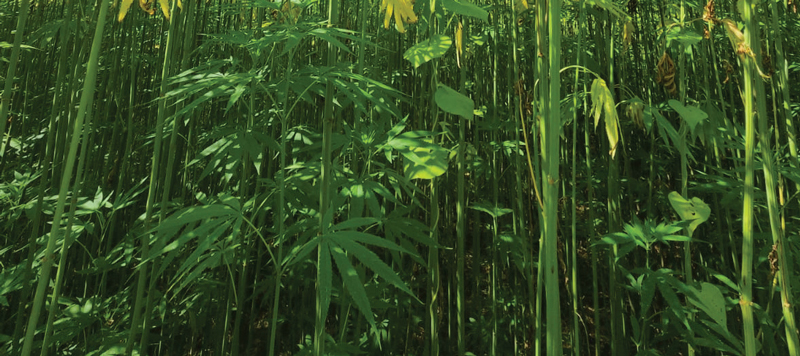
Hemp seeds for textile use are planted very close together to encourage the plant to grow tall and thin with very few branches.
Bear Fiber Inc., a forerunner in the textile hemp fiber movement, sees tremendous opportunity for hemp in the U.S. textile, apparel and fashion arena.
By Rachael S. Davis, Executive Editor
Buzzwords come and go in the textile industry, but two words in particular have had some staying power over the past handful years — sustainability and hemp. Not surprisingly, the two words are connected, and one man chasing hemp as the next big thing in sustainable fibers is Guy Carpenter. He is not alone in the United States in that endeavor but is widely acknowledged as one of the forerunners.
Carpenter’s experience in the fiber industry goes back many decades, and his exposure and interest in hemp began when he was working in Europe. He eventually co-founded Bear Fiber Inc. in 2017 when he realized no one else was exploring the potential of hemp fiber in the United States.
Bear wants to be the supplier of choice when it comes to high-quality textile grade hemp fiber, and the company is highly invested in reestablishing American hemp as a source of sustainable, natural fibers. The company operates under the trademarked motto “Hemp Makes It Better™,” and it’s a motto Carpenter firmly believes in.
Hemp! Why Hemp?
While a hot topic and buzzword in the textile industry lexicon, hemp for textile use is not new. Hemp is acknowledged as one of the earliest known textile fibers and has come and gone from the textile landscape throughout history. However, hemp has a checkered history in the United States due in part to its association with cannabis and the negative thoughts this connection invokes.
The current rebirth of the fiber in the United States coincides with the 2018 Farm Bill Act that removed industrial hemp from inclusion in the Controlled Substances Act (See “Hemp: A Reintroduction To One Of The Original Textile Inputs,” Textile World, November/December 2020). The bill made commercial production of hemp legal in the United States, and thus, an opportunity was born for textile hemp fiber.
Current market research reports looking at the value and potential growth of the hemp fiber industry vary depending on the market research company. But two things researchers agree on is the growth numbers are in the billions of dollars and increased use of hemp in the textile industry is driving the growth.
Carpenter isn’t focused purely on dollar signs. He understands the significance and widespread value of the industry from the farmer to the textile producer and wants to help develop the United States hemp fiber industry while also continuing to grow the global hemp industry. “We’re trying to create an industry, not just run a business,” he emphasized. “They say there’s 25,000 different things you can do with hemp, but my brain is tracked to one thing and one thing only — textile grade fiber for apparel and footwear.”
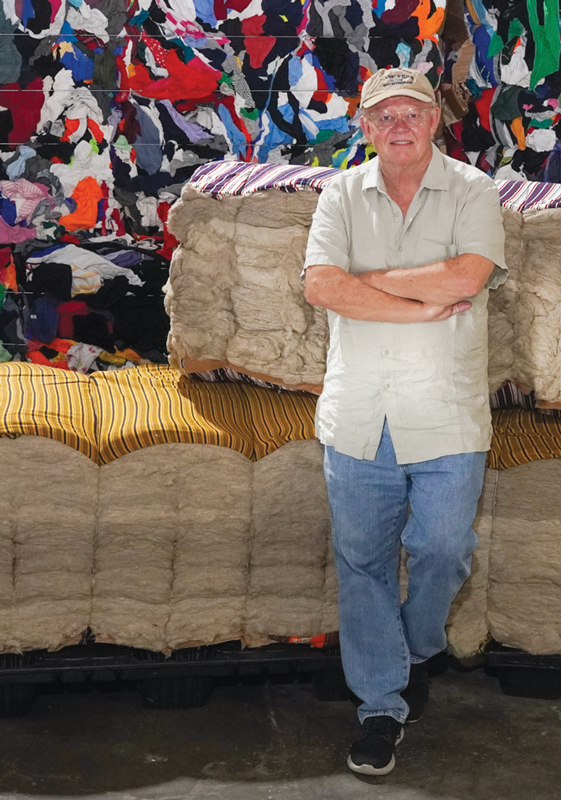
Guy Carpenter, co-founder of Bear Fiber Inc.
What Hemp Brings To The Textile Table
The benefits of hemp fiber, a member of the bast fiber family, are not in dispute. Hemp is an environmentally friendly and sustainable fiber. It is strong, durable and absorbent. It also has natural antimicrobial properties and exhibits resistance to ultraviolet light. Its benefits in textile apparel applications are evident.
“Using at least 30 percent hemp in a yarn blend with cotton makes for a new natural fiber-based technical textile, which is strong and will last longer,” Carpenter noted. “The blend allows for the familiar touch and comfort feel of cotton made better by the positive attributes of hemp.
“I should talk about sustainability, regenerative agriculture, carbon sequestration, and hemp’s strength and technical attributes,” Carpenter said. “But I like making apparel with hemp because it feels good, and it lasts a long time. It’s that favorite jacket, sweatshirt, T-shirt, socks, shirt or jeans that just keeps getting softer and softer over time. Hemp wears in, it doesn’t wear out!”
Growing Hemp
China and Europe already have established industrial hemp markets growing the plant for food, cannabidadiol (CBD) and textile use. There are many, many different hemp varieties depending on the end use for the plant.
Hemp grown for CBD, marijuana or food uses is cultivated to be as leafy as possible. More branches mean more buds and flowers where the cannabinoids are concentrated, and the plants are grown with ample space between each plant to allow this leafy growth, which also encourages thicker, stronger stalks.
Hemp plants are similar to trees with branches and everywhere there is a branch on the stalk, there is a knot hole. “Each knot hole is an interruption in the fiber growth of the long, straight fiber that we require for textile applications,” Carpenter said.
“Where fiber fineness is not a consideration, grain hemp stalk can be used,” Carpenter said. Applications may include nonwovens and composites for construction and geotextile products. “Because the stalk has matured by necessity to support the weight of the flower and then the grain itself, the fibers become stiffer and thicker in order to support the weight at the top of the stalk. These fibers are inherently too mature for textile yarn spinning applications.”
Therefore, the approach for growing hemp for high-quality textile fiber is quite different. The seeds are planted very, very close together, which encourages the plant to grow tall and thin with little in the way of branches. Hemp grows rapidly — the stalk can be 10 inches tall in as little as 14 days — and as the plant develops its first set of leaves, the leaves create a canopy that inhibits sunlight from reaching the ground, thus providing natural weed prevention so little to no herbicides are required.
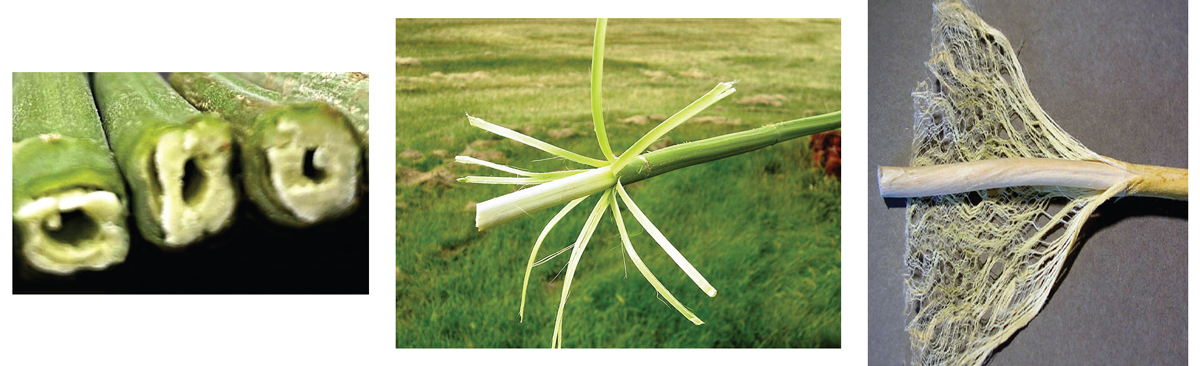
Once the plant is ready to flower, and before the fibers get too tough for textile applications, the fields are cut and the stalks lay on the ground to begin dew retting. This is a natural process whereby bacteria begin to degrade the pectin, which is the gummy substance that binds the fiber to the woody hurd — or center — of the stalk (See Figure 1). After retting, the stalks are baled and sent to a processor to be decorticated — a process that physically separates the fiber from the hurd in a manner similar to any bast fiber process. After decortication and refining, the fiber is ready to be degummed to remove the lignin “glueing” the individual fibers in bundles and ribbons. Extracting the lignin allows the fiber bundles to release the individual fibers during the next process — opening.
Figure 1: Hemp fiber is bound to the woody hurd at the center of the stalk with gummy pectin.
Developing The U.S. Hemp Industry: The Journey
Hemp is a natural fiber and as such, producing the best fiber for apparel and fashion uses is not an exact science. Carpenter has spent extensive time in China over the past 25 years learning about hemp farming and hemp fiber production, but knows he still has a lot to learn.
“It’s been a learning process here in the United States using the equipment available,” Carpenter said. “It’s been an adaptive process, and we have not always been successful!”
Cotton has enjoyed the benefit of decades of research and development in the United States, which along with the work the farmers do, means the United States grows the best and most consistent cotton the world.
To spin yarns, fiber consistency is imperative. Providing that consistency to the hemp industry is Bear Fiber’s biggest challenge.
To start, farmers need to grow the hemp variety that is best for textile fiber use as well as the best variety for the region in which they are based.
Encouraging U.S. hemp farming briefly led Bear Fiber into the hemp seed business. “Everyone wanted to grow European hemp varieties for us, and these varieties were not developed for textile grade fiber, or developed to grow successfully in the United States,” Carpenter said. “We were getting maybe 8 percent useable fiber from the stalks, whereas the Chinese had specifically been developing varieties for greater amounts of textile grade fiber that could be grown in a faster manner.” So, Bear Fiber began importing Chinese seeds, which was a whole new educational process that required forming a new business network.
Hemp is a hardy plant that can be grown in a variety of climates, although it prefers a temperate climate and fertile, loamy soil. “Honestly, we don’t yet know where the best place to grow hemp in the United States is,” Carpenter confessed. “But we are pretty sure where hemp can grow in 100 days or less and likely provide double digit textile grade raw fiber yield, which is what we are looking for. This also allows us to pay a fair price to the farmer or processor for the fiber.”
Carpenter believes there is a real opportunity for farmers, especially those in agriculture and textile producing states — such as Georgia, and North and South Carolina — where the spinning mills already exist. “However, we intend to be agnostic,” Carpenter said. “If the fiber is healthy and clean, we’ll ship it from any state in the union. It’s worth it.”
Bear Fiber currently is using textile hemp from North Carolina, Pennsylvania and Montana — where there are quantity processors that have fiber available to date. But the company also is working with newer processing operations in Missouri, Alabama, Texas, California and Oregon. “We want to help grow this industry and help create opportunity for the farmers across the country,” Carpenter said.
“Some states — including New York with a $10 million investment — have programs in place to advise and financially assist American farmers who risk growing this new fiber crop,” Carpenter continued. “But farmers have to pay bills just like anyone else, and if they can’t get real support, they can’t take the chance.”
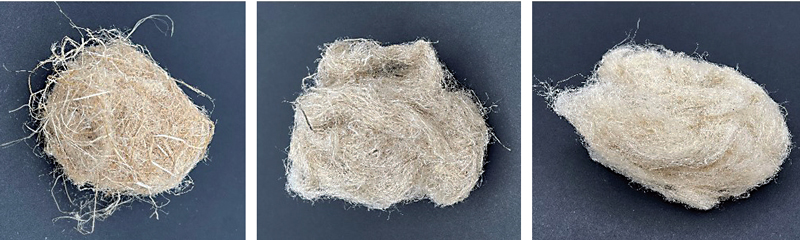
(left to right): Bast hemp fiber, refined hemp fiber and degummed or “cottonized” hemp
North Carolina has a fantastic advocate at NC State University by the name of Dr. David Suchoff, who is an alternative crops extension specialist in the department of Crop & Soil Sciences in the College of Agriculture and Life Sciences. Dr. Suchoff heads agricultural research stations and leads a national public/private hemp consortium. The goal of the consortium is to address many of the issues relating to the hemp industry through collaborative research with other institutions across the country. Suchoff also plans to expand hemp farm fiber outreach opportunities with emphasis on underserved farming communities.
Dew retting harnesses moisture that develops overnight to encourage bacteria growth. “That makes it harder to get good textile fiber from hemp grown in Montana where there is no dew,” Carpenter said. “But there are different varieties of hemp, and we are learning about techniques to promote bacterial growth for retting in geographic areas that don’t enjoy the same climate as say North or South Carolina.”
Decortication also is key step in hemp fiber processing to preserve the textile grade fiber. Any kinks or damage caused during decortication may weaken the fiber, which results in poor performance in downstream processing. “Great care has to be taken when decorticating textile grade fiber,” Carpenter said.
Bear Fiber’s Expertise
Circling back, one of Bear Fiber’s goals is to be the supplier of choice when it comes to high-quality textile grade hemp fiber. “Where Bear Fiber comes into play is we know how to separate the hurd and clean the fiber to where it needs to be so it can then be put through the wet processing of degumming,” Carpenter said. “The most important thing about this process is that raw fiber with any percentage of hurd must be cleaned and refined. Fiber with any percentage of hurd mixed in is not as valuable as raw fiber that is cleaner.”
Carpenter said in American hemp fiber processing currently, the raw fiber is anywhere from 1 to 6 inches long in bands or ribbons gummed together. Bear Fiber uses an alkaline process to degum the fiber. There are many methods available to degum hemp fiber — including boiling, electrification, acid and enzyme techniques — but Carpenter likes an alkaline process developed by the Chinese because it’s simple and cost effective. The end goal is fibers that are 1 to 2 inches long.
“We’re trying to achieve a uniformity in the degummed fiber so that it can be blended with other fiber from the United States,” Carpenter said. “Each bale is tested before degumming against a standard formulation, but we might have to adjust the alkalinity or the chemistry in some way if we need to lighten the fiber to achieve a more consistent fiber grade based on where the hemp came from and how well it was retted.”
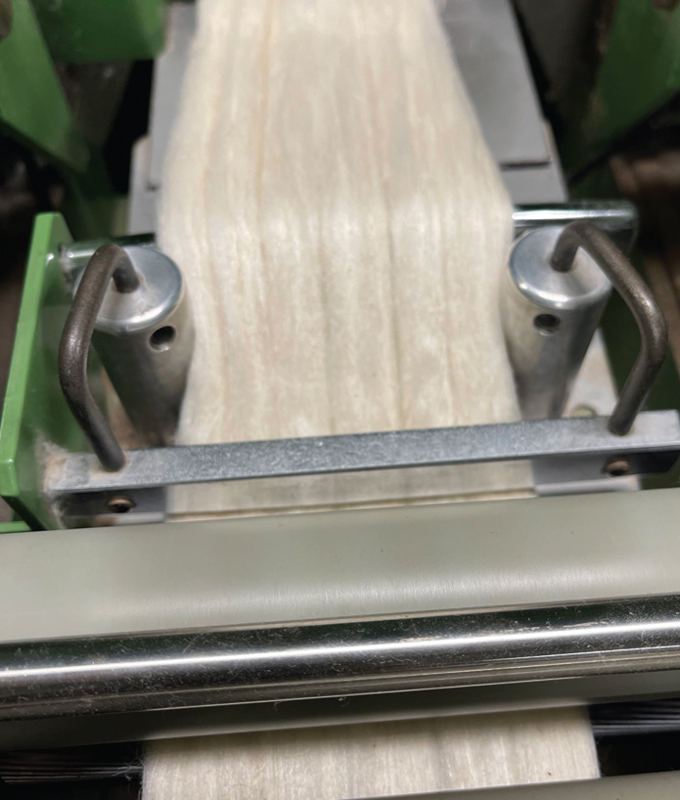
A hemp/cotton sliver on the drawing frame
Hemp fiber is valuable. Carpenter shared that currently, hemp fiber compares to alpaca fiber in price. “Right now, it’s still pretty expensive because everything that has come through our pipeline so far has been part of the development process,” Carpenter shared.
Carpenter has been busier than usual over the past several months. The company relocated within North Carolina from Wilmington to Morganton, to be closer to manufacturing partners. “We hope one day to grow into our own spinning and will focus on spinning natural fibers, recycled fibers and regenerative fibers” Carpenter said. “In Morganton, I’m surrounded by 120,000 pounds of recycled fiber. Material Return [a solution for custom circularity that works with manufacturers and brands to transform textile waste into new products], for example, is here in Morganton and it has a Smart Wool return program for socks. Bear Fiber looks forward to eventually blending innovative technical yarns comprised solely of natural, sustainable, recycled and regenerative fibers.
“The hemp fiber industry doesn’t really have a competitive environment yet,” Carpenter mentioned. “We haven’t produced enough fiber to make a difference in any market. To date, the only commercial products made using U.S. hemp and manufactured in the United States are Bear Fiber socks.” The socks are developed and knit in partnership with the Manufacturing Solutions Center in Conover, N.C.
“Our industry manufacturing partners have been receptive to hemp and a number of companies have been true first movers,” Carpenter shared.
Collaborative Approach, Partnerships Are Key
Carpenter has embraced a collaborative approach to growing the U.S. hemp industry. He has worked with brands, both big and small, and consults with and mentors anyone wanting to learn more about hemp and the opportunities it presents. “We all work together better than alone,” he said. “I always prefer to look for partners and establish relationships. We are all allies working together to create a market. I’m willing to help and share the knowledge I have in order to advance and grow this industry.”
While Carpenter is widely acknowledged to be a hemp “guru” of sorts, he does want to make it patently clear that he is not any sort of isolated Don Quixote character operating independently. “There is no way that one person could have achieved much without the help of dozens and dozens of people who believe that hemp fiber is an important and viable asset to the American textile and apparel industry,” Carpenter stressed. “It’s been a journey and I wouldn’t be where I am without the help I had along the way.
“I’d like to name and thank everyone, but there’s just not enough space in the magazine. For Bear Fiber, farmers, processors, spinners, weavers, knitters, finishers, the Textile Technology Center, NC State’s Wilson College of Textiles, VF Corp. and Vans all have been working to create a circular collaborative effort. We also would have been at a dead stop for months without processing help and fiber from IND Hemp — an amazing team that works with farmers to grow hemp out West and processes fiber, grain and hurd in Montana.”
“Guy Carpenter was the first person I turned to when I wanted to learn about Made-in-USA hemp, and he has continued to be a source of both technical and business knowledge as the Wilson College of Textiles and NC State University develop our position in growing, cultivating and manufacturing hemp,” said Dr. Andre West, director of the Zeis Textiles Extension for Economic Development at NC State’s Wilson College of Textiles. “Guy’s passion for a sustainable future led him to embrace hemp early on as a solution and build a unique knowledge base that has allowed him to mentor others as they build hemp-based products. He is grounded, knowing this is a long journey and a lifestyle change. And, he is playing his part to educate everyone that hemp fiber is a part of creating a better future for the planet and has a place in manufacturing textiles in the United States.”
One person who benefited from Carpenter’s willingness to mentor is Claire Crunk, founder and CEO of Trace Femcare Inc., a period care company that produces tampons using hemp and cotton fibers from fully traceable sources. “When I got my start in hemp fiber almost five years ago, I was a total neophyte,” Crunk said. “When I cold called Guy, he was gracious and clearly an expert, so right then and there, I asked him to be my mentor. Guy has been a consistent and selfless mentor since then — teaching, encouraging, and providing more than any conference or curricula ever could. He is one of our company’s most important partners, and I admire him both professionally and personally and am privileged to now call him a colleague and friend.
“As one of the first brands to sell products made from U.S.-produced textile-grade hemp fiber, we are proud that our work ultimately supports our partners, like Guy, in their success to provide textile industry quality hemp fiber at scale.”
A finished hemp/cotton blend yarn
Vans: Mainstream Interest In Sustainable Fibers Like Hemp
Brands are taking an interest in hemp too. VF Corp. believes “hemp has the potential of filling in some of the gaps in our fiber toolkit for brands and products that would like to utilize more natural fibers.”
“VF recently set ambitious goals for the reduction of greenhouse gas emissions utilizing science-based targets, and as one of VF’s largest brands, Vans is committed to supporting these goals,” said Emily Alati, director, Materials Innovation, Vans. “We believe supply chain innovations in natural fibers, including hemp, are necessary and if cultivated with sustainable agricultural methods and processed with lower energy inputs, it can be a competitive advantage to help VF reach those goals.”
According to the company, Vans has used hemp in its products for years, so supporting U.S. hemp agriculture and textile processing also aligns with its consumer and supply chain needs. Vans is currently sourcing hemp fiber from North Carolina in small quantities and hopes to increase that volume over time.
“We are also supporting those hemp farmers in their transition to regenerative agriculture practices to reduce the overall environmental impact of hemp farming,” Alati said. “Ultimately, we are eager to utilize regeneratively grown and U.S. hemp fiber while supporting minority farmers. Long term, we hope to see all VF brands utilizing domestic industrial hemp fiber and textiles for various end-uses across our global markets.”
Vans’ collaboration with Bear Fiber benefits both companies. “The relationship is based on expertise, trust and results,” Alati said. “Bear Fiber has demonstrated that hemp fiber suitable for short staple spinning can be grown and processed entirely in the United States. Its relationships with textile universities, labs and processing partners have led to commercial textiles in a relatively short time span.”
For Bear Fiber, the support received from VF Corp. and Vans starting some two-and-a-half years ago has been incredibly important. “You have a lot more credibility when you walk into a room with people employed by one of the most important brand companies in the world who say ‘we are behind hemp, we think hemp is important and we think this is the future,’” he stressed.
Bear Fiber currently is producing fabric for Vans. The yarn is spun by National Spinning Co. Inc. at its Whiteville, N.C., plant; the fabric is woven by Central Textiles Inc., Central, S.C.; and finishing is performed by Mount Vernon Mills Inc., at its facility in Trion, Ga.
Bear Fiber offers socks made using U.S. hemp that are developed and knit in partnership with the Manufacturing Solutions Center in Conover, N.C.
BFFs: Hemp And Cotton
Hemp is also seen as a potential competitor to cotton, which at times, hampers adoption of the plant for farming and textile use. Carpenter wants to stress that he doesn’t see hemp as a competitor or replacement for cotton and just wants to sell the value of another fiber crop. He sees the two as complementary fibers — best fiber friends (BFFs) — that can help both the farmer and the textile industry. “We are not asking farmers to grow hemp instead of cotton,” he noted. “We are asking them to grow it along with cotton.
“We want to replace 50/50 cotton/polyester blends with 65-percent cotton/35-percent hemp,” Carpenter continued. “We export our cotton everywhere because it’s of the highest quality. One day I hope to be exporting U.S. hemp fiber because it’s sought after for its quality. And the opportunity for hemp blended with U.S. cotton is tremendous.”
Carpenter considers Bear Fiber’s perseverance its greatest asset. “We know yarns and fabrics can be made to meet the quality standards that the brands and consumers are looking for because we’ve been doing it for 25 years in China.”
Ultimately, Carpenter wants what is best for the U.S. fiber industry and the U.S. textile industry.
“I want to help grow the hemp fiber industry into the American textile, apparel and fashion industries,” Carpenter said. “I think an American hemp fiber industry not only can provide consumers with better garments that last longer and feel better but can also be a huge benefit to small farmers and fiber farmers who are already growing cotton.
“The only competition we have is China, and we’re going to be better than them,” Carpenter predicted. “Consumers today have a heightened awareness of natural fibers and sustainability, and are demanding better choices. It’s up to the U.S. textile manufacturing industry to take advantage of this opportunity, to innovate and promote from the ground up our own domestic value chain. In the United States, we’ve already got the best cotton in the world, and that’s a huge advantage. But you know what? Hemp makes it better!”
The World Recycled Textile Sector is approximated to be USD 6.41 Bn in 2022 and is anticipated to arrive at USD 8.61 Bn by 2027, growing at a CAGR of 6.07{1668a97e7bfe6d80c144078b89af180f360665b4ea188e6054b2f93f7302966b}.
Current market Dynamics
Motorists
Lessened Co2 Emissions and Drinking water & Vitality Intake
Increase in Consciousness Among Individuals and Brands
Restraints
Substantial Processing Price and Decrease Excellent of Recycled Textile
Alternatives
Technological Progress in Recycling Method
Initiatives Currently being Taken by Firms for Recycling Employed Outfits
Difficulties
Complexity in Separating Apparel Thanks to Unique Elements Applied
Sector Segmentations
The World-wide Recycled Textile Current market is segmented based on Variety, Conclusion-Person Business, and Geography.
By Kind, the industry is categorised into Recycled Cotton, Recycled Wool, Recycled Polyester, Recycled Nylon, and Some others.
By Conclude-Consumer Field, the sector is labeled into Automotive, Retail, Mining, Creating & Construction, and Others.
By Geography, the market place is classified into Americas, Europe, Middle-East & Africa and Asia-Pacific..
Nations Studied
The united states (Argentina, Brazil, Canada, Chile, Colombia, Mexico, Peru, United States, Relaxation of Americas)
Europe (Austria, Belgium, Denmark, Finland, France, Germany, Italy, Netherlands, Norway, Poland, Russia, Spain, Sweden, Switzerland, United Kingdom, Relaxation of Europe)
Center-East and Africa (Egypt, Israel, Qatar, Saudi Arabia, South Africa, United Arab Emirates, Rest of MEA)
Asia-Pacific (Australia, Bangladesh, China, India, Indonesia, Japan, Malaysia, Philippines, Singapore, South Korea, Sri Lanka, Thailand, Taiwan, Relaxation of Asia-Pacific)
Competitive Quadrant
The report features Competitive Quadrant, a proprietary tool to analyze and examine the placement of corporations based on their Marketplace Posture rating and Market Efficiency rating. The tool employs various elements for categorizing the players into 4 types. Some of these factors deemed for assessment are financial general performance over the last 3 years, development techniques, innovation rating, new product or service launches, investments, growth in market place share, etc.
Ansoff Assessment
The report presents a specific Ansoff matrix evaluation for the World wide Recycled Textile Marketplace. Ansoff Matrix, also recognized as the Product/Sector Expansion Grid, is a strategic software utilized to design and style techniques for the development of the organization. The matrix can be applied to consider strategies in four techniques viz. Current market Advancement, Sector Penetration, Merchandise Improvement and Diversification. The matrix is also made use of for danger investigation to recognize the possibility concerned with each individual method.
The analyst analyses the World Recycled Textile Sector utilizing the Ansoff Matrix to provide the very best techniques a firm can get to strengthen its industry position.
Based on the SWOT examination carried out on the market and business gamers, the analyst has devised acceptable tactics for market development.
Key Subject areas Included:
1 Report Description
2 Investigation Methodology
3 Govt Summary
4 Industry Dynamics
5 Market Assessment
6 World-wide Recycled Textile Marketplace, By Form
7 Global Recycled Textile Sector, By Close-User Market
8 Americas’ Recycled Textile Sector
9 Europe’s Recycled Textile Current market
10 Center East and Africa’s Recycled Textile Market
The outcomes of the 16th ITMF World wide Textile Market Study (GTIS), formerly recognized as ITMF Corona-Study, demonstrate the deteriorating organization condition and expectations in the world wide textile industry in September 2022. According to the study published by the Intercontinental Textile Manufacturers Federation (ITMF) whilst improving, the business enterprise situation was relatively worst in Asia, and although all segments found them selves in unfavorable circumstances, spinners’ predicament has plunged to an unprecedented level.
Halting the decline in world-wide anticipations is a optimistic signal for the long term of the sector
A positive indication for the long term is that global expectations have stopped falling in September 2022, albeit remaining in adverse territory and thus indicating tricky moments in advance. Anticipations have improved in South Asia, North & Central The us, and Africa. Spinners have also far better prospective customers for March 2023, globally, indicating possible reduction.
Anticipations in textile market turnes detrimental
Get ingestion, get backlog, and potential utilisation level in the textile marketplace fell
In accordance to the study, the indicators for buy ingestion, buy backlog, and capability utilisation rate fell globally as perfectly. Businesses in North & Central and specially in South The usa saw get intake enhance although the Asian regions ongoing having difficulties with an unsatisfactory buy circumstance. Buy backlog fell on ordinary across all regions, nonetheless, both of those get intake and backlog greater in South The us. In all segments, the purchase backlog fell, except for dyers/finishers and knitters/weavers expert a small maximize in buy backlog. Although the capacity utilization price dropped globally in September 2022, it amplified in South The united states. Fibre producers registered a constant decrease in ability utilization fee, although it is stated that home textile producers have reversed their downward craze.
Weakening need, large uncooked substance rates, large strength price ranges, and inflation are the 4 main concerns of the international textile industry for the following 6 months. The concern about transportation fees has fallen considerably. Fears about geopolitics on the other hand have amplified noticeably in the earlier two months.
As an global discussion board for the world wide textile marketplace, ITMF supplies its members around the globe with a constant expertise exchange by way of surveys, experiments and publications. It participates in the progress of the industry’s benefit chain by publishing deemed opinions on long run developments and international developments, as effectively as the organization of once-a-year conferences.
GLO-DJIGBE, Benin, Oct 24 (Reuters) – On a huge manufacturing facility floor in southwestern Benin, dozens of younger persons lower, stitch and assemble cotton shirts – component of a important force by the West African place to create its textile sector.
Benin has in the final several many years become Africa’s leading cotton producer, with annual output of 728,000 tonnes in 2020/21, in accordance to govt figures. It exports almost all of that uncooked, with the the vast majority going to Bangladesh.
Now, an initiative is beneath way to generate work and earnings by processing the cotton domestically, with the objective of exporting attire to client marketplaces in Europe, Asia, Africa and the United States.
“We have made the decision that in this state, we are no extended likely to sell this cotton raw. We are going to transform this cotton, in particular by installing built-in textile factories,” claimed Letondji Beheton, running director of the Glo-Djigbe Industrial Zone (GDIZ), about 45 km from Cotonou.
GDIZ begun two years in the past as the end result of a partnership amongst the govt and Crop up Built-in Industrial Platforms (Occur IIP), a pan-African undertaking partly owned by the Africa Finance Company.
[1/6] Men and women get the job done at a shirt-earning manufacturing unit in the Glo-Djigbe Industrial Zone (GDIZ) in Abomey-Calavi, Benin October 13, 2022. REUTERS/Coffi Seraphin Zounyekpe
More than $1 billion has been invested in the zone so much, which will include textile factories as effectively as cashew processing models, pharmaceutical processing models, and far more, reported Beheton. Only a quarter of it has been formulated so much.
Despite the fact that the devices are not nevertheless in position to get cotton from field to manufacturing facility, GDIZ has begun teaching about 1,000 garment workers using imported elements for now.
“When the Glo-Djigbe manufacturing facility commences its routines, I am certain that we will earn much more,” said 46-12 months-previous cotton farmer Leonard Madjaedou, who has benefited from authorities assist to boost his yields.
In 13 months, the industrial zone aims to employ 15,000 men and women in 3 textile factories that will have a processing potential of about 40,000 tonnes of cotton fibre, Beheton reported.
Eventually, he envisages a multi-billion dollar marketplace that could process the majority of Benin’s cotton.
Cotton is developed in several West African international locations together with Mali, Togo, Burkina Faso and Ivory Coast, but most is exported uncooked with little industrial processing across the location.
But the woman’s pose, gaze and garments inform a wealthy tale of creative imagination and self-determination, said Tamika Nunley, affiliate professor of history in the College or university of Arts and Sciences (A&S).
This advertising poster for the exhibit “Social Fabric: Land, Labor, and Planet the Textile Sector Created” attributes an image of Marguerite from Cornell College Library’s Loewentheil Assortment of African-American Photographs.
“It’s not considerably-fetched that Marguerite manufactured that elaborate gown herself or picked it for herself in distinction to the coarse, shapeless garment that plantation proprietors procured for enslaved men and women to have on,” she mentioned.
Marguerite embodies “what self-fashioning appeared like from slavery to the changeover to legal emancipation,” mentioned Nunley, who contributed to the exhibit “Social Cloth: Land, Labor, and World the Textile Industry Developed,” which opens Oct. 27 in the Hirshland Gallery of Carl A. Kroch Library.
“Social Fabric” characteristics people like Marguerite and other men and women and destinations that supported the textile business in the U.S. in the course of the 19th and 20th hundreds of years. The show also connects past struggles for improved performing circumstances to present-working day intercontinental initiatives towards social justice and environmental sustainability in the textile market, according to Marcie Farwell, the Gordon and Marjorie Osborne Textile Sector Curator, who structured the show.
“You simply cannot weave this tale without the need of the weft of the landscape on which it was designed, the waterways on which it depended, and the persons and wildlife that it displaced,” Farwell wrote in the show notes. “The warp are the threads of the institution of slavery as nicely as the labor of little ones, girls, immigrants and prisoners.”
Diverse pieces of the show are dedicated to highlighting these communities and topics. They contain a display screen circumstance about incarcerated laborers, curated by Claudia León ’23, an American experiments important in A&S, as section of her RAD Community Background Fellowship job.
With artifacts and files spanning 400 yrs of historical past, the exhibit draws from several archives of Cornell University Library, which include the newly acquired American Textile Background Museum Osborne Library Selection, the Kheel Heart for Labor-Administration Documentation and Archives, and the Division of Uncommon and Manuscript Collections.
“Social Fabric” runs as a result of Sept. 1, 2023. It is element of a series of reveals arranged by Cornell College Library titled “Threads of History: Textiles at Cornell.”
Jose Beduya is a team author, editor and social media coordinator for the Cornell College Library.