
European Doors and Windows Industry to 2028

European Doors and Windows Industry to 2028

DUBLIN, Jan. 22, 2023 /PRNewswire/ — The “Europe Doors and Windows Market – Industry Outlook & Forecast 2023-2028” report has been added to  ResearchAndMarkets.com’s offering.

Research_and_Markets_Logo

Research_and_Markets_Logo

The Europe doors and windows market is expected to grow at a CAGR of 4.13{1668a97e7bfe6d80c144078b89af180f360665b4ea188e6054b2f93f7302966b} from 2022-2028.

Market Trends and Drivers

1. Integration of Photovoltaics in Fenestration

Modern construction styles provide several opportunities for installing BIPV materials and glass in window panels instead of plain or just glazed-glass panels in the Europe doors and windows market. High-rise buildings have windows on the sides, and multistory office buildings with glass curtain walls or facades offer ample opportunities for vendors to incorporate BIPV glass in openable and fixed windows.

Therefore, suitable doors and windows in the building envelope can be used for several integrated installations using photovoltaic modules and thin films. These innovative doors and windows can also be integrated with the building fabric. One of the most diversely used solar energy-harnessing materials in buildings is photovoltaic glass, which is available in thin films and window glass panes.

2. Improving Investments in Housing

Europe is known for its innovation in the industrial and consumer markets. Western Europe is among the largest markets for connected products in the world. The manufacturing industry in Europe contributes to about 15{1668a97e7bfe6d80c144078b89af180f360665b4ea188e6054b2f93f7302966b} of the GDP. Moreover, many big players in the doors and windows market are also based in Europe.

Furthermore, the European Union (EU) has initiated the Horizon 2020 program, the most extensive R&D funding and innovation program. The program focuses on creating industrial leadership by evolving current manufacturing operations using advanced computing, sensor technology, and robotics. Also, the renovation activities to increase energy efficiency and attain nearly zero-energy building status present long-term growth opportunities for the Europe doors and windows market.

3. Usage of Switchable/Smart Glass

The smart switchable glass is primarily used for privacy purposes and is also referred to as privacy glass. The switchable glass is used in educational institutions, hospitals, bathrooms, commercial offices or workplaces, windows, residential areas, doors and sliding doors, and many other applications. The smart glass becomes transparent immediately after switching on lights and switches to translucent after a power cut.

Smart glass technology allows for a light-filled space in private mode, making it a perfect option for exterior and interior glass doors and windows. It can be fitted into a broad range of shapes and sizes to fit any door, from sliding doors in glass office partitions to front doors in ultra-luxury homes and windows and panels in industrial and commercial buildings. Therefore, the rise in the adoption of smart glass technology is expected to contribute to the Europe doors and windows market significantly.

Industry Restraints

1 The Emergence of Market Softening Due to Fragmentation

The Europe doors and windows market has become fragmented and undifferentiated due to the presence of several vendors, with most of them dealing with similar or not functionally different products.

The fragmented European industry faces several challenges of becoming a soft market, where the number of sellers is likely to become higher than the number of potential buyers. In Europe, over 300 vendors constituted 60{1668a97e7bfe6d80c144078b89af180f360665b4ea188e6054b2f93f7302966b} of the market in 2022, and the remaining share will be held & distributed among over 4,900 small-scale businesses. This has also led to the softening of the already-fragmented doors industry.

Competitive Landscape

The Europe doors and windows market is highly fragmented, with over 5,000 manufacturers across significant markets. The industry has long been steered by customer demand. The manufacturers have continuously introduced new products, but this does not increase customer demand due to the infrequent product updates and a longer replacement cycle of doors and windows.

Furthermore, it is difficult to quantify the exact number of doors and window manufacturers across Europe because numerous small-scale and unidentifiable vendors and micro businesses are active in the market.

JELD-WEN, Inwido, VKR Group, and Internorm are the key players in the Europe doors and windows market. The growth of market vendors depends on industry conditions, technological innovations, and industry development. Access to the capital requirements bars the entry of new players in the market as the development and commercialization of efficient glazing technologies remain with a few vital capital-intensive areas. Therefore, existing vendors must expand in different regions while reviving domestic demand to achieve sustained growth.

Key Company Profiles

  • JELD-WEN

  • Inwido

  • VKR Group

  • Internorm

Other Prominent Vendors

  • dormakaba

  • ASSA ABLOY

  • GEZE

  • Gretsch-Unitas

  • NorDan

  • Arbonia

  • Aluplast

  • Josko

  • Reynaers Aluminum

  • Ford Windows

  • Indigo Products

  • Gealan

  • Astraseal

  • Neuffer Windows + Doors

  • Schuco International

  • Profine Group

  • Masco Corporation

  • Veka

  • Bertrand

  • Gartfen

  • Goran

  • Kinex

  • Karo

  • Korzekwa

  • Slowinscy

  • Weru

  • Rawington

  • Crystal Windows

Key Questions Answered:
1. How big is the Europe doors and windows market?
2. What is the growth rate of the Europe doors and windows market?
3. What are the significant trends driving the growth of the Europe doors and windows market?
4. Who are the key players in the Europe doors and windows market?
5. What is the estimated number of shipments to be reached by 2028 in the Europe doors and windows market?
6. What country holds the most prominent Europe doors and windows market share?

Report Attribute

Details

No. of Pages

562

Forecast Period

2022 – 2028

Estimated Market Value (USD) in 2022

$61.23 Billion

Forecasted Market Value (USD) by 2028

$78.06 Billion

Compound Annual Growth Rate

4.1 {1668a97e7bfe6d80c144078b89af180f360665b4ea188e6054b2f93f7302966b}

Regions Covered

Europe


Key Topics Covered:

1 Research Methodology

2 Research Objectives

3 Research Process

4 Scope & Coverage
4.1 Market Definition
4.1.1 Inclusions
4.1.2 Exclusions
4.1.3 Market Estimation Caveats
4.2 Base Year
4.3 Scope of the Study
4.4 Market Segments
4.4.1 Market Segmentation by Product
4.4.2 Market Segmentation by Type
4.4.3 Market Segmentation by Material
4.4.4 Market Segmentation by End-User
4.4.5 Market Segmentation by Installation
4.4.6 Market Segmentation by Operation
4.4.7 Market Segmentation by Geography

5 Report Assumptions & Caveats
5.1 Key Caveats
5.2 Currency Conversion
5.3 Market Derivation

6 Market at a Glance

7 Premium Insights
7.1 Market Overview
7.2 Market Dynamics: Key Trends, Drivers, and Restraints
7.2.1 Market Trends
7.2.2 Market Drivers
7.2.3 Market Restraints
7.3 Segment Analysis
7.4 Region Analysis
7.5 Competitive Landscape
7.6 About the Report

8 Introduction
8.1 Overview
8.1.1 Residential Construction
8.1.2 Non-Residential Construction
8.2 Emerging Touchless Access Control Technologies
8.3 Russia-Ukraine Trade Issues

9 Market Opportunities & Trends
9.1 Integration of Photovoltaics in Fenestration
9.2 Improvements in Operation and Functionalities of Door and Windows
9.3 Use of Switchable / Smart Glass
9.4 Increasing Use of Antimicrobial Films

10 Market Growth Enablers
10.1 New Construction and Growing Home Improvement Activities
10.2 Stable Pipeline for Hospitality and Tourism Industry
10.3 Improving Investments on Housing

11 Market Restraints
11.1 Emergence of Market Softening Due to Fragmentation
11.2 Volatility in Construction Industry and Raw Materials
11.2.1 Interrupted Building Construction Industry:
11.2.2 Non-Profitable Cost Trade-Off
11.2.3 Volatility in Raw Material Prices

12 Market Landscape
12.1 Market Size & Forecast
12.2 Historic Data
12.2.1 Revenue
12.2.2 Units
12.3 Five Forces Analysis
12.3.1 Threat of New Entrants
12.3.2 Bargaining Power of Suppliers
12.3.3 Bargaining Power of Buyers
12.3.4 Threat of Substitutes
12.3.5 Competitive Rivalry

13 Product
13.1 Market Snapshot & Growth Engine (Revenue)
13.2 Market Snapshot & Growth Engine (Units)
13.3 Market Overview
13.4 Doors
13.4.1 Market Size & Forecast
13.4.2 End-User
13.4.3 Type
13.4.4 Type – Interior (Door Type)
13.4.5 Type – Exterior (Material Type)
13.4.6 Material
13.4.7 Installation
13.4.8 Operation
13.5 Windows
13.5.1 Market Size & Forecast
13.5.2 End-User
13.5.3 Type
13.5.4 Material
13.5.5 Installation
13.5.6 Operation

14 End-User
14.1 Market Snapshot & Growth Engine (Revenue)
14.2 Market Snapshot & Growth Engine (Units)
14.3 Market Overview
14.4 Residential
14.4.1 Market Size & Forecast
14.4.2 Residential Doors Market in Europe by Country
14.4.3 Residential Windows Market in Europe by Country
14.5 Non-Residential
14.5.1 Market Size & Forecast
14.5.2 Non-Residential Doors Market in Europe by Country
14.5.3 Non-Residential Windows Market in Europe by Country

15 Type
15.1 Market Snapshot & Growth Engine (Revenue)
15.2 Market Snapshot & Growth Engine (Units)
15.3 Market Overview

16 Interior
16.1.1 Market Size & Forecast
16.1.2 Interior Doors Market in Europe by Country
16.1.3 Interior Windows Market in Europe by Country
16.2 Market Snapshot & Growth Engine (Revenue)
16.3 Market Snapshot & Growth Engine (Units)
16.4 Honeycomb / Hollowcore
16.4.1 Market Size & Forecast
16.4.2 Honeycomb / Hollowcore Doors Market in Europe by Country
16.5 Solid / Heavyweight
16.5.1 Market Size & Forecast
16.5.2 Solid / Heavyweight Doors Market in Europe by Country
16.6 Single Frames
16.6.1 Market Size & Forecast
16.6.2 Single Frames Doors Market in Europe by Country
16.7 Sauna Doors
16.7.1 Market Size & Forecast
16.7.2 Sauna Doors Market in Europe by Country
16.8 Other
16.8.1 Market Size & Forecast
16.8.2 Other Interior Doors Market in Europe by Country

17 Exterior
17.1.1 Market Size & Forecast
17.1.2 Exterior Doors Market in Europe by Country
17.1.3 Exterior Windows Market in Europe by Country

18 Material
18.1 Market Snapshot & Growth Engine (Revenue)
18.2 Market Snapshot & Growth Engine (Units)
18.3 Market Overview
18.4 Plastic & Glass
18.4.1 Market Size & Forecast
18.4.2 Plastic & Glass Doors Market in Europe by Country
18.4.3 Plastic & Glass Windows Market in Europe by Country
18.5 Wood
18.5.1 Market Size & Forecast
18.5.2 Wood Doors Market in Europe by Country
18.5.3 Wood Windows Market in Europe by Country
18.6 Metal
18.6.1 Market Size & Forecast
18.6.2 Metal Doors Market in Europe by Country
18.6.3 Metal Windows Market in Europe by Country
18.7 Composite
18.7.1 Market Size & Forecast
18.7.2 Composite Doors Market in Europe by Country
18.7.3 Composite Windows Market in Europe by Country
18.8 Other
18.8.1 Market Size & Forecast
18.8.2 Other Doors Market in Europe by Country
18.8.3 Other Windows Market in Europe by Country

19 Installation
19.1 Market Snapshot & Growth Engine (Revenue)
19.2 Market Snapshot & Growth Engine (Units)
19.3 Market Overview
19.4 New Construction
19.4.1 Market Size & Forecast
19.4.2 New Construction Doors Market in Europe by Country
19.4.3 New Construction Windows Market in Europe by Country
19.5 Replacement
19.5.1 Market Size & Forecast
19.5.2 Replacement Doors Market in Europe by Country
19.5.3 Replacement Windows Market in Europe by Country

20 Operation
20.1 Market Snapshot & Growth Engine (Revenue)
20.2 Market Snapshot & Growth Engine (Units)
20.3 Market Overview
20.4 Manual
20.4.1 Market Size & Forecast
20.4.2 Manual Doors Market in Europe by Country
20.4.3 Manual Windows Market in Europe by Country
20.5 Automatic
20.5.1 Market Size & Forecast
20.5.2 Automatic Doors Market in Europe by Country
20.5.3 Automatic Windows Market in Europe by Country

21 Country
21.1 Market Snapshot & Growth Engine (Revenue)
21.2 Market Snapshot & Growth Engine (Units)
21.3 Overview

22 Germany

23 France

24 UK

25 Italy

26 Poland

27 Spain

28 The Netherlands

29 Russia

30 Nordic Countries

31 Norway

32 Sweden

33 Finland

34 Denmark

35 Competitive Landscape

36 Key Company Profiles

37 Other Prominent Vendors

38 Report Summary

39 Quantitative Summary

40 Appendix

For more information about this report visit https://www.researchandmarkets.com/r/6a1ufl

Media Contact:

Research and Markets
Laura Wood, Senior Manager
press@researchandmarkets.com

For E.S.T Office Hours Call +1-917-300-0470
For U.S./CAN Toll Free Call +1-800-526-8630
For GMT Office Hours Call +353-1-416-8900

U.S. Fax: 646-607-1907
Fax (outside U.S.): +353-1-481-1716

Logo- https://mma.prnewswire.com/media/539438/Research_and_Markets_Logo.jpg

Cision

Cision

View original content:https://www.prnewswire.com/news-releases/european-doors-and-windows-industry-to-2028—new-construction-and-growing-home-improvement-activities-drives-growth-301726842.html

SOURCE Research and Markets

Germany’s auto industry must defend itself in move to EVs

Germany’s auto industry must defend itself in move to EVs

Germany for decades led on very well-engineered combustion vehicles. It’s now dealing with a watershed calendar year in the quest to keep an edge in the age of electrical cars.

Europe’s most important economic climate is beneath developing force to retool dozens of fossil fuel-period factories utilizing tens of 1000’s of personnel in a race for clear-technologies management with the U.S. and China.

Volkswagen Team, Mercedes-Benz and BMW are rolling out several new battery-driven models in the coming months that will be pivotal to proving they can finally start off to slender the gap to Tesla and China’s BYD, the two distinct leaders in EV gross sales.

At stake is practically nothing fewer than Germany’s long run as a international industrial powerhouse.

The process looks a lot more sophisticated than ever. The war in Ukraine has billed energy prices in Germany, which experienced to flip all around its Russia-reliant vitality policy.

China, which is emerging from lockdowns, has created a sizable guide processing the uncooked materials underpinning the EV revolution. Its homegrown automakers — propped up with substantial sums of point out assist — are now expanding in Europe.

The hottest menace has cropped up in the U.S., the place President Joe Biden is luring EV suppliers with $370 billion worth of clean up-know-how subsidies in the Inflation Reduction Act.

Tax credits incentivizing the assembly of battery cells and packs are so generous that the U.S. has the likely to come to be the most financially rewarding location in the environment for generation, UBS analysts said previous yr.

Calls on Germany and the European Union to reply in type are receiving louder by the day.

The danger posed by the IRA has been a recurring subject in talks at the Environment Economic Forum’s once-a-year collecting in Davos this week, with various European leaders demanding a lot more aggressive subsidies at property.

They are not happy about the U.S.’s solution, which they say favors American organizations and puts their EU rivals at a drawback.

Curiously, Chancellor Olaf Scholz has not complained considerably, irrespective of possessing as much to reduce as anyone.

The automotive field employs close to 786,000 men and women in Germany and is the country’s most significant in terms of investments, income and exports. Any setbacks for the nation’s automakers and their suppliers would reverberate in the course of the wider German economic climate.

In a modern job interview with Bloomberg, Scholz struck a conciliatory tone, indicating his government appreciates and broadly supports what Biden is seeking to attain, and is “working really really hard to avoid” a trade war.

That is comprehensible, presented Germany’s reliance on exports. But the outcomes of missteps remain — just inquire the United kingdom, which is reeling from the collapse of Britishvolt, a corporation the govt was counting on becoming a huge domestic battery participant.

Berlin final week pledged an more 1 billion euros ($1.1 billion) for battery tasks as component of a more substantial European assist package, but that is dwarfed by what the U.S. is supplying.

BloombergNEF has tracked practically $28 billion in new electric powered mobility-related financial commitment announcements in North The united states due to the fact the IRA passed in August.

Europe’s ideal hope for a homegrown battery startup, Sweden’s Northvolt, is thinking of delaying plans for a important cell manufacturing facility in Germany, and rather expanding to start with in North America.

Germany will not fully pass up out. China’s, the world’s most important maker of EV batteries, has started off output at its initially European cell plant in the eastern German town of Erfurt.

VW is building a battery manufacturing facility in Salzgitter that will be able to make 40 gigawatt-hours of cells for every yr, sufficient for roughly 500,000 EVs.

But the country’s automakers even now have a means to go in convincing motorists to invest in into their EV change.

Tesla past 7 days manufactured deep selling price cuts in the U.S. and Europe, on the heels of two rounds of reductions in China.

People are indicators CEO Elon Musk is willing to act aggressively to maintain the enterprise increasing.

Musk’s erratic habits in the latest months may well build an opening for mass manufacturers like VW, but the German giant desires to correct software package troubles that have just lately place off customers.

The two BMW and Mercedes have built messes not long ago with their tries to squeeze entrepreneurs for a lot more revenue to unlock program-enabled capabilities.

All 3 producers need to have to kind out supply chain difficulties that have contributed to declining sales.

Germany and Europe “risk falling behind” in the world wide race for clean up mobility, Hildegard Müller, who heads Germany’s VDA auto lobby, said past week, just after the country’s automakers satisfied with Scholz in the chancellery.

“Berlin and Brussels ought to assure Europe’s competitiveness as speedily as possible.”

Home Textile Market to See Huge Growth by 2030: Swiscot Textiles,

Home Textile Market to See Huge Growth by 2030: Swiscot Textiles,

Home Textile Market

Worldwide Home Textile Market In-depth Research Report 2021, Forecast to 2026 is the latest research study released by HTF MI evaluating the market risk side analysis, highlighting opportunities, and leveraging with strategic and tactical decision-making support. The report provides information on market trends and development, growth drivers, technologies, and the changing investment structure of the Worldwide Home Textile Market. Some of the key players profiled in the study are Milords International Ltd, A W Hainsworth & Sons, Lantex Manufacturing Co Ltd., Palmhive Technical Textiles Limited, Swiscot Textiles Ltd, AUTUMN DOWN, Lancashire Textiles, Claire Gaudion, SO KLARA, The Throw Company, Ian Mankin, Laura Ashley Holdings, Bedeck Limited, Hoftex Group AG, John Lewis plc, SHERIDAN, VOSSEN GmbH & Co. KG, The White Company, Designers Guild Ltd, PMS International, Joules Group plc, Christy.

Get free access to sample report @ https://www.htfmarketintelligence.com/sample-report/united-kingdom-home-textile-market

Worldwide Home Textile Market Overview:

The study provides a detailed outlook vital to keep market knowledge up to date segmented by Residential, Commercial, Hotel/Resorts, Offices, Shops, Others, Bed Linens, Bath Linens, Infills, Accessories, and 18+ countries across the globe along with insights on emerging & major players. If you want to analyze different companies involved in the Worldwide Home Textile industry according to your targeted objective or geography, we offer customization according to your requirements.

Worldwide Home Textile Market: Demand Analysis & Opportunity Outlook 2028

Worldwide Home Textile research study defines the market size of various segments & countries by historical years and forecasts the values for the next 6 years. The report is assembled to comprise qualitative and quantitative elements of Worldwide Home Textile industry including market share, market size (value and volume 2017-2021, and forecast to 2027) that admires each country concerned in the competitive marketplace. Further, the study also caters to and provides in-depth statistics about the crucial elements of Worldwide Home Textile which includes drivers & restraining factors that help estimate the future growth outlook of the market.

The segments and sub-section of Worldwide Home Textile market is shown below:

United Kingdom Home Textile Market Breakdown by Application (Residential, Commercial, Hotel/Resorts, Offices, Shops, Others) by Type (Bed Linens, Bath Linens, Infills, Accessories).

Some of the key players involved in the Market are: Milords International Ltd, A W Hainsworth & Sons, Lantex Manufacturing Co Ltd., Palmhive Technical Textiles Limited, Swiscot Textiles Ltd, AUTUMN DOWN, Lancashire Textiles, Claire Gaudion, SO KLARA, The Throw Company, Ian Mankin, Laura Ashley Holdings, Bedeck Limited, Hoftex Group AG, John Lewis plc, SHERIDAN, VOSSEN GmbH & Co. KG, The White Company, Designers Guild Ltd, PMS International, Joules Group plc, Christy.

Enquire for customization in Report @ https://www.htfmarketintelligence.com/enquiry-before-buy/united-kingdom-home-textile-market

Important years considered in the Worldwide Home Textile study:
Historical year – 2017-2021; Base year – 2021; Forecast period** – 2022 to 2028 [** unless otherwise stated]

If opting for the Global version of Worldwide Home Textile Market; then the below country analysis would be included:
• North America (the USA, Canada, and Mexico)
• Europe (Germany, France, the United Kingdom, Netherlands, Italy, Nordic Nations, Spain, Switzerland, and the Rest of Europe)
• Asia-Pacific (China, Japan, Australia, New Zealand, South Korea, India, Southeast Asia, and the Rest of APAC)
• South America (Brazil, Argentina, Chile, Colombia, the Rest of the countries, etc.)
• the Middle East and Africa (Saudi Arabia, United Arab Emirates, Israel, Egypt, Turkey, Nigeria, South Africa, Rest of MEA)

Buy Worldwide Home Textile research report @ https://www.htfmarketintelligence.com/buy-now?format=3&report=1896

Key Questions Answered with this Study
1) What makes Worldwide Home Textile Market feasible for long-term investment?
2) Know value chain areas where players can create value?
3) Teritorry that may see a steep rise in CAGR & Y-O-Y growth?
4) What geographic region would have better demand for products/services?
5) What opportunity emerging territory would offer to established and new entrants in Worldwide Home Textile market?
6) Risk side analysis connected with service providers?
7) How influencing are factors driving the demand of Worldwide Home Textile in the next few years?
8) What is the impact analysis of various factors in the Worldwide Home Textile market growth?
9) What strategies of big players help them acquire a share in a mature market?
10) How Technology and Customer-Centric Innovation is bringing big Change in Worldwide Home Textile Market?

Browse Executive Summary and Complete Table of Content @ https://www.htfmarketintelligence.com/report/united-kingdom-home-textile-market

There are 15 Chapters to display the Worldwide Home Textile Market
Chapter 1, Overview to describe Definition, Specifications, and Classification of United Kingdom Home Textile Market Breakdown by Application (Residential, Commercial, Hotel/Resorts, Offices, Shops, Others) by Type (Bed Linens, Bath Linens, Infills, Accessories)
Chapter 2, the objective of the study.
Chapter 3, Research methodology, measures, assumptions, and analytical tools
Chapters 4 and 5, Worldwide Home Textile Market Trend Analysis, Drivers, Challenges by consumer behavior, Marketing Channels, Value Chain Analysis
Chapters 6 and 7, show the Worldwide Home Textile Market Analysis, segmentation analysis, characteristics;
Chapters 8 and 9, show Five forces (bargaining power of buyers/suppliers), Threats to new entrants, and market conditions;
Chapters 10 and 11, show analysis by regional segmentation [The United States, Canada, Germany, France, UK, Italy, Russia, China, Japan, Korea, Southeast Asia, India, Australia, Brazil, Mexico, Argentina, Chile, Colombia, Egypt, Saudi Arabia, United Arab Emirates, Nigeria & South Africa], comparison, leading countries, and opportunities; Customer Behaviour
Chapter 12, identifies the major decision framework accumulated through Industry experts and strategic decision-makers;
Chapters 13 and 14, are about the competitive landscape (classification and Market Ranking)
Chapter 15, deals with Worldwide Home Textile Market sales channel, research findings, conclusion, appendix, and data source.

Thanks for showing interest in Worldwide Home Textile Industry Research Publication; you can also get individual chapter wise sections or region-wise report versions like North America, LATAM, United States, GCC, Southeast Asia, Europe, APAC, United Kingdom, India or China, etc

Craig Francis (PR & Marketing Manager)
HTF Market Intelligence Consulting Private Limited
Phone: +1 434 322 0091
sales@htfmarketintelligence.com

About Author:
HTF Market Intelligence Consulting is uniquely positioned to empower and inspire with research and consulting services to empower businesses with growth strategies, by offering services with extraordinary depth and breadth of thought leadership, research, tools, events, and experience that assist in decision-making.

This release was published on openPR.

Worldwide Pharmacy Repackaging Systems Industry to 2030

Worldwide Pharmacy Repackaging Systems Industry to 2030

DUBLIN, Jan. 21, 2023 /PRNewswire/ — The “Pharmacy Repackaging Programs Marketplace Dimensions, Market place Share, Software Analysis, Regional Outlook, Expansion Trends, Essential Players, Competitive Procedures and Forecasts, 2022 To 2030” report has been extra to  ResearchAndMarkets.com’s presenting.

This report offers strategic insights into the all round pharmacy repackaging devices marketplace alongside with the industry size and estimates for the duration 2020 to 2030. The research research covers in-depth assessment of sector segments based mostly on form of solution, kind of dosage, and distinct geographical regions.

Pharmaceutical repackaging is the act of transferring specified doses of a medication from a manufacturer’s most important container into yet another most important container, normally of smaller sized size to use by sufferers and or dispensing institutions. Things such as raise in consciousness of automated devices in made economies, sizeable price preserving achieve in medical center pharmacy and improve in dosage precision are driving the sector progress of pharmacy repackaging devices marketplace globally.

Pharmaceutical repackaging is conduct for various variety of drug variety these types of as tablet, capsule, tablets, sterile items, liquids, ointment and many others. It is observed that, in the foundation yr 2021, good medication packaging programs is major earnings building segment and it is predicted that it will present major progress all through forecast time period mainly because it enhance individual adherence by clearly organizing and labeling multiple drugs.

In solid treatment packaging systems phase, blister card packaging units most normally utilised in industry as it will allow less difficult administration of day by day doses for caregivers and elderly people at property or in very long phrase care facilities.

Pharmaceutical repackaging as an emerging field, it involves transfer of medicine from bigger bulk containers into lesser, completely ready-to-dispense portions. Lots of corporations who repackage prescription drugs do a huge selection of repackaging operations this sort of as solitary-to-many, multiple-to-one, multiple-to-many, unit-dose, usefulness kits.

Things these as increase in recognition of automated units in produced economies, reduction in dispensing problems, increased individual compliance, considerable reduction in price, enhanced performance and reduction in preparation time are influencing the growth of pharmacy repackaging programs market place globally.

For the objective of review industry is categorized on the basis of dosage kind these types of as unit dose packaging and various unit packaging. It is observed that, in the base calendar year 2021, unit dose packaging is biggest earnings contributor as maximize in protection, preferred system of drug distribution in accordance to ASHP (American Modern society of Healthcare facility Pharmacists), greater advantage and desired technique of drug distribution in many hospital are driving the growth of unit dose packaging sector globally.

Nonetheless, some aspects this sort of as higher charge of repackaging equipment, labor expected to prepare and supply device dose things and extra education expected to repackage medicines not offered commercially in device-dose form may well hinder the advancement of unit dose packaging market place.

Firms Stated

  • ARxIUM
  • Becton Dickinson & Enterprise (CareFusion Company)
  • Kirby Lester
  • Health-related Packaging Inc.
  • Omnicell Inc.
  • Parata Devices
  • Pearson Clinical Technologies
  • Proficient Rx
  • Swisslog Keeping Ltd.
  • Takazono Corp.
  • TCGRx
  • Yuyama Co. Ltd.

Historic & Forecast Period of time

This study report represents evaluation of every section from 2020 to 2030 taking into consideration 2021 as the base yr. Compounded Yearly Progress Amount (CAGR) for each individual of the respective segments approximated for the forecast period of 2022 to 2030.

Key Concerns Answered in this report

  • What are the essential micro and macro environmental aspects that are impacting the growth of Pharmacy Repackaging Devices marketplace?
  • What are the crucial investment decision pockets with respect to item segments and geographies at this time and for the duration of the forecast period of time?
  • Believed forecast and market projections up to 2030.
  • Which phase accounts for the swiftest CAGR during the forecast interval?
  • Which sector section holds a more substantial current market share and why?
  • Are low and center-earnings economies investing in the Pharmacy Repackaging Methods sector?
  • Which is the largest regional current market for Pharmacy Repackaging Programs industry?
  • What are the industry developments and dynamics in emerging marketplaces these types of as Asia Pacific, Latin The us, and Center East & Africa?
  • Which are the key tendencies driving Pharmacy Repackaging Techniques industry growth?
  • Who are the important competition and what are their key methods to increase their current market existence in the Pharmacy Repackaging Methods market place around the globe?

Vital Topics Included:

1. Preface

2. Govt Summary

3. Pharmacy Repackaging Programs Sector: Company Outlook & Market place Dynamics
3.1. Introduction
3.2. Worldwide Pharmacy Repackaging Units Marketplace Price, 2020 – 2030, (US$ Million)
3.3. Market place Dynamics
3.3.1. Industry Motorists
3.3.2. Industry Restraints
3.3.3. Important Challenges
3.3.4. Important Possibilities
3.4. Impact Investigation of Drivers and Restraints
3.5. See-Noticed Investigation
3.6. Porter’s Five Pressure Design
3.7. PESTEL Analysis

4. Pharmacy Repackaging Methods Sector: By Solution, 2020-2030, USD (Million)

5. Pharmacy Repackaging Units Marketplace: By Dosage, 2020-2030, USD (Million)

6. North The united states Pharmacy Repackaging Units Industry, 2020-2030, USD (Million)

7. British isles and European Union Pharmacy Repackaging Methods Sector, 2020-2030, USD (Million)

8. Asia Pacific Pharmacy Repackaging Techniques Current market, 2020-2030, USD (Million)

9. Latin The usa Pharmacy Repackaging Systems Marketplace, 2020-2030, USD (Million)

10. Center East and Africa Pharmacy Repackaging Methods Current market, 2020-2030, USD (Million)

11. Corporation Profile

For far more info about this report pay a visit to https://www.researchandmarkets.com/r/wka0jp

About ResearchAndMarkets.com
ResearchAndMarkets.com is the world’s top source for international market place investigation reviews and marketplace details. We present you with the most current info on worldwide and regional markets, crucial industries, the top rated companies, new items and the newest tendencies.

Media Speak to:

Investigation and Marketplaces
Laura Wooden, Senior Manager
[email protected]
 
For E.S.T Business office Hours Get in touch with +1-917-300-0470
For U.S./CAN Toll Absolutely free Connect with +1-800-526-8630
For GMT Office Several hours Contact +353-1-416-8900
 
U.S. Fax: 646-607-1907
Fax (outside U.S.): +353-1-481-1716

Brand – https://mma.prnewswire.com/media/539438/Study_and_Markets_Emblem.jpg

Source Study and Markets

MIT engineers grow “perfect” atom-thin materials on industrial silicon wafers | MIT News

MIT engineers grow “perfect” atom-thin materials on industrial silicon wafers | MIT News

Accurate to Moore’s Regulation, the selection of transistors on a microchip has doubled each yr due to the fact the 1960s. But this trajectory is predicted to soon plateau due to the fact silicon — the spine of modern-day transistors — loses its electrical houses the moment gadgets manufactured from this materials dip underneath a specific size.

Enter 2D resources — delicate, two-dimensional sheets of ideal crystals that are as thin as a single atom. At the scale of nanometers, 2D resources can carry out electrons considerably additional efficiently than silicon. The search for up coming-era transistor resources consequently has targeted on 2D components as possible successors to silicon.

But right before the electronics industry can transition to 2D products, scientists have to to start with find a way to engineer the resources on field-normal silicon wafers when preserving their best crystalline variety. And MIT engineers may now have a solution.

The team has made a technique that could permit chip suppliers to fabricate ever-scaled-down transistors from 2D products by growing them on current wafers of silicon and other resources. The new system is a sort of “nonepitaxial, one-crystalline progress,” which the crew applied for the very first time to improve pure, defect-totally free 2D supplies on to industrial silicon wafers.

With their strategy, the group fabricated a very simple functional transistor from a kind of 2D materials referred to as transition-metal dichalcogenides, or TMDs, which are regarded to conduct energy improved than silicon at nanometer scales.

“We count on our technological know-how could empower the development of 2D semiconductor-based, substantial-overall performance, up coming-era digital equipment,” says Jeehwan Kim, associate professor of mechanical engineering at MIT. “We’ve unlocked a way to capture up to Moore’s Legislation working with 2D materials.”

Kim and his colleagues depth their strategy in a paper showing right now in Nature. The study’s MIT co-authors incorporate Ki Seok Kim, Doyoon Lee, Celesta Chang, Seunghwan Search engine marketing, Hyunseok Kim, Jiho Shin, Sangho Lee, Jun Min Suh, and Bo-In Park, along with collaborators at the College of Texas at Dallas, the College of California at Riverside, Washington University in Saint Louis, and establishments throughout South Korea.

A crystal patchwork

To deliver a 2D material, scientists have generally used a guide course of action by which an atom-thin flake is thoroughly exfoliated from a bulk content, like peeling absent the levels of an onion.

But most bulk resources are polycrystalline, that contains many crystals that improve in random orientations. Where by 1 crystal fulfills a further, the “grain boundary” functions as an electrical barrier. Any electrons flowing as a result of 1 crystal out of the blue end when achieved with a crystal of a unique orientation, damping a material’s conductivity. Even immediately after exfoliating a 2D flake, researchers ought to then look for the flake for “single-crystalline” areas — a laborous and time-intense process that is tricky to use at industrial scales.

Lately, scientists have uncovered other strategies to fabricate 2D materials, by escalating them on wafers of sapphire — a material with a hexagonal sample of atoms which encourages 2D components to assemble in the similar, one-crystalline orientation.

“But no one uses sapphire in the memory or logic market,” Kim suggests. “All the infrastructure is based on silicon. For semiconductor processing, you have to have to use silicon wafers.”

However, wafers of silicon absence sapphire’s hexagonal supporting scaffold. When researchers try to grow 2D supplies on silicon, the result is a random patchwork of crystals that merge haphazardly, forming several grain boundaries that stymie conductivity. 

“It’s regarded almost impossible to expand single-crystalline 2D elements on silicon,” Kim states. “Now we clearly show you can. And our trick is to avert the formation of grain boundaries.”

Seed pockets

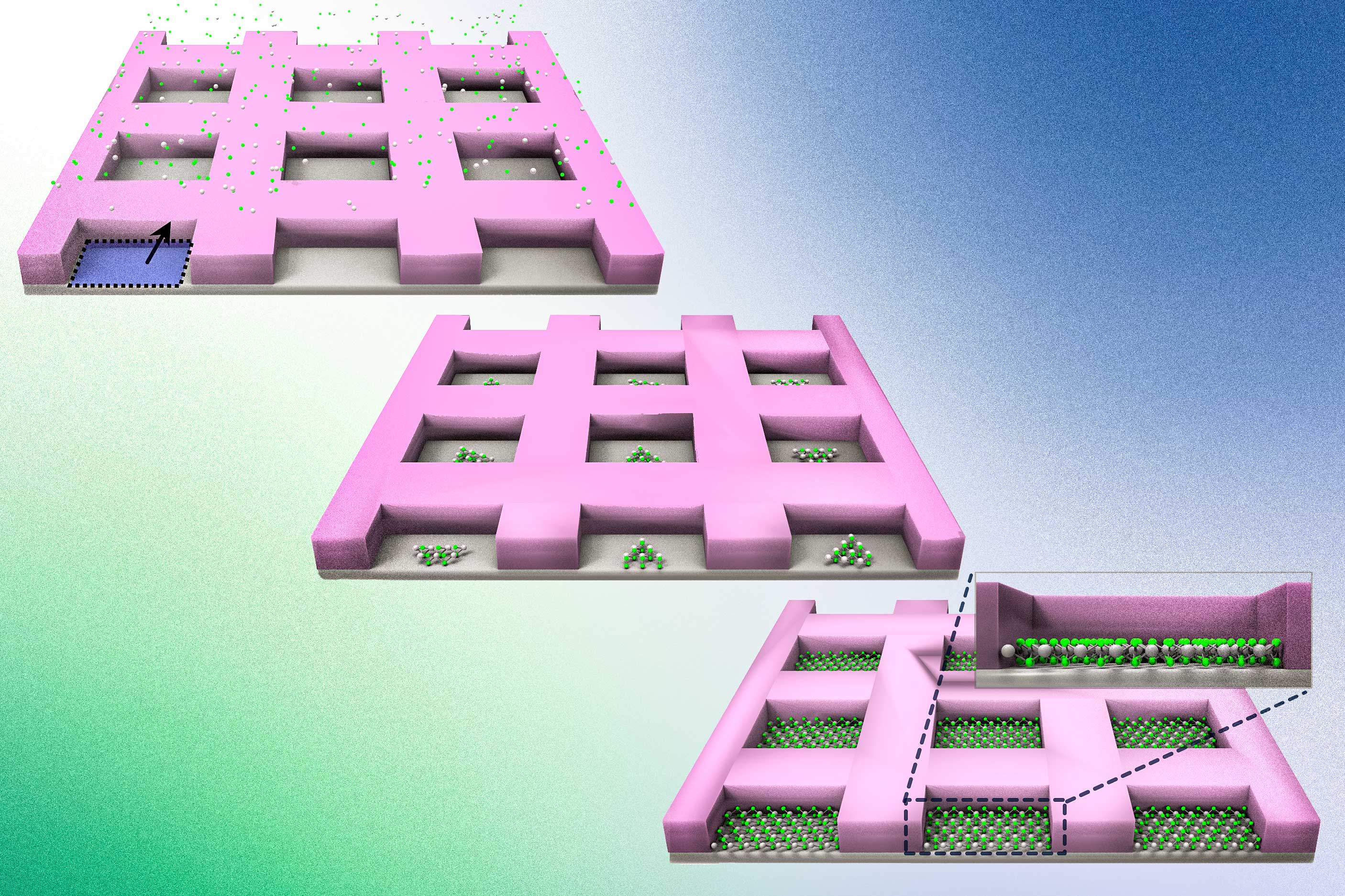
The team’s new “nonepitaxial, solitary-crystalline growth” does not need peeling and looking flakes of 2D materials. In its place, the scientists use conventional vapor deposition strategies to pump atoms across a silicon wafer. The atoms sooner or later settle on the wafer and nucleate, rising into two-dimensional crystal orientations. If left on your own, each individual “nucleus,” or seed of a crystal, would expand in random orientations across the silicon wafer. But Kim and his colleagues uncovered a way to align every expanding crystal to create solitary-crystalline areas throughout the total wafer.

To do so, they initially lined a silicon wafer in a “mask” — a coating of silicon dioxide that they patterned into small pockets, every made to entice a crystal seed. Throughout the masked wafer, they then flowed a gasoline of atoms that settled into each individual pocket to kind a 2D product — in this situation, a TMD. The mask’s pockets corralled the atoms and inspired them to assemble on the silicon wafer in the similar, solitary-crystalline orientation.

“That is a really stunning end result,” Kim says “You have single-crystalline advancement all over the place, even if there is no epitaxial relation amongst the 2D material and silicon wafer.”

With their masking method, the team fabricated a basic TMD transistor and confirmed that its electrical functionality was just as superior as a pure flake of the same material.

They also utilized the strategy to engineer a multilayered product. After masking a silicon wafer with a patterned mask, they grew just one style of 2D substance to fill 50 percent of each individual sq., then grew a next style of 2D materials more than the initial layer to fill the rest of the squares. The result was an ultrathin, single-crystalline bilayer composition in just about every square. Kim states that likely ahead, various 2D supplies could be developed and stacked with each other in this way to make ultrathin, flexible, and multifunctional movies.

“Until now, there has been no way of building 2D elements in single-crystalline type on silicon wafers, therefore the whole group has been having difficulties to know following-generation processors without transferring 2D products,” Kim claims. “Now we have wholly solved this problem, with a way to make devices smaller sized than a few nanometers. This will transform the paradigm of Moore’s Regulation.”

This analysis was supported in section by the U.S. Protection Sophisticated Investigate Tasks Agency, Intel, the IARPA MicroE4AI method, MicroLink Units, Inc., ROHM Co., and Samsung.

Siemens Expands Digitalization Portfolio For Machine Tool Industry

Siemens Expands Digitalization Portfolio For Machine Tool Industry

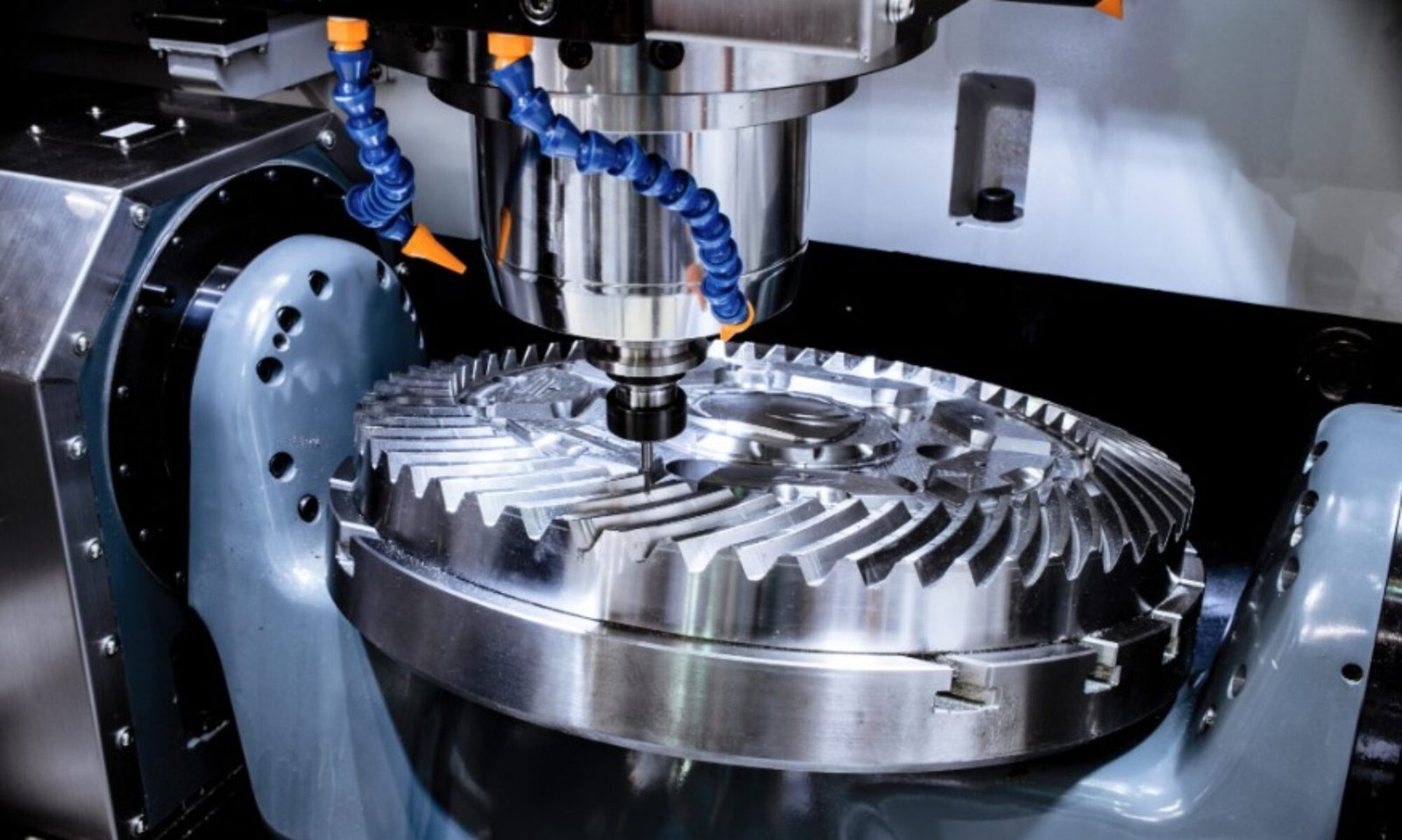
Siemens has declared an expanded portfolio for the machine tool marketplace. This will empower companies and buyers of equipment equipment to style, understand and improve devices and parts faster. In addition, to respond flexibly to market calls for and improve productiveness throughout a variety of person industries. These offerings will be showcased at IMTEX 2023, below the motto “Accelerate digitalization for machine tool manufacturing”.

Achim Peltz, CEO of Movement Regulate, Electronic Industries, Siemens AG, explained, “The device instrument business in India can harness the monumental prospective of creation info for building, noticing and optimizing functions to attain scale and profitability. Our portfolio for the Device Tool Business permits adaptable and sustainable motion.”

SINUMERIK One particular – the digital native CNC

With SINUMERIK One particular, Siemens provides the technological know-how to simply build and function with electronic twins of machine applications. With its built-in SIMATIC S7-1500F PLC, it delivers up to 10 moments more quickly PLC cycle situations. This will help SINUMERIK A person to be entirely built-in into the TIA Portal engineering framework. Additionally, enabling standardization of all engineering jobs for machine builders and customers. Built-in features like digital commissioning and practical procedure simulation opens up new prospects for equipment makers & consumers alike. This appreciably reduces the merchandise progress stage, time-to-market & even generation cycle instances. Nowadays above 70{1668a97e7bfe6d80c144078b89af180f360665b4ea188e6054b2f93f7302966b} of Indian OEMs have already adopted SINUMERIK A person to accelerate their electronic transformation journey.

Industrializing Additive Production

Siemens is the only provider service provider of integrated software program and automation options for industrial use of Additive Manufacturing (AM). This permits the development, producing and use of additive purposes, including large-volume manufacturing. Moreover, it covers the complete conclude-to-finish worth chain, from industrial AM end users as very well as AM equipment builders.

Siemens Xcelerator for digital transformation

Siemens introduced the availability of alternatives tailor-built for the Equipment Instrument Industry in India as section of the Siemens Xcelerator, the open up digital company platform. These answers meet up with the necessities of businesses in locations this kind of as device developing, fabricated metals, aerospace, auto manufacturing, electronics, electricity, strength producing and professional medical gear. Siemens Xcelerator for equipment applications, contains selected portfolio of IoT-enabled components, software, as very well as a market.

The Siemens Xcelerator marketplace has purposes working with Industrial Edge know-how like Defend MyMachine, Analyze MyWorkpiece and some others. It allows unparalleled protection and workpiece high-quality. Various MindSphere programs like Deal with MyMachines and Review MyPerformance/OEE are also out there on the marketplace. It delivers smart useful resource management throughout the shopfloor. The sector put has further solutions that help in optimizing the system workflows.

Some of these programs give broader connectivity even for CNC equipment that are not equipped with SINUMERIK. This suggests that practically nothing stands in the way of a shop flooring-broad connection of machines. With these choices, device builders and people can make certain they can establish a device or element quicker, greater and additional successfully although boosting productiveness.

Siemens is showcasing these choices at IMTEX 2023 from 19th to 25th January 2023 underneath the motto “Accelerate digitalization for machine tool manufacturing”.