Pharmacy benefit managers in the hot seat

Pharmacy benefit managers in the hot seat

With Megan R. Wilson and Ben Leonard

PBMS FACE THE MUSIC — Pharmacy benefit managers are bracing for a hard week on the Hill.

The Senate Finance Committee will hold a hearing Thursday on the impact PBMs — the pharmaceutical middlemen that negotiate drug discounts with drugmakers and design prescription drug benefits for health plans — have on the health system.

The House Energy and Commerce Health Subcommittee is also expected to look into how much value PBMs add as part of a broader discussion about fairness in the health care market, according to a memo shared with Megan.

The hearings could suggest what’s to come for what lawmakers, lobbyists and the administration consider a key issue for the rest of the year.

What PBMs are saying: They argue they’re misunderstood. J.C. Scott, who leads the industry group for PBMs, said earlier this month that his members “have a proven track record of reducing prescription drug costs.”

His group, Pharmaceutical Care Management Association, is running an ad campaign touting the benefits PBMs offer and slamming a bipartisan bill to rein them in, which was recently advanced by the Senate Commerce Committee.

PBMs say they’re already subject to transparency rules and instead support a pack of patent reform bills that would crack down on ways drugmakers prevent cheaper generics and biosimilars from coming to market.

What lawmakers will likely point out: The three largest PBMs — CVS Caremark, Express Scripts and OptumRx — control roughly 80 percent of the prescription drug market. They also each have affiliated pharmacies and own, or are owned by, insurance companies.

The administration angle: During hearings last week featuring HHS Secretary Xavier Becerra, a bipartisan set of lawmakers homed in on PBMs, Ben reports from the Hill.

“There is a growing concern that the middlemen … are skimming off a good deal of the money,” Becerra said. “We’re going to try to move to make sure that if there’s a middleman … that it’s done efficiently.”

It’s not just HHS: The Federal Trade Commission is studying how the industry affects consumer drug prices.

And there’s more: Several Senate HELP Committee members have suggested they want to turn a critical eye toward PBMs, and staffers tell your host to expect more action in the future. Plus, the House Oversight and Accountability Committee has launched an investigation into the industry’s effect on patients.

WELCOME TO MONDAY PULSE, where we’re intrigued by the new interior design trend: mushrooms.

Are you the proud owner of a mushroom-shaped lamp? Or maybe you have a tip about this week’s PBM hearing on the Hill. Either way, drop us a line at [email protected] and [email protected].

TODAY ON OUR PULSE CHECK PODCAST, host Carmen Paun talks with Erin Schumaker, who discusses a U.S. Department of Defense–funded $3 million collaboration between UMass Lowell and Soar Technology to find the best human decision-making attributes artificial intelligence can imitate and the value of training AI to handle situations in which there are no clear right or wrong answers.

TAKING ON OPIOIDS ONLINE — Lawmakers and the administration want to involve big tech companies in the fight against opioid abuse.

Sens. Roger Marshall (R-Kan.), Jeanne Shaheen (D-N.H.) and Chuck Grassley (R-Iowa) hosted Rahul Gupta, director of the White House’s Office of National Drug Control Policy, for a discussion about combating the opioid epidemic.

They want social media companies to be more proactive in stopping drug dealers from using their platforms, according to a statement about the Friday meeting.

They also discussed potential legislative and executive action, including the Cooper Davis Act, a bill introduced last Congress that would require internet service providers to report knowledge of drug-related offenses to the Drug Enforcement Administration.

ANOTHER WAY TO COUNT — The House Energy and Commerce Committee advanced legislation that would bar federal agencies from using “quality-adjusted life years” when determining the cost-effectiveness of treatments, Ben reports.

Republican leaders hoped for a bipartisan vote to ban the widely used metric, saying it undervalues the benefits that therapies provide to people who have disabilities or are elderly.

The Friday party-line vote, 27-20, suggests Republicans will have trouble getting the bill enacted as it currently stands, even if the House passes it.

Energy and Commerce ranking member Frank Pallone (D-N.J.) has expressed concerns that the bill, if enacted, would interfere with Medicare’s future drug-price negotiations by prohibiting other cost-effectiveness measures.

WHAT THEY KNEW — Months before the latest infant formula recall, the FDA knew about positive tests for bacteria in some products, POLITICO’s Helena Bottemiller Evich reports.

In late February, formula giant Reckitt recalled 145,000 cans of a plant-based formula because of the “possibility of cross-contamination with Cronobacter sakazakii” — the deadly pathogen that sparked the infant formula crisis last year.

But months before — in November — FDA inspectors had become aware of the positive tests that ultimately sparked the recall.

The revelation that it took months to announce the recall comes more than a year after a massive infant formula recall from Abbott Nutrition, renewing questions about the FDA’s oversight of formula and whether enough has changed since then to prevent another recall.

TB’S RETURN — Europe saw the first rise in tuberculosis deaths in nearly two decades, POLITICO’s Sarah-Taïssir Bencharif reports.

The increase in the disease’s toll in 2021, reported by the World Health Organization last week, is largely attributed to the pandemic disrupting diagnostics and treatments.

In the WHO European Region, 27,300 people died from TB in 2021 compared with 27,000 deaths in 2020, according to the report.

But WHO officials caution the pandemic also changed the way TB data was collected, which also could affect the year-over-year numbers.

FLORIDA’S WAITING GAME — Florida regulators are going after abortion providers — but not only for violating its 15-week ban, POLITICO’s Arek Sarkissian reports.

Over the last year, the state has punished more than a dozen providers for violating a nearly decade-old law that requires pregnant patients to wait 24 hours before getting an abortion.

The 2015 law was in limbo in the courts until a judge upheld it last April. Florida’s abortion regulator, the Agency for Health Care Administration, almost immediately began issuing fines even as abortion rights advocates argued providers weren’t given enough time to prepare.

Caroline Dvorsky has been promoted to deputy White House liaison at the Department of Health and Human Services, POLITICO’s Daniel Lippman reports. She most recently was senior adviser.

Aaron Bernstein will become the new director of the National Center for Environmental Health and the Agency for Toxic Substances and Disease Registry at the CDC. He previously led the Center for Climate, Health, and the Global Environment at Harvard T.H. Chan School of Public Health.

Ellen Locke is now the political action committee manager for UnitedHealth Group. She most recently was director for U.S. government relations at MetLife and is a Nationwide alum.

ProPublica reports on Cigna’s savings from having its doctors reject claims without reading them.

The New York Times reports on patients who say their Adderall is no longer working.

What are Pharmacy Benefit Managers?

What are Pharmacy Benefit Managers?

Pharmaceutical giant AbbVie was able to delay competition to its blockbuster arthritis drug, Humira, into the US market for many years. But Americans can finally choose from one of several arthritis biosimilars, as generics for complex molecule drugs are known.

Although biosimilars will sell at a list price lower than Humira, there is no guarantee that patients will actually be offered as much access to cheaper biosimilars as they are to the name-brand product.

The first biosimilar to enter the market is Amgen’s Amjevita, which was launched in the US on Jan. 31, 2023. The drug will be available in the US at two different list prices, $3,288 and $1,557 for a two-week supply, respectively 5{1668a97e7bfe6d80c144078b89af180f360665b4ea188e6054b2f93f7302966b} and 55{1668a97e7bfe6d80c144078b89af180f360665b4ea188e6054b2f93f7302966b} less than the Humira list price.

It’s not different quantities, not different means of administration, not even different packaging. It’s the same product, sold at two prices, one more than double the other. Understanding why that is sheds some light into the workings of a secretive actor that profits from the complexity of American drug pricing: Pharmaceutical Benefit Managers (PBMs).

What are PBMs?

It’s not easy to explain how PBMs work, because their role is not designed to be understood. They are a unique feature of the healthcare industry in the US. They are arguably as responsible as the pharmaceutical industry for the sky-high prices that Americans pay for drugs compared to the rest of the world. They are also uniquely obscure. A 2017 survey by the National Pharmaceutical Council found that just under a third of companies employing the services of a PBM actually understood how they work. Because of this, they get away with their role in price hiking without big pharma’s infamous reputation.

Although the name may suggest otherwise, PBMs are not one person, or even a department within a company. They are whole companies—huge ones, in fact. The biggest, CVS Caremark (34{1668a97e7bfe6d80c144078b89af180f360665b4ea188e6054b2f93f7302966b} market share), reported nearly $170 billion in revenue for 2022, or about 60{1668a97e7bfe6d80c144078b89af180f360665b4ea188e6054b2f93f7302966b} of the overall revenue of CVS, which includes health plans, pharmacies, and other services. Express Scripts (24{1668a97e7bfe6d80c144078b89af180f360665b4ea188e6054b2f93f7302966b} PBM market share) and OptumRx (which is part of United Health Group, and accounts for 21{1668a97e7bfe6d80c144078b89af180f360665b4ea188e6054b2f93f7302966b} of the market) both have revenue of around $100 billion a year. Karen Lynch, CVS CEO, made more than $20 million in 2021; Andrew Witty, UnitedHealth Group CEO, got $16.8 million in compensation in 2021 (Heather Cianfrocco is OptumRx’s CEO, but her salary information aren’t public); Express Scripts’ CEO George Paz was paid $13.8 million in 2021.

By way of comparison, in 2020, before covid vaccines added billions to big pharma’s bottom lines, the pharmaceutical company with the most revenue—Johnson & Johnson—grossed $82 billion.

What do PBMs do?

The need for PBMs stems from the structure of America’s health system. Submitting and processing insurance claims, negotiating drug prices, establishing reimbursement rates with pharmacies: These are all administrative layers that add onto the cost, and the bureaucracy, of privatized healthcare. In most other countries, government bodies negotiate the price of drugs and their reimbursement rates, so there is limited need for this type of intermediary.

On paper PBMs make perfect sense. Insurance companies use them to outsource the burden of negotiating with drug companies, and processing drug claims, trusting that their expertise will get the best deal and in so doing, pass down the savings to both the companies and subscribers. Except, these savings don’t really trickle down—at least not all, and not always.

Where the trouble with PBMs starts

PBMs list the drugs they have negotiated in what is known as a formulary, or a tiered list of medications. The least expensive drugs are on lower tiers, typically generics. These have low or no copays. As tiers go up, so do copays. However, that isn’t necessarily proportional to the actual price of a drug. For instance, a medication might be on the top tier simply because there is a generic available for it, and a much more expensive drug without a generic (or biosimilar) substitute could be on the second tier. Typically, a formulary will be structured in three or four tiers, with the top one reserved for drugs that patients have to pay for out-of-pocket.

PBMs are paid by health insurance companies through administrative fees, but often a portion of those fees is proportional to the savings they bring to an insurance plan through negotiation. The higher the discounts, the more valuable PBMs are, and the more they are paid. It seems logical enough, yet this is where the first issue lies: Though a PBM’s goal should be to lower the cost to their client, this isn’t necessarily the best way to get a high discount from a drug company.

In fact, the higher a drug’s price is before the negotiation, the more the negotiation will appear effective—even if the price was already determined by keeping into account a future discount. “It’s a little like raising the price of a jacket before you put the jacket on sale,” says Robin Feldman, a professor of law at University of California Hastings and the author of Drugs, Money, & Secret Handshakes, a book on the role of PBMs in drug pricing. “Looks like a great deal, but it’s not.”

Secrecy protects the middleman

What adds complexity, and warped incentives, is the way the discounts given to PBMs work. For the most part the discounts happen in the form of rebates. “The [insurance] company never knows the actual price paid for that particular medicine purchase. The rebates come in well after that the patient has purchased the drug,” says Feldman. Rebates are given after patients of the insurance plan buy large volumes of a certain medicine, and PBMs are allowed to pocket a portion of those rebates. They are then supposed to pass on the rest of the savings to the insurance companies and their subscribers, but there is no way to know for sure what the share is.

PBMs and pharmaceutical companies claim that their agreements are trade secrets, although price and price terms should not be, as Feldman and her colleague Charles Tait Graves argue in the Yale Journal of Law and Technology. “The deals for calculating the rebates are deeply hidden secrets. The health plan, their auditors, and even the government don’t get full access to the contracts,” says Feldman. Only pharmaceutical companies and PBMs know the full details pricing agreements, and even the insurance companies that pay the PBMs only have marginal access to them.

“Imagine saying to the defense industry, ‘Want to order a tank? Great. But we won’t tell you the price—not now, or ever. Just trust your broker that you are getting a really good deal,’” says Feldman. Yet, that is exactly what happens.

Perverse incentives

PBMs, particularly very large ones, also have a gatekeeping function. If medications are not included in formularies, or are too high up in the tiers, drugmakers might not see sales. So drug companies offer higher and higher rebates, and since the PBMs profit from rebates that are given after purchase, it is in their interest to put the drugs for which they get higher rebates in lower tiers. An efficient market would put generics, biosimilars, and less expensive drugs in the lowest tiers, but that isn’t always the case in the US.

As rebate incentives grow, so does the misplacement of drugs in formularies. Generic makers typically give no rebates—they just make much cheaper drugs—while big pharma companies give very high discounts for name-brand drugs, based on volume. An analysis of Medicare prescription prices estimated that an average 26{1668a97e7bfe6d80c144078b89af180f360665b4ea188e6054b2f93f7302966b} rebate was offered across its formulary, which includes many generic drugs that don’t offer any. So the average rebate for brand-name drugs is surely more than 26{1668a97e7bfe6d80c144078b89af180f360665b4ea188e6054b2f93f7302966b} for Medicare, and potentially even higher for private insurers.

According to an analysis published in 2021 in the Journal of Law and Bioscience, in 2010, 73{1668a97e7bfe6d80c144078b89af180f360665b4ea188e6054b2f93f7302966b} of generic drugs were on the least expensive tiers across formularies; in 2017, only 28{1668a97e7bfe6d80c144078b89af180f360665b4ea188e6054b2f93f7302966b} were. Similarly, in 2010 47{1668a97e7bfe6d80c144078b89af180f360665b4ea188e6054b2f93f7302966b} of drugs were placed in inappropriate tiers, while in 2017 74{1668a97e7bfe6d80c144078b89af180f360665b4ea188e6054b2f93f7302966b} were. These misplacements, added up to $13.25 billion in surplus expenditures on drugs between 2010 and 2017.

Further, just as insurance plans don’t know the full amount of the rebates negotiated with the manufacturers, they don’t know the reimbursement rates given to pharmacies. So the plan pays a certain price, and if the negotiated rate with the pharmacy is lower, the PBM can pocket the difference.

What does this have to do with Humira and biosimilars?

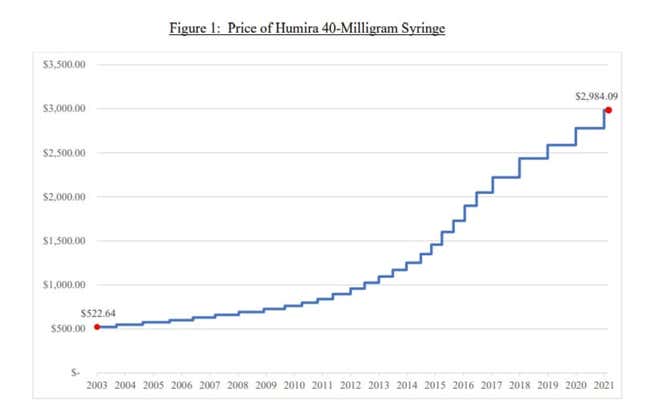
Humira’s price has gone up year after year since it was introduced in 2003, far outpacing inflation. In 2003, according to the US House Oversight Committee, a 40 mg syringe retailed for about $523. In 2021, it was nearly $3,000—if following inflation that price would be $767. The recommended dose for treating arthritis is usually 40 mg every other week.

Chart showing Humira's price climbing through the years

Graphic: US House Oversight Committee

One reason is rebates. Formularies are updated yearly, rebates renegotiated, and list prices continue to rise to make up for even higher discounts. But as Humira had managed to keep competition out, its rebates and discounts were likely just a way for AbbVie to maintain a good relationship with PBMs.

Now, however, things are different, and biosimilars are entering the market. But they could fail in the US if PBMs don’t include them in low enough tiers in their formularies. It could very well happen—for instance, the agreements PBMs make with AbbVie could include some conditions for keeping the biosimilar competition at bay in the formularies.

If so, PBMs would be better off by agreeing to the big brand’s demand than trying to broker a deal with the smaller competitor. “The problem is how volume works. The brand already has much of the market. The [biosimilar] is trying to get into the market but has to start with a much lower volume,” says Feldman.

Enter Amjevita’s double price strategy: A high price that could carry a high rebate, and a lower price with low or no rebate. “With respect to the two list-price approach that we’ve employed here at this launch, this is really to address the complexity of the US market,” said Murdo Gordon, who leads Amgen’s commercial operations, in a call with Amgen’s investors. “Pharmacy benefit managers have a business model that requires that they negotiate rebates with manufacturers, and so they would prefer a high list price,” he explained.

So Amgen’s pricing still plays into the PBM rebate game, while also illustrating just how much PBM rebates contribute to high drug prices. In this case, intermediaries between the manufacturer and insurance providers cost $1,731 per every Amjevita 40 mg pen. “Amjevita is available at both list prices for patients without insurance for purchase,” Michael Strapazon, a spokesperson for Amjen, told Quartz, adding that the company offers financial support to uninsured patients. 

What about patients?

Many insured patients are unlikely to see the difference in the short term—copays for Humira and Amjevita will remain similar. Those purchasing the drugs without insurance, or paying coinsurance, will though. And eventually, the cost of inflated prices will trickle down to policy holders, too.

Things might be changing, however. Scrutiny over PBM activity is increasing at a bipartisan level, and policy proposals to provide more accountability to their work have been introduced in many states. As of April 2022, for instance, New York State has forced PBMs to disclose the full details of their deals with pharmaceutical companies, and several bills with similar scopes have been introduced in Congress since 2019. On Mar. 1, the House Oversight and Accountability Committee chairman, Kentucky’s Republican congressman James Comer, launched an investigation into the role of PBMs in the rise of drug prices.

Pharmacy Benefit Managers Put in Crosshairs of Drug Price Fight

Pharmacy Benefit Managers Put in Crosshairs of Drug Price Fight

A Residence investigation into the entities that take care of prescription drug added benefits ought to be accompanied by other actions that can assist shed light on how US drug price ranges are fashioned, analysts say.

The House Committee on Oversight and Accountability on Wednesday introduced an investigation into pharmacy benefit administrators like CVS Caremark and Cigna’s Express Scripts and their affect on sufferers.

The probe was welcome news for the pharmaceutical sector and impartial pharmacies, who argue that PBM fees and consolidation with major health and fitness strategies and pharmacy chains has driven up drug expenditures and restricted consumer decisions. PBMs say they help deliver bargains to patients, and that drug manufacturer listing costs are the root of substantial drug prices.

Analysts say the investigation is just the hottest indication of growing momentum in Washington to scrutinize the purpose of PBMs in shaping high prescription drug prices. This, as well as the ongoing probe into PBMs by the Federal Trade Fee, could direct to guidelines to strengthen oversight and assistance decreased drug expenditures for individuals, policy observers say.

But analysts also warning that this interest to PBMs doesn’t negate the want to appear into drug company price tag environment and other methods that analysts say lead to the convoluted system that determines what Us residents fork out at the pharmacy counter.

“Many members of Congress are disappointed by the deficiency of transparency in the drug provide chain and PBMs are a very easy concentrate on,” reported Stacie Dusetzina, an associate professor in the Office of Health and fitness Plan at Vanderbilt College Clinical Center.

“It is significant to comprehend that drug makers set the record costs PBMs the conditions for protection. PBMs, ideas, and drug companies share the blame for the raise in checklist price ranges,” Dusetzina added.

Committee Chairman James Comer (R-Ky.) asked for information from the Office environment of Staff Management, the Centers for Medicare & Medicaid Companies, and the Protection Well being Company to figure out the impression of PBMs on authorities-administered wellbeing-care courses. He also despatched letters to the country’s 3 largest PBMs—CVS Caremark, Convey Scripts, and OptumRx—for files and communications linked to their business enterprise practices.

Transparency Drive

Congress and the FTC have examined PBMs in the previous, but the development of the sector and consolidation with wellness strategies and pharmacies has fueled a greater thrust to comprehend the entities that a lot of analysts say rely on secrecy to form drug coverage. Right now, the a few major PBMs regulate practically 80{1668a97e7bfe6d80c144078b89af180f360665b4ea188e6054b2f93f7302966b} of the industry.

The passage of President Joe Biden’s landmark Inflation Reduction Act (Community Law 117-169) has also prompted lawmakers to search at other areas to support decrease drug costs. With the IRA, Medicare now has the authority to negotiate the rates of some of the medicine it spends the most on, and also to demand from customers rebates from drugmakers who raise price ranges on their products and solutions more rapidly than the price of inflation.

“As pressure builds to handle pharmaceutical costs, PBMs significantly are in the cross-hairs,” stated Robin Feldman, a law professor and researcher at the College of California, San Francisco.

Quite a few best lawmakers have recognized PBM oversight as a top rated precedence this Congress. The Senate Judiciary Committee in February advanced a team of bills aimed at reducing drug prices, which include the Prescription Pricing for the Men and women Act (S. 113). This invoice would direct the FTC to analyze the consequences of consolidation in the PBM field on pricing, and also to supply suggestions to Congress on other techniques to increase level of competition and protect shoppers.

A 7 days afterwards, the Senate Commerce Committee held a hearing on a monthly bill (S.127) from Chairwoman Maria Cantwell (D-Clean.) and Sen. Chuck Grassley (R-Iowa) that would prohibit PBMs from charging overall health options far more for a drug than they reimburse pharmacies. The Pharmacy Reward Supervisor Transparency Act would also require PBMs to report yearly to the FTC certain details about payments they obtain from health and fitness options and fees billed to pharmacies.

The Dwelling probe is particularly concentrated on the rebates drug brands pay back to PBMs in exchange for superior placement on lists of covered medication acknowledged as formularies, as very well as service fees PBMs demand to unaffiliated pharmacies.

“PBMs are supposed to assistance buyers by lowering charges through the passing on of rebates they obtain from companies. But these rebates really do not appear to be to be making their way to consumers,” said Michael Carrier, an antitrust professor at Rutgers Legislation Faculty.

Brian Newell, a spokesperson for the main drug industry trade group, the Pharmaceutical Investigate and Suppliers of The us, explained of PBMs: “These entities perform hand in glove with insurers to determine what medicines persons have obtain to and what they finally spend at the pharmacy. Their business enterprise design is rife with conflicts of curiosity that impartial authorities and other congressional investigations have identified can direct to bigger charges for sufferers. People today are looking to Congress to rein in these abusive tactics, and we hope this is a single move in that direction.”

But JC Scott, president and CEO of the primary PBM trade team the Pharmaceutical Care Management Association, explained PBMs “have a established monitor report of decreasing prescription drug costs in federal programs, in the end for people and taxpayers.”

“While we appreciate—and share—the Committee’s concern around drug pricing and existing gaps in affordability, we strongly urge users of the committee and Congress to remain focused on actual solutions that are established to lessen prescription drug expenditures,” Scott additional.

Rate ‘Dysfunction’

The price of the Dwelling probe’s findings will count on how lawmakers use it to have an understanding of how PBMs work in a drug pricing method that analysts say feeds off misaligned incentives.

The probe “is a thing that’s an acknowledgment that drug pricing dysfunction much more broadly is not just the final result of just one singular layer of the source chain, but many layers of source chain functioning in live performance with 1 a different to yield the dysfunction,” mentioned Antonio Ciaccia, CEO of Ohio-based drug pricing information company 46brooklyn Exploration.

“I’m hoping that we can get more of that nuance right—not just blame it all on PBMs but demonstrate how what PBMs do to the industry exacerbates the challenges that we experienced with the other levels in the supply chain,” Ciaccia claimed.

The emphasis on drug pricing policy is sure to outcome in even a lot more demands for responses on how drug charges are formed, Dusetzina claimed.

“There is going to be additional force on PBMs, programs, and manufacturers about what style of pricing information is designed public heading forward,” she reported.