(Bloomberg) — Wells Fargo & Co. reported higher-than-expected web fascination profits in the 1st quarter as the organization ongoing to enjoy the gains of the Federal Reserve’s charge hikes.
Most Browse from Bloomberg
The business had $13.3 billion in NII in the initially a few months of yr, up 45{1668a97e7bfe6d80c144078b89af180f360665b4ea188e6054b2f93f7302966b} from a calendar year before and additional than the 42{1668a97e7bfe6d80c144078b89af180f360665b4ea188e6054b2f93f7302966b} jump analysts anticipated, Wells Fargo reported in a assertion. That helped counter a surge in provisions for souring loans, leaving earnings to major analysts’ estimates.
Wells Fargo and friends JPMorgan Chase & Co. and Citigroup Inc. are kicking off significant financial institution earnings Friday, providing a first appear at how loan providers fared as a result of a tumultuous quarter in which three lesser financial institutions collapsed. PNC Fiscal Providers Team Inc. also claimed Friday, the very first final results for regional firms.
All four of those corporations ended up aspect of a group of 11 financial institutions that aided shore up ailing Very first Republic Lender with a blended $30 billion deposit infusion as it confronted worry in the wake of Silicon Valley Bank’s failure. Wells Fargo contributed $5 billion to the energy, which requires just about every firm parking revenue at Initial Republic for at the very least 120 times.
“We are happy to have been in a solid placement to assistance assistance the US economic process during the recent situations that impacted the banking field,” Chief Govt Officer Charlie Scharf reported in the assertion. “Regional and group banking companies are an significant portion of our economic program and are uniquely positioned to serve their prospects and communities.”
The San Francisco-centered firm remaining entire-12 months advice for both net fascination money and non-desire costs unchanged.
Wells Fargo shares rose 1.1{1668a97e7bfe6d80c144078b89af180f360665b4ea188e6054b2f93f7302966b} to $40.10 at 9:55 a.m. in New York. They’ve dropped 2.9{1668a97e7bfe6d80c144078b89af180f360665b4ea188e6054b2f93f7302966b} this calendar year.
The company included $643 million to its pile of income set aside for most likely soured loans, signaling a worsened financial outlook. Net demand-offs jumped 17{1668a97e7bfe6d80c144078b89af180f360665b4ea188e6054b2f93f7302966b} as opposed to a year in the past, bringing overall provisions to $1.2 billion, topping the $919 million average of analyst estimates compiled by Bloomberg.
The improve in reserves was largely tied to the firm’s business office financial loans inside of its professional true estate portfolio, Wells Fargo said. It also additional reserves for credit-card and automobile loans in the quarter.
In modern months, traders have develop into more and more fearful about business genuine estate credit history high quality, with large swaths of offices sitting down vacant in significant metropolitan parts throughout the state in the aftermath of the pandemic. Wells Fargo stated that around 12{1668a97e7bfe6d80c144078b89af180f360665b4ea188e6054b2f93f7302966b} of its workplace bank loan portfolio is operator-occupied, and approximately a person-3rd have recourse to a guarantor.
The firm documented an 8{1668a97e7bfe6d80c144078b89af180f360665b4ea188e6054b2f93f7302966b} drop in firmwide deposits, noting the the decline was fueled by clients migrating to increased-yielding alternatives and an improve in purchaser shelling out. Normal deposit expenditures soared to 83 basis details in contrast with just 3 basis points a 12 months in the past.
Costs, a important concentrate of Scharf’s turnaround exertion, totaled $13.7 billion, somewhat greater than analysts expected. That served deliver Wells Fargo’s performance ratio, a evaluate of profitability, to 66{1668a97e7bfe6d80c144078b89af180f360665b4ea188e6054b2f93f7302966b}.
Wells Fargo remains under a Federal Reserve-imposed asset cap limiting the size to an conclude-of-2017 amount. Assets at the stop of the very first quarter totaled $1.86 trillion, lessen than a year previously.
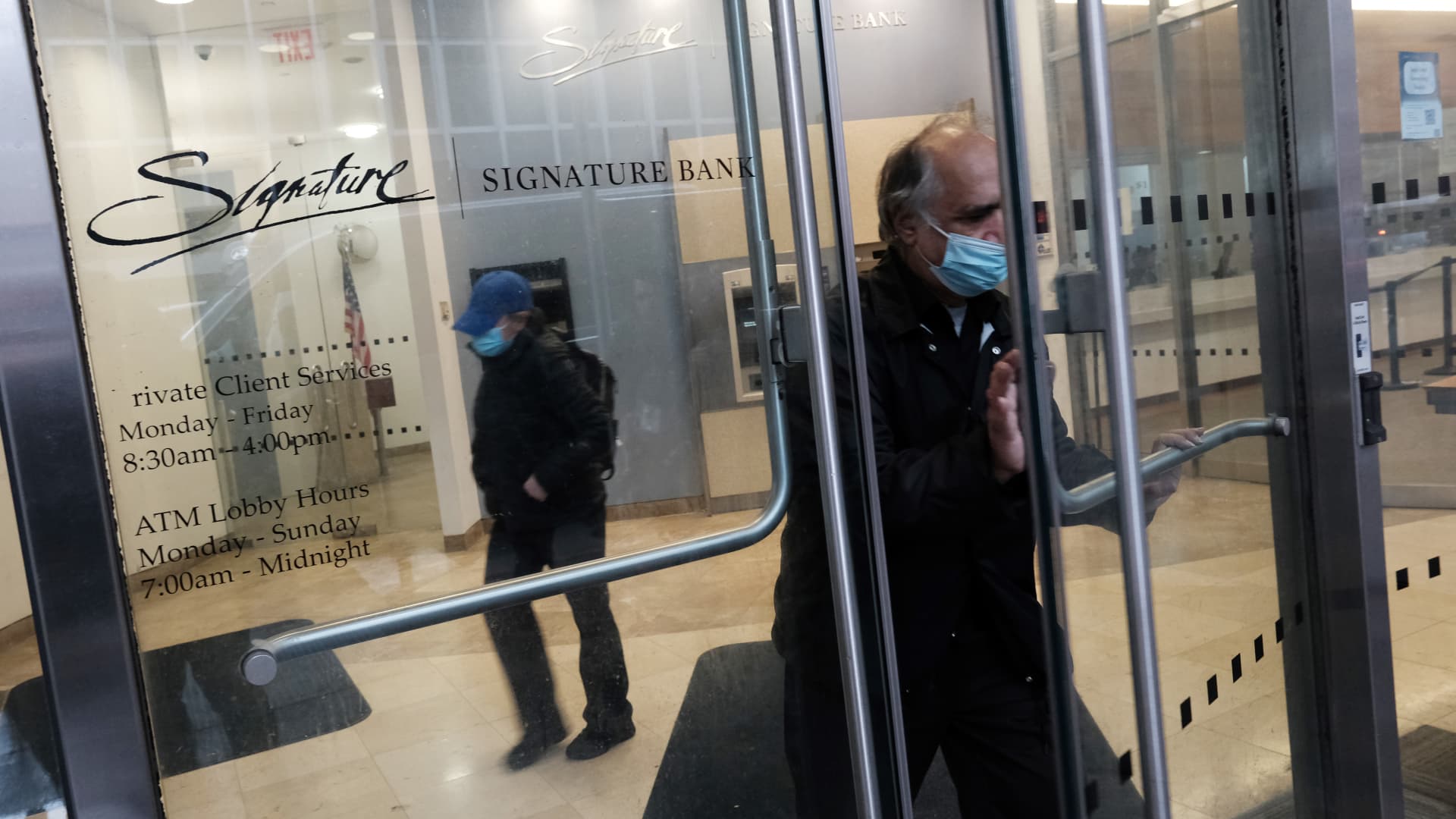
The Federal Reserve’s initiatives to shore up the banking field have served provide desired capital — and indicated just how deeply the issues run for the troubled sector. In the days following the implosion of Silicon Valley Lender and Signature Financial institution, monetary institutions went to the Fed for virtually $300 billion in liquidity by brief-expression financial loans, in accordance to Fed info unveiled late Thursday. A very good chunk of that revenue appeared to go to SVB and Signature, but extra than fifty percent went to other banks in need of cash to preserve operations likely. The excellent information: Banks were inclined to go to the Fed for assist, and the central bank was ready and capable to comply. The terrible news: They wanted that a lot assistance. “Appropriate now, we are in the sea of the unknown,” explained Danielle DiMartino Booth, CEO and chief strategist of Quill Intelligence and a previous senior official at the Dallas Fed. The uncertainty stems from just how a lot assistance the economical sector requirements, and how deep the problems penetrate. Subsequent the blowups of the two banks, the Fed on March 12 introduced twin initiatives that set up a distinctive lending facility — the Financial institution Term Funding Method — and loosened conditions at its discounted window to make it far more offered for borrowing. In standard times, a excursion to the price cut window carries a stigma, an sign that clients are in some sort of monetary problems and are unable to go by way of usual current market routes to raise capital. Systems these as the BTFP can have that stigma, too, but in this circumstance the Fed designed its conditions a little bit easier than the lower price window. No matter, financial institutions borrowed from the low cost window to the tune of $152 billion, even though the uptake at the new method was just fewer than $12 billion, even although it permitted a single-calendar year loans when compared to the price reduction window’s 90 times. The BTFP also pays par value on securities available in exchange for dollars, while the discounted window uses market place price. “The price reduction window can take anything. You carry us your rubbish, we are going to give you a haircut, and we will deliver you a lifeline. But it is really heading to cost you,” mentioned Booth, who was an advisor to former Dallas Fed President Richard Fisher. “We have witnessed the greatest uptake of the price cut window in history. That will take out the economic disaster 2008 highs, which is a sign of intense liquidity strains in the banking system which will manifest as hugely impaired credit score generation,” she included. There also was some speculation that the light uptake on the BTFP was its newness. Data unveiled this Thursday could provide a clearer photo of how a great deal demand from customers there is for liquidity, and how fragile the system remains. The initial demand for the two funding avenues drew detect across Wall Road. “The sharp increase in banks’ emergency borrowing from the Fed’s discounted window speaks to the funding and liquidity strains on banking institutions, pushed by weakening depositor self confidence next just one financial institution winddown and two lender failures,” Moody’s Buyers Support, which has downgraded its outlook on the overall banking sector in the course of the stress, explained in a report last week. Extra support offered The Fed adopted up the March 12 system with a renewed initiative Sunday that stepped up the frequency of its worldwide greenback swaps program from weekly to each day. When there never appear to be signs of greenback shortages, the central bank joined with many world wide counterparts to head off any difficulties off before they transpire. The announcement mirrored those designed through other durations of uncertainty in the fiscal procedure these types of as the fiscal disaster of 2008 and the early times of the Covid pandemic in 2020. The swaps transfer appeared to be “precautionary” amid to some degree bigger desire for bucks, specifically at the European Central Lender, but not but a indicator of broader stresses, said Padhraic Garvey, regional head of exploration, Americas for ING. “There are a lot of security nets out there at this stage,” Garvey said. “The burning issue is how weak are the weakest links, and how are they dealt with if they break.” Coverage decision on tap Indeed, the Fed has multiple issues to grapple with as its two-day policy conference begins Tuesday. The article-conference statement will present some clues as to the place officials see the economy and financial technique heading, though Chairman Jerome Powell will be called to describe the central bank’s coverage reaction later on. In the very first week of the new lending services, the Fed stability sheet jumped to virtually $8.7 trillion, an increase of some $297 billion. That arrived soon after a nine-thirty day period rundown of $573 billion for the duration of a course of action recognized as quantitative tightening. It also served as a reminder that at the time the Fed pumps up its holdings of securities, it can be often problematic in making an attempt to lower them devoid of influencing the market’s functions. “That’s what the Fed has uncovered in the past 30 days, which is that quantitative easing was fantastic when they had been shopping for bonds,” mentioned previous Fed official Christopher Whalen, the founder of Whalen World Advisory. “But when you attempt and halt it, not only is it challenging to just take the liquidity out, but for the reason that of the scale of the purchases they designed in 2021, their hands are now tied.” Recent Fed officials will have to weigh the many crosscurrents when coming up with a amount final decision this 7 days. Some current market veterans, like Evercore founder Roger Altman, assume not increasing charges could heighten problem about instability. Altman explained to CNBC on Monday that he thinks a pause could “undermine” confidence. Which is not a universally shared sentiment, nevertheless the industry mostly expects a quarter percentage issue desire amount hike this week. “The technique is clearly beneath a great deal of worry, and to consider to convince all people that it is really not by boosting premiums will just do the opposite,” explained Mark Zandi, main economist at Moody’s Analytics. “It just tends to make you seem to be detached from the fact of what is actually heading on.”
Editor’s note: Morning Money is a free version of POLITICO Pro Financial Services morning newsletter, which is delivered to our subscribers each morning at 5:15 a.m. The POLITICO Pro platform combines the news you need with tools you can use to take action on the day’s biggest stories. Act on the news with POLITICO Pro.Washington’s financial policy bubble is preoccupied with crypto. But a far more consequential regulatory battle is brewing just below the headlines.
The looming fight is over bank capital — the tool regulators use to ensure lenders have enough of a funding buffer to sustain operations during bad times. It can be more complex than blockchain, and getting it right has huge ramifications for the economy. It requires officials to strike a balance between averting the next financial crisis — which could be triggered by a proverbial unknown unknown — while not limiting banks so much that it holds back growth.
“Every decision a bank makes first factors capital costs or benefits,” Federal Financial Analytics managing partner Karen Petrouwrote earlier this month.
That’s why the biggest banks in the U.S. have started to mobilize their lobbyists and trade groups to try to head off what could be a significant increase in capital requirements.
Wall Street giants are on alert because of Fed Vice Chair for Supervision Michael Barr, President Joe Biden’s pick to serve as the central bank’s pointman on regulation.
Before Barr was confirmed, the Fed and other banking agencies were already working to finalize unfinished post-2008 capital rules from the Basel Committee. Then Barr upped the ante when he announced a “holistic” review of all the capital regulations imposed on banks since the global financial crisis.
Barr says capital levels are “strong.” But he triggered the banks when he indicated that U.S. requirements may nonetheless be too low.
Industry representatives argue that Barr’s rationale for potentially hiking bank capital is flawed and that the review process has been opaque. Some say privately that his push is politically motivated.
The Financial Services Forum, the Bank Policy Institute and the Securities Industry and Financial Markets Association have started to pump out blog posts making the case that higher requirements would be a drag on the economy and force banks to retrench in the capital markets — ceding more ground to less-regulated financial institutions derided as “shadow banks.”
“Nothing really suggests that we need to impose additional capital requirements on the system and on the largest banks in particular,” Financial Services Forum CEO Kevin Fromer, who represents the chief executives of eight U.S. megabanks, told MM.
House Republicans are joining the fight, even as they beat up on the big banks for “woke” social agendas. Rep. Andy Barr, who chairs the subcommittee overseeing bank regulators, told MM that he will conduct “vigorous oversight” of the Fed’s capital review.
“I am particularly focused on preventing regulators from imposing excessive requirements that would sideline capital as we continue to battle forty-year high inflation,” Barr said.
On Capitol Hill,BPI says it has already done “a lot of meetings.” The group is hosting a capital symposium in Washington next month featuring JPMorgan Chase CFO Jeremy Barnum and former Fed Vice Chair Donald Kohn.
But bank reps struggle to speculate on where regulators may land, and so they’re preparing for the worst. Regulators who might be inclined to raise capital levels would no doubt have political cover from some top Democrats like Senate Banking Chair Sherrod Brown and even from smaller banks. European regulators have also rejected banking industry claims that easing capital requirements would boost lending.
“Instead of building up capital to withstand losses or investing in the real economy and workers, they’re spending billions in profits on stock buybacks and dividends,” Brown told MM. “Taxpayers shouldn’t be left holding the bag for Wall Street CEOs who put profits over working families.”
Have a great week — What are we missing? Let us know. We’re [email protected] and [email protected].
The House is out. The Senate is in … Monday … Fed Governor Michelle Bowman speaks at an ABA conference in Florida at 8 a.m. … Treasury assistant secretary Joshua Frost is among the speakers at the CFTC’s Global Markets Advisory Committee meeting that starts at 9:30 a.m. … Tuesday … The Consumer Price Index for January is out at 8:30 a.m. … Senate Banking holds a hearing on the need for crypto safeguards at 10 a.m. … Wednesday … Former Bank of England Governor Mark Carney is among the witnesses at a Senate Budget hearing on climate-related economic risks at 10 a.m. … Senate Finance considers Daniel Werfel’s IRS commissioner nomination at 10:30 a.m. … The Congressional Budget Office will release its budget and economic outlook at 2 p.m. … Thursday … Senate Finance holds a hearing on modernizing trade laws at 10:30 a.m. … Friday … CBO Director Phillip Swagel speaks at the Bipartisan Policy Center’s event on the fiscal health of the U.S. at 10 a.m. …
SEC plans stablecoin case— The SEC has told crypto firm Paxos that it plans to sue the company for violations related to the Binance USD stablecoin that it issues and lists, according to WSJ. Such a case would mark another escalation in the agency’s digital asset crackdown, and it comes as lawmakers have already started drafting legislation to regulate stablecoins.
Binance CEO Changpeng Zhao said if BUSD were deemed a securityit would have “profound impacts on how the crypto industry will develop (or not develop) in the jurisdictions where it is ruled as such.”
The latest on GOP oversight plans — We’ve got a flurry of news nuggets on House Financial Services Republicans ramping up their oversight and investigations agenda, including developments on crypto.
Financial Services Chair Patrick McHenry and his oversight subcommittee chief, Rep. Bill Huizenga, want SEC Chair Gary Gensler to explain why former FTX CEO Sam Bankman-Fried was arrested the night before he was set to appear at a committee hearing in December. Rep. Maxine Waters responded by urging McHenry to have Bankman-Fried follow through on his plans to testify.
On the aforementioned bank capital front, Rep. Andy Barr, chair of the financial institutions subcommittee, told MM that he also plans to closely monitor any “gold plating” of new regs and climate-risk stress testing that he said “compromise the international competitiveness of American financial institutions.”
“We need a capital framework that not only ensures safety and soundness of the financial system, but also protects access to capital for all sectors of our economy, including energy, to help engineer the great American economic comeback,” Barr said.
Barr said it’s something that he’ll talk about with Digital Assets Subcommittee Chair French Hill, and that he expected it to come up at a yet-to-be-scheduled bank regulator hearing.
But Barr indicated he sees some merit in crypto caution. “Not everything the regulators do is wrong,” he said. “In light of FTX, circumspection is warranted. We’ll be looking into it.” (More on this below.)
Today, Rep. Frank Lucas, a senior committee Republican, plans to reintroduce a bill that would restrict the SEC’s ability to implement corporate climate disclosures tied to agricultural products.
Why Powell and Biden are at odds — Our Victoria Guida has news you can use today if you’re trying to understand why Fed Chair Jerome Powell and President Joe Biden are sending different messages on the U.S. economy. The short answer: Inflation is complicated.
The Consumer Price Index for January, which will be released Tuesday, will probably show inflation fell for the seventh consecutive month, but Powell isn’t declaring victory like Biden.
Victoria’s money quote: “I believe both [Biden] and Powell would order the same items off the menu,” said Jason Furman, who served as chief economist to former President Barack Obama. “But they think the menu is very different, with POTUS seeing the soft landing as an item that is on it while Powell is much less certain that it is.”
First look: Progressives launch economic messaging campaign — Victoria also reports that Groundwork Collaborative, a progressive think tank, is stepping up its efforts to shape the narrative around the economy with a new initiative called the Economic Speakers Bureau.
They’ll foster a network of people — think everyone from recently departed Biden administration officials to labor organizers to nonprofits — and do media training and provide talking points.
Their pitch: Everyday people aren’t central enough in the conversations about economic policy.
For now, it’s directed at shaping who gets quoted in the news — broadcast, digital, print, podcasts — but “we are already brimming with ideas for Hill engagement as well,” said Groundwork Executive Director Lindsay Owens.
“We’ve centered industry and business as experts on the economy for decades. We’ve let CEOs weigh in on tax policy, but tax policy affects me and you, too.”
Eric Harris, most recently an aide to the House Select Committee on Economic Disparity, has been tapped to run the project. He recently made headlines for his work on the panel that highlighted inequality through a documentary-style film. He said the speakers bureau would aim to “meet people where they’re at,” reaching them through the media they consume.
Lawmakers will be eager to find ways to communicate the benefits of legislation they helped pass, like the Inflation Reduction Act, said Owens, a former staffer to Sen. Elizabeth Warren (D-Mass.). “For people like Groundwork who believe these were the right policies, now when these policies hit, we have to prove we were right.”
UK gets a pass from CFIUS — The U.S. will allow the UK to keep an exemption from foreign investment screenings, including real estate deals. The FT reports that the decision by the Treasury-led Committee on Foreign Investment in the U.S. is a vote of confidence in Britain’s new foreign investment law, which has blocked several Chinese transactions.
Video: A primer on crypto regulation in 2023
MM’s Sam Sutton and Politico Video’s Krystal Campos have a video rundown of key policymakers in the crypto regulatory debate. Click above to give it a watch.
Bank regulator crackdown isn’t exactly the new ‘Choke Point’ — Digital asset advocates are starting to compare recent crypto policy moves by bank regulators to the Obama-era “Operation Choke Point,” a behind-the-scenes, DOJ-led effort that critics said discouraged banks from serving businesses like gun sellers and payday lenders.
But it’s not really an apples-to-apples comparison, according to a research note from BTIG’s Isaac Boltansky and Isabel Bandoroff.
“‘Operation Chokepoint’ was effectively covert as the pressure was applied at the bank supervisor level.” … Since the second half of last year, “every single bank regulator has expressed its concern with digital assets and issued policies that raise the bar for compliance.”
“Bank regulatory actions over the last 6 months have made accessing the financial system more difficult for crypto firms, but it is important to underscore that this has been done in the light of day and does not carry either the political or procedural baggage of ‘Operation Chokepoint.’”
Federal Reserve Governor Chris Waller put it this way Friday: “If people want to hold such an asset, then go for it. I wouldn’t do it, but I don’t collect baseball cards, either. However, if you buy crypto assets and the price goes to zero at some point, please don’t be surprised and don’t expect taxpayers to socialize your losses.”
Trump, Kushner get boost from Saudi funds — WaPo: “The day after leaving the White House, [Jared] Kushner created a company that he transformed months later into a private equity firm with $2 billion from a sovereign wealth fund chaired by Saudi Crown Prince Mohammed bin Salman. Kushner’s firm structured those funds in such a way that it did not have to disclose the source, according to previously unreported details of Securities and Exchange Commission forms.”
Blackstone burned after courting small investors — WSJ: “[Blackstone’s real-estate fund] Breit has a backlog of billions of dollars worth of redemption requests to work through, and reassuring investors remains paramount. The debacle has raised doubts about the durability of a retail-investor focused strategy and left Breit facing ongoing questions about its property valuations.”
Risks lurk in ESG funds — Bloomberg: “[P]ortfolios intended to uphold environmental, social or good governance principles may end up being exposed to human-rights abuses and environmental damage via supply chains.”