

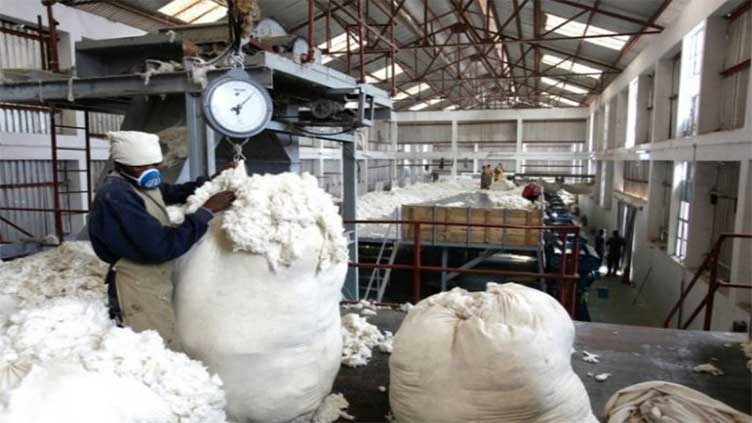
Encouraging cotton growing helps excel textile industry – Pakistan

Encouraging cotton growing helps excel textile industry – Pakistan


Encouraging cotton growing helps excel textile industry – Pakistan

Pakistan


Encouraging cotton growing helps excel textile industry


FAISALABAD (APP) – With the country facing a severe economic crunch, the government is mulling multiple options for economic revival including boosting exports to strengthen depleting foreign exchange reserves and generating employment opportunities to overcome growing poverty.


As the textile industry had been the key player in exports over the decades, paying special heed to this sector by providing a congenial environment could pave the way to capture more international markets and earn revenue.


Enhanced cotton growing is of vital importance for this sector as it encompasses a bigger chain of operations from farming to textiles mills and then to end users’ products showcased at fashion apparel outlets.


This chain of operations not only benefits industrialists but also a major chunk of our populace linked to the agricultural sector. But unfortunately, cotton growing diminished with the passage of time after the installation of Sugar Mills in cotton-growing areas, especially in South Punjab and Sindh provinces.


Pakistan Cotton Ginners Association (PCGA), in its recent fortnightly report on cotton arrivals, has put the production figure at 4.7 million bales till Feb 1, 2023, which is almost 35 per cent below than last year.


“If we reach five million bales this year by end of next month, it would be around 50 per cent below than the official production assessment of 11 million bales for 2023”, informed PCGA Chairman Chaudhry Waheed Arshad.


“If we have to survive with our textile industry, we must frame result-oriented policies focusing on both the farmers and the industrialists,” he stated.


Chaudhry Waheed Arshad recommended measures like announcing support prices, declaring specific cotton zones, and introducing high-yielding, climate-smart and pests-resistant cotton varieties and mechanized farming techniques to get desired results.


“Agriculture is our mainstay and cotton is our lifeline. Therefore, strengthening this sector and announcing special incentives for cotton growers would definitely improve economic growth and the country’s exports,” he stated.


Chaudhry Waheed said that less cotton growing was harming ginning industry because if produce is less then mill owners can import cotton for their needs but what about ginners? “There are 1300 ginning factories countrywide with only 400-500 units remaining operational normally. But, at present only 154 factories are working.”


He claimed that the country has lost 2.4 million acre cotton area to other crops during the last 15 years and “if this trend continues, it would be a severe blow to the cotton-based industries. Therefore, we need to employ the full potential of this sector.”


He was confident sooner or later agriculture sector would attain the status of an industry and farmers must be well prepared to harvest its benefits.


According to the Trade Development Authority of Pakistan (TDAP), Pakistan is the 8th largest exporter of textile products in Asia with the 4th largest producer and the third largest consumer of cotton. Textile is 46 per cent of Pakistan’s total manufacturing sector that provides employment to 40 per cent of the total labour force.


Khawaja Usman, a noted industrialist owning spinning units has said that usually, the textile sector needs 16 million cotton bales annually to add value and export a variety of products to the international market.


“However, the temporary closure of some textile units due to the global recession troubled the economy.

Therefore, local textile sector requirements would revolve around 12-13 million bales this year,” he predicted.

He said if production finally turns out to be five million bales in 2023, the textile sector would need to import seven million bales to meet its requirements. “Therefore, the textile sector had already finalized contracts for import of required cotton bales.”


Khawaja Usman stressed incentivizing the farmers to grow cotton in more areas, and the industry to enable it to compete in the international market as he regretted the fall of cotton production by 16 per cent to merely 8.6 million bales in 2020 from 10.2 million bales in 2019, is not encouraging.


The TDAP officials quoting Pakistan Bureau of Statistics data have also revealed that Pakistan earned over US$15 billion (15400 million dollars) in the financial year 2021 up from over US$ 12.5 billion (12526 million dollars) in 2020 from cotton and textile products. According to their statistics although exports of various textile products registered an increase, export of raw cotton nosedived by 95 per cent in FY 2021 with the main factor being lower production than expectations.


Vice President, of the Multan Chamber of Commerce and Industry, Asim Saeed Sheikh has also claimed that local cotton production was usually falling short to meet the needs of the textile sector, except for 2011 when Pakistan touched the highest mark of 14.7 million bales.


“Many cotton-growing farmers shifted to sugarcane crops over the years resulting in diminishing produce. Above this, we also witnessed torrential rains and flooding this year that swept away large cotton areas,” he said. “This would obviously prove to be a major challenge for cotton growers and allied industries.”


According to climate change research, poor seed quality, heat waves, viruses, pests and the increasing trend of farmers switching to other profitable crops for some quick profits reduced cotton production.


Therefore, it is high time to fully concentrate this segment of the economy to steer the country out of the economic crunch, boost exports and earn foreign exchange to bridge trade and current account deficits

‘ ;
var i = Math.floor(r_text.length * Math.random());
document.write(r_text[i]);

Poor cotton seeds stunting revival of textile industry, research

Poor cotton seeds stunting revival of textile industry, research
Ronny Kibet a Cotton farmer picking ready cotton at his  farm in Koitilial village in Aror ward,Elgeyo Marakwet County on February 2,2022. [Christopher Kipsang,Standard]

Improving upon the high-quality of cotton seed has been fronted as 1 of the ways the region can revitalise the struggling textile industry.

The Kenya Institute for General public Coverage Investigate and Evaluation (Kippra) also recommends the incorporation of cotton advancement programmes into counties’ built-in advancement ideas.

This, Kippra says, will be certain cotton farming is perfectly sourced.

In a publication talking about the standing of the second-hand economy in the state, textiles amid them, Kippra notes how the substantial opportunity of this sector in Kenya is hiccupped by the undersupply of cotton.

https://www.youtube.com/view?v=RQ9I97OPLvE

As these, the country has grow to be dependent on imports of second-hand clothes with 183,830 tons remaining shipped in 2021.

Knowledge shared by Kippra in the publication titled Rejuvenating Community Production in the Context of Secondhand Overall economy, Kippra states that cotton developing in the place is accomplished by compact-scale farmers on land averaging a person hectare (per farmer) and is primarily intercropped with other foods crops.

It notes that there are about 40,000 compact-scale cotton farmers now as in contrast to 200,000 in the mid-1980s.

“The believed once-a-year usage of cotton by the textile mills is approximated at 8,000MT (41,200 bales), and the great demand to fulfill national necessities is 26,000MT (140,000 bales),” claims Kippra. “These stats clearly show that the substantial probable of the textile marketplace is curtailed by undersupply of cotton raw components.”

Major good reasons for the undersupply, it adds, are the constraints faced by cotton farmers, such as the decline in seed cotton generation, minimal high-quality of cotton seeds leading to declining yields, and rather higher prices of generation thanks to reduced efficiency.

The level of popularity of polyester, which is much more durable and fewer high priced to develop than cotton, and the importation of 2nd-hand clothes are also to blame.

“To assure high quality cotton seed, it is needed to enhance cotton seed investigation and improvement by making sure that the Kenya Agricultural Livestock and Research Organization(Kalro) is adequately funded for this objective,” states Kippra.

Kippra also needs neighborhood textile apparel industries, and cotton-escalating counties to include improvement programmes for the crop into their County Built-in Improvement Strategies (CIDP).

“The textile business is also experiencing increased enterprise expenditures these types of as superior electricity expenditures, which are eroding their market competitiveness,” Kippra notes.

The publication paperwork that Kenya has 52 textile mills that change (cotton) fibre into yarn, but only 15 are operational.

“Due to low labour productivity and lower technology, functioning textile mills use only 45 for each cent of their ability,” Kippra states.

Textile industry capacity utilisation halves on high cotton prices

Textile industry capacity utilisation halves on high cotton prices

The ability utilisation of the textile marketplace has plunged 50 per cent with domestic cotton price ranges ruling substantially previously mentioned the global sector because of to levy of import duty.

Nevertheless uncooked cotton prices are hovering about ₹60,000 per sweet (of 356 a kg) from its peak rate of ₹1.10 lakh for every sweet, the rates are however higher than pre-Covid concentrations.

Cotton in India is offering at a premium compared to competing international locations owing to the import responsibility of 11 for every cent levied by the authorities previous February.

‘Retrograde measure’

Talking at the 100th Annual Standard Conference of Cotton Association of India, Atul S Ganatra, President, mentioned the import duty on cotton has eroded the competitiveness of value-included products in the global markets and the textile field is now constrained to operate with only 50 for each cent of its put in capacity.

Levy of import obligation is a retrograde measure not in consonance with free trade coverage of the state and sends a improper sign to the globe cotton group, he mentioned urging the govt to get rid of it.

Cotton efficiency in India carries on to be amid the cheapest in the world, in spite of an envious growth of Indian cotton sector above the many years that has carved a market for by itself in the entire world cotton overall economy.

India’s cotton productivity for every hectare is just 468 kg from the entire world normal of 744 kg. India lags behind lesser nations around the world this kind of as Bangladesh, Syria, Sudan in cotton efficiency.

All stakeholders together with Cotton Association of India have produced repeated representations to the Governing administration to revive Know-how Mission on Cotton, he explained.

GM cotton yield doubled

Introduction of Genetically Modified cotton engineering in India experienced furnished the considerably-needed thrust to enhance cotton productiveness from 307 kg per hectare in 2001-02 to 566 kg for each hectare in 2013-14. The produce has virtually doubled in 5 decades following the introduction GM know-how in India, he reported.

Popularising Large Density Planting, farm mechanisation and providing a thrust to investigation-oriented agronomy are some other crucial techniques forward to enhance our cotton productivity, he advised.

Added-lengthy staple (ELS) cotton generation is a great deal reduce than the demand from customers in the nation. India demands about 20 lakh bales of ELS cotton to cater the domestic marketplace. Even so, the domestic generation is about 5 lakh bales and imports the rest from Egypt, US and Australia.

“We have recommended to the Authorities to detect regions suited for cultivation of ELS cotton, offer superior quality cottonseed and plan guidance with extra MSP,” he claimed.

Demand crunch: Textile sector bats for stimulus, cotton import duty removal

Demand crunch: Textile sector bats for stimulus, cotton import duty removal
&#13
&#13
&#13
&#13
&#13

&#13
Textile sector players are batting for removing of import obligation on cotton and a stimulus from the authorities immediately after currently being strike by a dip in desire owing to the world-wide money crisis and the Ukraine war. The marketplace has been also impacted by the rise in Indian uncooked cotton price ranges, which are at minimum 10-20 per cent increased than global cotton correct now.

&#13

&#13
“The charge of Indian raw cotton is 10-20 per cent larger than the international cotton, which includes the Chinese cotton. This would make Indian spinning mills not to source cotton from India due to the greater amount. At the very same time, the Govt of India has imposed 11 for every cent import obligation. This spoils the level-actively playing industry,” claimed K Venkatachalam, chief advisor, Tamil Nadu Spinning Mills Affiliation (Tasma).&#13

&#13
India’s cotton textile and uncooked cotton exports dipped by 29 for every cent to $5.406 billion in the April-September period, in contrast to $7.606 billion through the very same time in 2021-22. All through the exact same interval, cotton textile exports dipped by 23 per cent to $4.791 billion as against $6.468 billion last calendar year. Likewise, uncooked cotton exports much too declined by 62 for each cent from $1.138 billion from April to September 2021 to $435.9 million in 2022, in accordance to the details shared by the Tasma.

&#13

&#13
“Our cotton fees are not competitive globally. Domestic current market is also shifting faster from cotton to polyester and use is down. For this reason, the governing administration should really remove the import duty and make our raw products at par with worldwide rates,” said Sanjay Kumar Jain of Delhi-based mostly TT Ltd.

&#13

&#13
This will come at a time when there is a lack of demand for textile goods globally because of to the Ukraine-Russia war. “Unless the Govt of India proposes a stimulus offer to textile industries at all levels, whether or not they are spinning, weaving, fabricating, prepared-built garments and dwelling textiles, most of the industries will develop into NPAs incredibly soon, as they are all functioning only for two to 3 days in a 7 days and their performance has appear down to the extent of 30 per cent only,” Venkatachalam added.

&#13

&#13
On the other hand, relocating in line with the general items exports that dipped by 16.7 per cent to $29.8 billion in Oct, completely ready-manufactured garment (RMG) exports too dipped in the course of the thirty day period.

&#13

&#13
“Since most of the conventional markets of Indian RMG together with British isles, EU and the US are witnessing recession and world headwinds, leading to shrinking of demand on one side and customers inquiring for 15 for every cent lower price on the other, we have requested the governing administration for expediting FTAs in these marketplaces and make certain all tariff strains of RMG sector, which will permit a responsibility reduction from the existing 9.6 per cent and act as a powerful breather,” said Naren Goenka, chairman, Clothing Export Advertising Council (AEPC).

&#13

&#13
The whole set focus on of attire exports for 2022-23 is $17.6 billion as against $16.01 billion in 2021-22, out of which $ 9.2 billion was obtained in the course of April-October 2022.

&#13

&#13
Tiruppur knitwear exports back in development observe

&#13

&#13
After clocking destructive development in the course of the months of August, September, and October by 14.6 for every cent, 24.4 for every cent and -34.1 per cent, respectively as opposed to the corresponding months of past year 2021, Tiruppur knitwear exports turned favourable in November by recording a 10.6 for every cent development. Tiruppur contributes to 55 for every cent of the country’s knitwear exports, according to the Tiruppur Exporters’ Association (TEA).

&#13

&#13
The export date for the month of November 2022 reveals that readymade garment exports have reversed the detrimental development and posted a beneficial advancement of 22.71 per cent as opposed to November 2021.

&#13

&#13
“The good development in November is rather encouraging and variables like Economic Cooperation and Trade Agreement (ECTA) entered with Australia will come into effect from December 29 and the envisaged Settlement with Uk will occur in another two months, will help to raise the knitwear exports from Tiruppur,” explained K M Subramanian, President, TEA. He more mentioned that the Uk and Australian potential buyers are intrigued to place orders with Tiruppur due to the fact of the China In addition one particular policy of the respective nations.

&#13

&#13
&#13

Cotton exporter Benin developing home-grown textile industry

Cotton exporter Benin developing home-grown textile industry

GLO-DJIGBE, Benin, Oct 24 (Reuters) – On a huge manufacturing facility floor in southwestern Benin, dozens of younger persons lower, stitch and assemble cotton shirts – component of a important force by the West African place to create its textile sector.

Benin has in the final several many years become Africa’s leading cotton producer, with annual output of 728,000 tonnes in 2020/21, in accordance to govt figures. It exports almost all of that uncooked, with the the vast majority going to Bangladesh.

Now, an initiative is beneath way to generate work and earnings by processing the cotton domestically, with the objective of exporting attire to client marketplaces in Europe, Asia, Africa and the United States.

“We have made the decision that in this state, we are no extended likely to sell this cotton raw. We are going to transform this cotton, in particular by installing built-in textile factories,” claimed Letondji Beheton, running director of the Glo-Djigbe Industrial Zone (GDIZ), about 45 km from Cotonou.

GDIZ begun two years in the past as the end result of a partnership amongst the govt and Crop up Built-in Industrial Platforms (Occur IIP), a pan-African undertaking partly owned by the Africa Finance Company.

More than $1 billion has been invested in the zone so much, which will include textile factories as effectively as cashew processing models, pharmaceutical processing models, and far more, reported Beheton. Only a quarter of it has been formulated so much.

Despite the fact that the devices are not nevertheless in position to get cotton from field to manufacturing facility, GDIZ has begun teaching about 1,000 garment workers using imported elements for now.

“When the Glo-Djigbe manufacturing facility commences its routines, I am certain that we will earn much more,” said 46-12 months-previous cotton farmer Leonard Madjaedou, who has benefited from authorities assist to boost his yields.

In 13 months, the industrial zone aims to employ 15,000 men and women in 3 textile factories that will have a processing potential of about 40,000 tonnes of cotton fibre, Beheton reported.

Eventually, he envisages a multi-billion dollar marketplace that could process the majority of Benin’s cotton.

Cotton is developed in several West African international locations together with Mali, Togo, Burkina Faso and Ivory Coast, but most is exported uncooked with little industrial processing across the location.

Editing by Alison Williams

Our Benchmarks: The Thomson Reuters Belief Principles.