
Nursing home staff prevent bedsores and falls but industry opposes Biden minimums

Nursing home staff prevent bedsores and falls but industry opposes Biden minimums

Comment

Lisa Cabrera saw the warning signs of poor care at her father’s California nursing home — the bug bites on his back, the facial injuries from a fall, the times he was soaked in urine instead of being ready for trips to church. Still, she believed repeated assurances that the staff had inspected the pressure sore on his heel and changed the bandages.

But her dad, Louie Sira, 67, a disabled former janitor, kept gesturing to his right leg, indicating he felt pain. Finally, Cabrera peeled the dressing back herself, which had grown worse since the last time she looked.

“It stunk so bad, and it was bigger,” Cabrera said. The gangrenous wound had dug down to bone and tendon in his heel, according to court records. Doctors were forced to amputate his right leg above the knee. He died three months later, in August 2019.

A county jury awarded $13.5 million in civil damages to Sira’s family and other plaintiffs after lawyers argued Parkview Healthcare Center in Hayward, Calif., and its affiliated management company, Mariner Health Central, skimped on nursing staff to boost profits. State and county authorities are seeking civil penalties, alleging among other things that Mariner saved more than $4 million by short-staffing the Parkview facility in the last three years Sira lived there.

Parkview and Mariner, which are appealing the verdict, say the plaintiffs did not present sufficient evidence of neglect or, in the case of Sira, wrongful death. It has denied all allegations including that its facilities were understaffed and that it kept its nursing force low for financial gain.

Critics say the details of Sira’s suffering add to decades of accumulated evidence that residents suffer more complications, such as bed sores and falls, in nursing homes with inadequate numbers of front-line nurses and nursing assistants. Now, after years of debate and industry resistance, the Biden administration has set in motion plans for a federal minimum staffing requirement for the nation’s 15,500 nursing homes. The new rule is expected to be announced in 2023.

Health and Human Services Secretary Xavier Becerra said in an interview that the extraordinary toll of coronavirus deaths in nursing homes served as a catalyst for the Biden administration to take action. Nearly 160,000 nursing home residents have died of covid-19 in the coronavirus pandemic, a catastrophic impact on frail elderly people who were especially vulnerable to infection and living in closely packed quarters. About 2,700 staff members also have died in the pandemic.

“The dirty little secret was there,” Becerra said. “With covid, you couldn’t hide it.”

Many experts and advocates have been demanding minimum staffing in U.S. nursing homes for decades. “If we can finally get this accomplished, it’s not going to solve all the problems, but it’s going to make a big difference,” said Charlene Harrington, a professor emeritus at the University of California at San Francisco and a researcher on the impact of staff size and training on nursing home quality.

Seniors are stuck home alone as health aides flee for higher-paying jobs

A pivotal 2001 report produced for the agency that regulates the industry, the Centers for Medicare and Medicaid Services (CMS) found that nursing homes should deliver at least 4.1 hours of nursing care to each resident every day to avoid harm such as bed sores and falls — about the equivalent of one nurse for every seven residents on day and evening shifts.

Most U.S. nursing homes fall short of that minimum.

In 2019, the year before the pandemic, only about a third, or 5,200, nursing homes “frequently” reached the 4.1 hours threshold for each resident, according to an estimate by the U.S. Government Accountability Office. It defined “frequently” as at least 80 percent of the days in a year.

On the bottom end of the spectrum, the GAO estimate said, roughly a fifth, or 3,000, nursing homes met the minimum standard on fewer than 20 percent of the days in a year.

Amid industry opposition to mandates, however, the 2001 CMS study guidelines have never become a requirement. In the two decades since, lawsuits, state inspections, academic studies and government reports have continued to show the negative impact of low nursing staff levels on quality.

Nursing home companies accused of misusing federal money received hundreds of millions of dollars in pandemic relief

It is not yet clear what ratio the administration will impose, and whether it will adhere to the 2001 guidelines or pick another range. It is conducting a new analysis of nursing home operations to help it decide. Wherever it lands, Biden’s plan will run up against the lobbying clout of the nation’s nursing homes, which have won previous debates over a national staffing minimum, including in 2016, when President Barack Obama’s administration rejected the idea.

The industry contends minimum staff mandates of 4.1 hours per resident per day would cost up to $10 billion per year and are unworkable because of a shortage of workers willing to do the job. It says government has never provided enough funding, especially through Medicaid programs, to support that level of staffing, which it says could require 187,000 new workers.

“It’s one thing to announce we are going to get all these workers in all these buildings, but are we as a society willing to pay for it? So far the answer has been no,” said Mark Parkinson, president and chief executive of the American Health Care Association, which represents the nursing home industry.

“If you have more staff, it’s better than having less staff,” he added. But imposing a broad mandate does not make sense, he said. The association cites federal data showing total nursing home employment dropped to 1.34 million workers from 1.58 million during the pandemic.

“The administration can propose it and may require it to be done,” Parkinson said, “but the workers are not there and it will not happen.”

The association has said most nursing homes in the country are grappling with the fallout of staff shortages made worse by the pandemic. LeadingAge, an association that represents nonprofit nursing homes, also opposes the mandate. It said in written comments to the administration that the rule “unjustly punishes nursing homes that are unable to meet standards due to factors beyond their control.”

Critics counter that the nursing home industry has abundant profit available to boost staffing and make the jobs more attractive. But the industry’s business model, with multiple related corporate entities often receiving payments from a single nursing home, makes it difficult to follow the money.

Overdoses, bedsores, broken bones: What happened when a private-equity firm sought to care for society’s most vulnerable

Shortchanging the direct-care workforce — primarily made up of women and people of color — with low pay, poor training and insufficient numbers is a tempting way for nursing homes to boost the bottom line, said Kelly Bagby, vice president at AARP Foundation Litigation and a former senior counsel in the Health and Human Services inspector general’s office.

“It’s the simplest way to maximize your profit,” she said.

‘Staffing is scary unsafe’

A review of enforcement actions and lawsuits filed against nursing homes illuminates the ways a poor ratio of residents to staff can lead to alleged poor care and neglect.

In Washington state, for instance, a state inspector documented staffing levels at the Arcadia Healthcare — University Place on Jan. 27, 2020. For 110 residents, there were four direct-care nurses on duty during the day shift, a ratio of one nurse assistant to 27 residents, according to the report. That day, multiple residents received their insulin hours late. The inspection report cited other examples of allegedly deficient care, including untreated pain and poor wound care.

A registered nurse at the facility told the inspector “staffing is scary unsafe here.” Representatives of the facility did not respond to requests for comment. A New York venture capital and private-equity firm listed in federal records as an indirect owner of the facility, Goldner Capital Management, also did not respond. In the facility’s corrective action plan included in the inspection report, the facility said it would provide 30 days of 24-hour manager coverage to ensure staffing levels were safe. The report said the facility also “consolidated resident rooms to provide safer staffing abilities.”

In Detroit, an inspection report for the Westwood Nursing Center said that on the weekend of Aug. 27 and 28 this year, several residents reported they could not find nursing staff and did not receive daily medications. Some of them called 911. Investigators confirmed in a review of records that multiple residents did not get their pills, including medications for pain, hypertension, blood clotting and heart problems. The inspection report said the nurses scheduled to work that weekend “called off” and that some managers, unable to obtain nurses from an outside agency, attempted to provide care themselves but did not distribute medications.

Subsequent inspections revealed a number of alleged violations at Westwood. In one, the inspection report found, a resident was restrained on multiple days in a recliner by an attachable table top. The resident was observed “pulling on the secured table and yelling out.” A staffer told the inspector the table was in place to keep the resident from falling. The resident was supposed to be released from the restraint arrangement every two hours, according to a physician’s order, but there was no evidence that order had been followed, the report said. The report also documented bedrooms allegedly strewn with garbage and swarming with flies. Westwood did not respond to a request for comment. Previously, a letter to the facility from the state in May 2022 said Westwood did not have any noncompliance issues at that time.

‘I couldn’t take care of everybody’

Certified nursing assistants provide the bulk of care in nursing homes. They earned a median wage of $14.41 an hour in 2021, according to the nonprofit policy group PHI, citing the Bureau of Labor Statistics data. They lift patients in and out of bed — a task that sometimes requires two people. They shower, bathe and groom. They are supervised by smaller numbers of higher-skilled nurses — registered nurses and licensed practical nurses — who dispense medications and monitor vital signs.

The federal staffing requirement for each facility is one eight-hour shift per 24 hours for a registered nurse — who can make vital judgments for medical interventions — and one licensed practical nurse on duty at all times.

For the total nursing staff needed — including the people who deliver most of the care, the certified nursing assistants — the government’s rule is vague: whatever an operator determines is “sufficient” to assure the safety and well-being of residents.

To fill the void left by the lack of specific federal requirements, 35 states and D.C. have adopted their own minimum staffing standards. With the exception of D.C., they fall below the standard the CMS study identified as appropriate in 2001. In a study by the nonprofit Kaiser Family Foundation, D.C. ranked No. 1 among states on Medicare’s quality rating system, with 53 percent of facilities listed at five stars.

Major nursing home chain violated federal standards meant to stop spread of disease even after start of covid-19, records show

In Chicago, Jacinda Gaston, who was a trainee resident assistant, described her struggles this year trying to care for residents on what she said was an understaffed floor of the Alden Lakeland Rehabilitation and Healthcare Center. On many of her shifts, just two caregivers were available to take care of 72 residents, she said in an interview. Other times, there would be three caregivers and rarely there would be four, she said.

When she arrived at 3 p.m. for the start of the evening shift, she said, she would often find residents who had been lying in bed, soaked in urine and feces for hours.

“It was disturbing. I couldn’t take care of everybody,” she said. “Knowing that these people have been sleeping in their own waste all day, we had to figure out who was the worst” and prioritize them for cleaning and fresh undergarments.

Gaston worked at Alden Lakeland from March to August of this year, she said. She now works at a different nursing home that she says is better staffed. A state inspection report of Alden Lakeland in June cited Alden as deficient for failing to provide sufficient staff.

Alden Lakeland’s Chicago parent company, Alden Group, which operates more than 50 nursing homes, is the subject of a class-action lawsuit alleging chronic short-staffing and neglect.

Alden declined to comment on specific allegations, citing pending litigation. “Alden vigorously denies any and all allegations of wrongdoing set forth by the plaintiffs and their attorneys and is confident the judicial process will vindicate Alden in this action,” the company said. “Alden is committed to providing quality care, and the well-being of our residents has been and always will be our top priority.”

In Beaver, Pa., a federal investigation into alleged staffing violations led to criminal indictments on charges of conspiracy and fraud against executives and administrators of the 589-bed Brighton Rehabilitation and Wellness Center. The facility was the scene of one of the worst coronavirus outbreaks in the country in the spring of 2020, requiring the intervention of Pennsylvania National Guard troops. As of early October, 94 residents had died at Brighton from coronavirus infections, according to federal data. A spokesman for the operators, Comprehensive Healthcare Management Services, did not respond to a request for comment. Comprehensive pleaded not guilty in the case, which is pending in U.S. District Court.

Bobbie Johnson’s mother, Shirley Mike, checked in to Brighton in 2016 after a bout of sepsis. Johnson said the facility seemed nice at first. But as time went on, she said, she saw signs that her mother’s care was lacking. Her room smelled bad and her toenails grew so long they curled under her toes and caused her to limp, Johnson said. She had an unexplained bruise on her hand.

“It looked like her hair, like they didn’t try to comb it,” she said. “It didn’t look right to me.”

Johnson would bring her McDonald’s cheeseburgers and a diet soda on visits. Then in 2020 the pandemic hit. Visitors were no longer allowed. On April 3, 2020, Johnson received a call saying her mother had fallen and had been taken to the hospital. She was returned to Brighton later that day. Desperate, Johnson said she called Brighton repeatedly to check on Shirley’s condition, but the phone would just ring and ring, unanswered.

She would not know the extent of her mother’s facial injuries from the fall until more than a week later, after her mother had died of covid-19 and an undertaker informed her that Shirley had stitches in her mouth.

Brighton had given Shirley a coronavirus test on April 11, which came back positive on April 14. But Johnson was not told of the positive test until after her mother died, on April 15, according to a lawsuit alleging neglect and short-staffing filed against Brighton by Johnson and multiple other families.

“I was desperate to find out what was going on,” Johnson said. “Did they just let her lay there and die?”

Allegations of inadequate staffing took center stage in the 2021 civil trial against the Parkview nursing home and its operating company, Mariner Central. The lawyer for Lisa Cabrera and plaintiffs representing nine other residents, Susan Kang Gordon, said Parkview failed to meet California’s minimum staff threshold of 3.5 hours per day per resident of direct nursing care on 328 days over a three-year period.

State and county officials also have cited Parkview in their sweeping investigation of Mariner’s operations: “The facility routinely failed to have sufficient staff to meet the needs of its residents,” they said in a court filing in January of this year. It also has alleged that Mariner submitted inflated staff reports to the government.

The companies denied all of the allegations in a statement: “Parkview Health Care Center and Mariner Central vehemently disagree with the judgment entered in the Alameda County Superior Court and are pursuing an appeal. The companies strongly believe the appeal will be successful and the judgment will be reversed.”

Responding to the state’s claims against it, the companies added, “Parkview and the affiliated entities look forward to vindicating themselves as they defend against these scurrilous allegations.”

In the case of Louie Sira, who arrived at Parkview in 2016 after a stroke and several heart attacks, the pressure sore on his heel started as a red spot the size of a fingernail in December 2018, Gordon told the jury in the civil trial. She contended the staff neglected to follow doctor’s orders and treat it correctly by relieving pressure. He also suffered six falls in the first four months of 2019, Gordon said. He allegedly was infected multiple times with scabies and head lice.

After his daughter peeled back the heel bandage and saw the horrible nature of his wound in May 2019, he suffered a cardiac arrest while his leg was being amputated. Lawyers said he was never the same. He required a feeding tube. An expert witness testified the root cause of his death in August 2019 was the pressure injury on his right heel.

The plaintiffs’ lawyers alleged during trial that huge gaps existed in documentation of his wound care. A doctor ordered an examination by a wound specialist on Dec. 28, 2018, but there was no record the wound was examined by the wound specialist until 55 days later, according to an analysis of Sira’s medical records by the plaintiff legal team. In April 2019, 14 days passed without any record that his wound had been checked by nurses, the plaintiffs said.

Mariner has countered in court records that Sira died of preexisting conditions and that plaintiffs failed to prove that the nursing home’s conduct caused the death.

It remains uncertain how much the Parkview plaintiffs will recover after the jury award (which was modified to $8 million plus $6.6 million in attorneys’ fees). In addition to appealing in state courts, Mariner Health Central filed under Chapter 11 of the U.S. bankruptcy code in September 2022 to protect itself from paying the judgment, calling it a necessary step to keep its nursing homes open. Mariner, headquartered in Atlanta, is part of a network of 50 related companies, but only three are subject to the jury verdict, according to its bankruptcy filing documents.

Cabrera wonders now if she should have tried harder to move her father to a different facility after she noticed signs of neglect. But at the time she was concerned about moving him away from his family in Hayward, away from the community where he grew up as an avid Oakland A’s fan, where he worked for decades of his life before he was disabled by a series of strokes.

“I was always verbal about my dad’s complaints, and we did have a couple of meetings (with Parkview administrators) and we would come up with a plan of action, but nothing ever followed through,” Cabrera said. “I have never had to deal with somebody being in a home like that before. I trusted that they were going to take care of him.”

Banking Industry in South Africa Market Report 2022

Banking Industry in South Africa Market Report 2022

DUBLIN, Nov. 15, 2022 /PRNewswire/ — The “Banking Industry in South Africa 2022″ report has been added to  ResearchAndMarkets.com’s offering.

South Africa’s banking sector is well capitalised and its capital adequacy and liquidity ratios have remained well above minimum statutory requirements. Total banking sector assets increased in the year to end-March 2022, with increases reported in gross loans and advances, investment and trading securities and short-term negotiable securities.

Profitability improved significantly. However, the operating environment remains highly volatile and the banking sector is facing elevated domestic and global risks, including the possibility of being placed on an international grey list over South Africa’s failure to implement adequate measures to prevent illicit money flows.

Trends

Mobile and digital banking are key drivers of financial inclusion in South Africa. Despite the uptake of digital banking, cash transactions are prevalent, and banking activity continues to be dominated by cash withdrawals, which are often made at supermarket till points. Many banks are consolidating and closing underserved branches and ATMs. Demand for credit is rising, and rising inflation and interest rates are placing consumers under growing pressure and increasing the risk of bad debt. Cybercrime poses a growing threat to banking service providers and their customers, and money-laundering is on the increase.

Financial Inclusion

South Africa’s formally financially included is high at over 90{1668a97e7bfe6d80c144078b89af180f360665b4ea188e6054b2f93f7302966b} and various banks offer products for low-income earners. Co-operative financial institutions and microfinance institutions play a fundamental role in financial inclusion. Stakeholders say that migration to formal savings platforms has accelerated since 2020.

Report Coverage

This report covers the banking industry in South Africa including the major commercial banks, development banks, central bank, digital banks, microfinancing and stokvels. It includes comprehensive information on the size and state of the sector, industry statistics and performance indicators, rankings, corporate actions and other developments.

There are profiles of 81 companies including the major banks such as FirstRand (FNB), ABSA, Standard, Nedbank, Capitec and Investec, development banks such as the Land Bank and relatively new players such as TymeBank and Bank Zero.

Key Topics Covered:

1. INTRODUCTION

2. DESCRIPTION OF THE INDUSTRY
2.1. Industry Value Chain
2.2. Geographic Position
2.3. Size of the Industry
2.4. Key Success Factors and Pain Points

3. LOCAL
3.1. State of the Industry
3.2. Key Trends
3.3. Notable Players
3.4. Corporate Actions
3.5. Regulations
3.6. Enterprise Development and Social Economic Development

4. AFRICA

5. INTERNATIONAL

6. INFLUENCING FACTORS
6.1. The War in Ukraine
6.2. Economic Environment
6.3. COVID-19
6.4. Financial Inclusion
6.5. Technology, Research & Development (R&D) and Innovation
6.6. Government Support
6.7. Labour
6.8. Cryptocurrency
6.9. Crime
6.10. Environmental Issues

7. COMPETITIVE ENVIRONMENT
7.1. Competition
7.2. Ownership Structure of the Industry
7.3. Barriers to Entry

8. SWOT ANALYSIS

9. OUTLOOK

10. INDUSTRY ASSOCIATIONS

Select Companies Mentioned:

  • Absa Bank Ltd
  • Access Bank South Africa Ltd
  • African Bank Ltd
  • African Dawn Capital Ltd
  • Afriticket System (Pty) Ltd
  • Agribel Capital (Pty) Ltd
  • AgricReview (Pty) Ltd
  • AgriRewards (Pty) Ltd
  • Albaraka Bank Ltd
  • Alicerose Nominee (Pty) Ltd
  • All In One Vermietung GmbH
  • API Capital (Pty) Ltd
  • Axis Security Services Ltd
  • BA Excepted Group Life Scheme Ltd
  • BA Holdco Ltd
  • BANCO Bocom BBM SA
  • Bank of China Ltd
  • Bank of Taiwan Co. Ltd
  • Bank Zero Mutual Bank
  • Barko Financial Services (Pty) Ltd
  • Baroda Pioneer Asset Management Co Ltd
  • Batho Bonke Absa HDSA Employee Trust
  • Bemax International (Pty) Ltd
  • Bidvest Asset Management (Pty) Ltd
  • Blue Holdings (Pty) Ltd
  • BNP Fortis Factor NV
  • BNP Paribas Commercial Finance Ltd
  • BOC International (China) Ltd
  • BoCom International Holdings Company Ltd
  • BOCOM Wealth Management Co Ltd
  • Buyers Trust Investment Solutions (Pty) Ltd
  • C T International Financiers (Pty) Ltd
  • Capital Harvest (Pty) Ltd
  • Capitec Bank Ltd
  • Cavalry Holdings Ltd
  • CCB Financial Asset Investment Corporation Ltd
  • CH Risk and Securities (Pty) Ltd
  • China Construction Bank Corporation
  • Citibank N.A.
  • CNH Industrial Capital Europe SAS
  • Co-Operative Switch (Pty) Ltd (The)
  • Deutsche Bank AG
  • Development Bank of Southern Africa
  • Diners Club (S A) (Pty) Ltd
  • Direct365Online Ltd
  • Discovery Ltd
  • East Africa Investment (Mauritius) Ltd
  • FHP Managers (Pty) Ltd
  • Finamics Accounting Services (Pty) Ltd
  • Finbond Group Ltd
  • FinGlobal Finance (Pty) Ltd
  • FireID Payments (Pty) Ltd
  • First Garment Rental (Pty) Ltd
  • FirstRand Bank Ltd
  • GBS Mutual Bank
  • Geniob Trading (Pty) Ltd
  • Gloster Farm (Pty) Ltd
  • Golden Fountain Finance Ltd
  • Grindrod Bank Ltd
  • Habib Overseas Bank Ltd
  • HBZ Bank Ltd
  • HKFT Properties (Pty) Ltd
  • HSBC Bank PLC
  • ICICI Bank Ltd
  • Imfundo Finance (RF) (Pty) Ltd
  • Industrial Development Corporation of South Africa Ltd
  • Investec Bank Ltd
  • Ithala Development Finance Corporation Ltd
  • JCB Finance Holdings Ltd
  • JPMorgan Chase Bank N.A.
  • Lewis Group Ltd
  • Mortgage Max (Pty) Ltd
  • MTN Group Ltd
  • NBC Holdings (Pty) Ltd
  • Nedbank Ltd
  • NQ Plus Networks (Pty) Ltd
  • Old Mutual Finance (RF) (Pty) Ltd
  • Oltio Holdings (Pty) Ltd
  • Ooba (Pty) Ltd

For more information about this report visit https://www.researchandmarkets.com/r/igl131

About ResearchAndMarkets.com
ResearchAndMarkets.com is the world’s leading source for international market research reports and market data. We provide you with the latest data on international and regional markets, key industries, the top companies, new products and the latest trends.

Media Contact:

Research and Markets
Laura Wood, Senior Manager
[email protected]   

For E.S.T Office Hours Call +1-917-300-0470 
For U.S./CAN Toll Free Call +1-800-526-8630
For GMT Office Hours Call +353-1-416-8900

U.S. Fax: 646-607-1904
Fax (outside U.S.): +353-1-481-1716 

Logo:  https://mma.prnewswire.com/media/539438/Research_and_Markets_Logo.jpg 

SOURCE Research and Markets

Campaign Contribution Data Show Finance Industry Split on Democrats and Republicans

Campaign Contribution Data Show Finance Industry Split on Democrats and Republicans

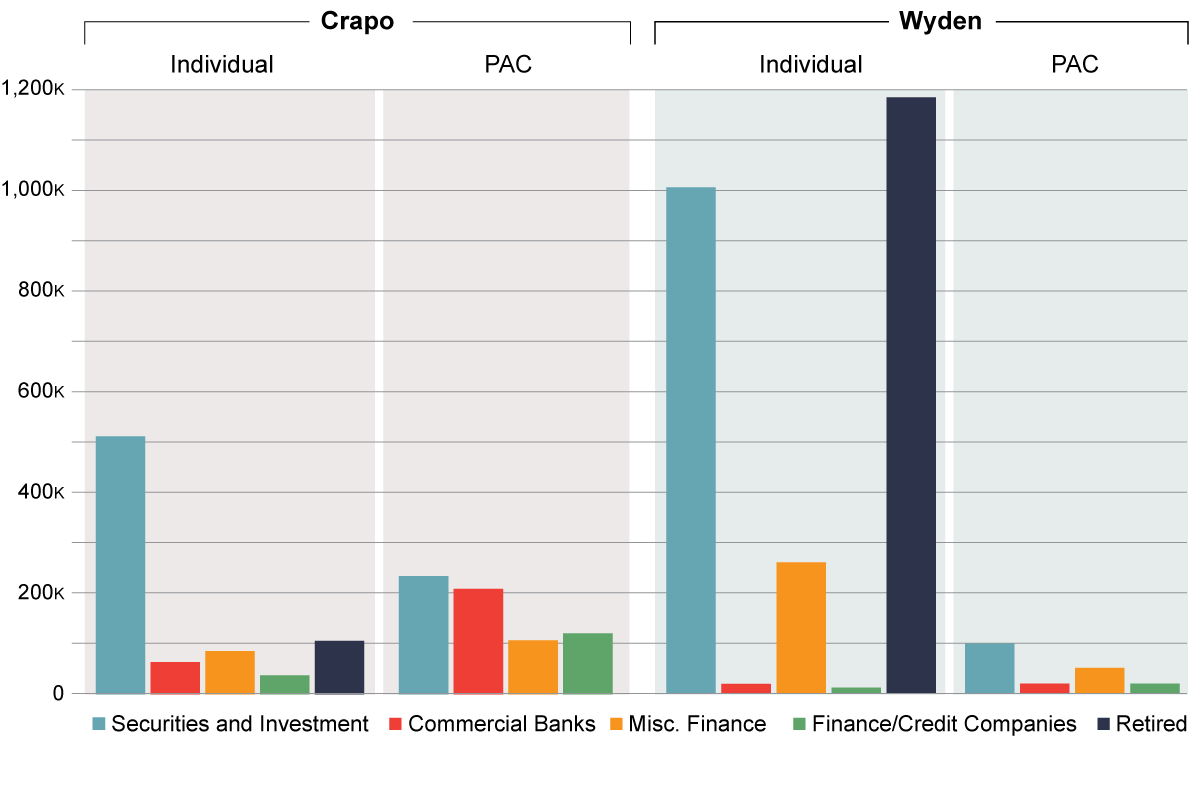
Campaign contribution data from economic connected industries obtained from opensecrets.org for Senator Wyden, D-Oregon and chairman of the Senate Finance Committee, and Senator Crapo, R-Idaho and position member of the Senate Finance Committee, shows higher assistance for Wyden from the securities and investment business and greater support from commercial banks and finance and credit organizations for Crapo.

Senators Wyden and Crapo are nicely-suited to have their contributions compared and applied as a circumstance study for marketplace support for the Democratic and Republican functions. Donations to this pair should make more perception into sector assistance for their respective functions than any other pairing in the Senate.

They are both equally incumbent senators, so they would each advantage from incumbent fundraising strengths. They are each up for re-election this year, so donors who donate late in an election cycle are included for each candidates. They equally maintain seats that are viewed as electorally protected, this means the donors are unlikely to be interested in striving to swing a close election. They are also equally the greatest-position associates of the Senate Finance Committee of their respective get-togethers, so neither is getting a seniority reward that the other isn’t.

And they stand for states not famous for their financial sector, indicating many of their economic marketplace donors are from other states.

Study from Brandice Canes-Wrone , professor of politics at Princeton College, and Kenneth Miller, professor of political science at the University of Nevada, Las Vegas displays that candidates that are far more reliant on out-of-point out donors are inclined to be extra responsive to the opinions of the nationwide donor base as opposed to the belief of the voters they characterize. Safer seats, this sort of as individuals occupied by Senators Wyden and Crapo, also tend to be more responsive to nationwide voters. Because finance is a countrywide business, clustered in states not represented by Wyden and Crapo, such as New York, the impact of the national donor foundation on financial problems should to be significantly acute for both of those.

But why donate to a prospect in a risk-free seat? If they will get in any scenario, why not conserve your funds? Candidates in protected seats are nonetheless expected by their celebration to fundraise, and candidates can transfer limitless sums of income to the countrywide and state bash committees. For that reason, contributions can even now enhance their status and leverage within their occasion, and so donations can nevertheless be made use of to curry favor with them, researchers located.

Analysis from Anthony Fowler, professor of general public coverage at the University of Chicago, reveals that corporations ordinarily do not gain adequate from electing favored candidates, at least not by a margin to justify their donation. However, donors are much more likely to get meetings with users of Congress than common voters, and donations are much more of a way to get a member’s consideration, gain entry, and cultivate personalized interactions with them and their team. Considering the fact that Wyden and Crapo are both senior customers of their committees, and possible to serve until finally their retirement, receiving their consideration with donations can be a beneficial organization investment.

With that in hand, what type of aid do the two senators acquire from finance-relevant industries?

Campaign Contribution Data Show Finance Industry Split on Democrats and Republicans

Working with contribution information compiled from opensecrets.org, contributions from industries of desire and contributions from people and people from political action committees, or PACs can be examined.

Particular person contributions are capped at $2,900 for every prospect for each election, which means a donor can add the maximum in a most important and then all over again in the basic election, totaling $5,800 for the election cycle. In this circumstance, PACs are corporations developed by a enterprise (union PACs are not involved in this dataset) that can fundraise from the workforce of that business enterprise. Which includes both equally particular person donations and PAC donations supplies a broader view of help inside the marketplace for Wyden and Crapo.

The info show that Crapo received extra contributions from the industrial banking sector, $64,342 from people doing work in that market, and $210,000 from PACs produced by enterprises in that field, than did Wyden. Wyden’s contributions from industrial banking institutions had been $19,395 from people today and $19,750 from PACs, totaling $39,145 vs. a overall of $274,342 for Crapo.

Crapo also gained more from finance and credit rating corporations than did Wyden. Crapo received a complete of $159,550 with $37,850 and $121,700 coming from people and PACs respectively. Wyden received a complete of $31,173 with $11,673 and $19,500 coming from people today and PACs respectively.

1 conflating variable as it relates to these two industries is that Crapo is a member of the Banking, Housing, and City Affairs Committee and Wyden is not. On the other hand, both business banking institutions and finance and credit organizations donated more to Republicans in standard in 2022.

Wyden received far more funds from the securities and expense industry and from donors classified as currently being in miscellaneous finance industries than did Crapo. He also been given far more from retired donors than Crapo.

Crapo gained $748,754 from securities financial investment, and finance donors, in comparison to $1,105,310 for Wyden. Donors in the miscellaneous finance classification donated a whole of $194,119 to Crapo and $311,714 to Wyden. Retired donors donated $106,692 to Crapo and $1,185,095 to Wyden.

Nevertheless retired individuals do on constitute an industry, their contributions are involved in this assessment owing to associates of that group’s   use of monetary items. The Senate Finance Committee is included in the challenge of retirement coverage reform and passed the Gain Act previously this yr as aspect of a broader established of reform expenses dubbed “SECURE 2..” Market insiders believe that this reform really should go all through this Congress and it is supported by each senators.

Following the earlier sample, miscellaneous finance donors have presented additional to Democrats in typical in 2022, as did the securities and investments field. Retired people on the other hand, have specified more to Republicans ($316.7 million) than Democrats ($289 million).


Tags

Documented by

Reprints

To area your purchase, please e-mail Field Intel.

How Intelligent Automation is changing the Finance Industry

How Intelligent Automation is changing the Finance Industry

How Intelligent Automation is changing the Finance Industry 4Why the Banking, Finance and Insurance plan industries must embrace digital brokers right before they’re left powering

By Sanjeev Kumar, VP EMEA at Increase.ai

Technology’s romance with the entire world of finance is one particular of contradiction. Innovation is a critical part of the business, and fintech in unique is a slicing-edge place. However, legacy banking companies remain averse to embracing new tech that they see as risky and untested globally. If latest developments, like the wide move to digital banking, have shown anything, it’s that the world of finance is in the midst of seismic modify and that there is even far more sizeable improve to occur.

2022 has been a difficult year throughout all industries. Younger generations exhibit less loyalty to support suppliers, models, and workplaces. In an unsettled environment, organisations will need to established by themselves aside. People are spoilt for alternative and pressed for time. It has in no way been more vital for banking institutions and money establishments to offer buyers a premium service and to have rock-sound personnel retention techniques in spot.

The remedy lies with synthetic intelligence (AI). Smart automation, digital agents and conversational AI are tested units for money establishments to tackle customer and staff churn immediately. As an ever-rising number of economical organisations adopt these systems, it is no longer a subject of if but of when conversational AI becomes a essential and commonplace option in the finance marketplace.

How Intelligent Automation will work

Clever automation combines artificial intelligence and automation technologies to automate very low-stage jobs. For illustration, freeing up personnel to engage in the responsibilities they have been properly trained for, alternatively than low-stage administration and very simple customer requests.

While clever automation can take many kinds, a person of the much more typical sorts we see in the banking, fiscal products and services and insurance (BFSI) industries is virtual brokers. Digital agents use innovative all-natural language algorithms in the form of conversational AI to fully grasp the user intent of internal and external queries and supply contextual responses. For instance, just one digital agent could possibly be in place for client complaints, though one more will be put in to deal with interior service desk requests. On an specific degree, the profit is obvious for workers – position fulfillment – and for shoppers – support fulfillment.

Smart Automation in motion

It is not just a suggestion to embrace a modern day, electronic-initially shopper banking expertise, but at this issue, it is an expectation. With banks and insurers remaining gradual off the mark, new entrants to the business have been equipped to swiftly get market-share by providing sleek, efficient, and shopper-friendly solutions crafted about AI systems.

Simply call centres garner significantly ire from clients they are clunky and time-consuming nevertheless, human interaction nonetheless plays a crucial job in consumer provider procedures. The trouble is that human interaction ought to only be utilised when vital, not as the initial port of simply call. For case in point, if a digital agent can not solve a query, then a individual will be on hand to carry in their expertise to address whichever the trouble is.

On the other hand, thanks to conversational AI, this is rarely a issue that banks and finance establishments need to have to offer with any extended. With the suitable implementation, digital brokers can solve more than 90{1668a97e7bfe6d80c144078b89af180f360665b4ea188e6054b2f93f7302966b} of client queries. Any remaining provider tickets are normally more advanced and can be dealt with by human agents, building a streamlined, nevertheless very personalised, provider.

So, what is keeping organisations back again?

In a term, fear. Concern of shopper backlash at ‘robots’ responding to their issues. Fear all over the security of allowing AI accessibility to broad swathes of consumer facts. Fear of expense-to-advantage ratios. 85{1668a97e7bfe6d80c144078b89af180f360665b4ea188e6054b2f93f7302966b} of executives concur that anxiety holds back again innovation efforts often or generally in their organisations. But nine out of 10 organisations are undertaking practically nothing to simplicity individuals fears.

When easy to understand,, these fears are increasingly misplaced, as developments in conversational AI technological know-how have assisted to dispel these fears. Intelligent virtual agents are creating absolutely sure that terribly built chatbots are staying relegated to historical past. Safety is prioritised with these solutions as nicely, producing positive that consumer and question info is stored and shielded appropriately. And smart automation does not will need to be high-priced. Organizations can choose and pick the extent and scope of automation they wish to utilize, with the skill to take a look at out a alternative before going all in on it. Most importantly, conversational AI and automation technologies are no for a longer period just for large firms with great economies of scale scaled-down-scale businesses can craft bespoke automation applications that do the job to their scale also.

Personalisation is a escalating aspect of conversational AI and a escalating precedence for buyers. As AI technological innovation advances, new applications inside BFSI will burst forth – from spotting fraudulent action through pattern tracking to pinpointing probable tries at fraud by comprehending shopper keystrokes and voice styles – and the options are endless.

The upcoming is bright, the potential is automatic

The time is now for steady, streamlined adoption of digital brokers and conversational AI. With electronic banking becoming the principal form of banking, specially as consumers turn out to be additional digitally-savvy, creating a cohesive electronic providing for shoppers has never been additional significant, and discussion AI has a substantial job to perform in enabling this.

Building the ideal knowledge for customers and personnel is only attainable by creating on good foundations, and it’s vital that organizations have the suitable technologies in put to attain this. And when it will come to developing foundations, conversational AI has a massive purpose to participate in. This technological know-how not only aids consumers to acquire improved-top quality products and services, but personnel see a lot less time spent on mundane administrative and low-amount jobs. The benefits even attain corporate final decision-makers, who can accomplish greater consumer pleasure, more staff retention and a sleeker and far more economical inside and exterior conversation resolution with conversational AI.

Of study course, it is important to be aware that not just about every organisation’s AI solution will be the exact same, but it is abundantly very clear that pretty number of organisations will be in a position to do without having a person in the coming many years.

RiskLens Fast Facts on Cyber Risk in the Financial Industry

RiskLens Fast Facts on Cyber Risk in the Financial Industry

RiskLens Fast Facts on Cyber Risk in the Financial IndustryFlagstar Financial institution, the seventh major bank home finance loan loan company in the US, introduced in June, 2022, that it experienced been hacked in December, 2021, and personal facts on 1.5 million clients exfiltrated. In accordance to information reports, Flagstar has not discussed the 6-month time lapse from the attack to the announcement. Earlier in 2021, Flagstar was among the the several organizations breached as a result of the hack of the Accellion file transfer appliance.

Flagstar explained it has no evidence that any of the information and facts obtained in the most up-to-date breach has been misused – even so, at the very least two customer lawsuits are in the courts, one particular filed by a plaintiff who claims that his identification was falsely utilized to get out a loan immediately after the breach. The bank is featuring two a long time of credit rating monitoring to clients.

RiskLens is the chief in cyber chance quantification 

Estimate of Probable Charges for Flagstar Lender from a Process Intrusion Assault

Flagstar hasn’t made public the aspects of the attack, but let us suppose for assessment that the lender was hit with a technique intrusion attack, in other words, code exploitation, brute force password guessing or other practices that gave cyber criminals a foothold on the network. Employing the RiskLens My Cyber Possibility Benchmark instrument, we can estimate the influence of a procedure intrusion assault on a monetary organization of Flagstar’s size: 

  • $310.3 million for Key Response Fees
  • $22.7 million for Shed Earnings
  • $585,000 for Fines & Judgments
  • $333.6 million Total 

Monetary Sector Cyber Incidents Count

The authoritative 2022 Verizon DBIR experiences that finance was strike with 2,527 cyber incidents in 2021, which includes 690 info breaches. That placed this sector at quantity five for overall incidents, but amount 1 for data breaches, out of 21 surveyed.

Most Possible Cyber Dangers by Incident Frequency and Decline for Banking, Insurance plan, and other Economical Institutions

The RiskLens data science staff estimates risk for companies in an market classification centered on the cyber situations historical past plus a broad assortment of parameters these kinds of as profits, quantity of workers and amount of database documents. 

In RiskLens modeling, technique intrusion for a fiscal establishment of Flagstar’s size and style comes in as a rather low possibility at a 4 {1668a97e7bfe6d80c144078b89af180f360665b4ea188e6054b2f93f7302966b} possibility of transpiring in a year with an anticipated expense of about $330 million. As proven in the chart under, insiders are the most most likely source of cyber functions in finance – banks and other financials have been reasonably thriving in decreasing frequency of exterior productive assaults. As the IBM Safety X-Power Menace Intelligence Index 2022 commented:

“High security standards in position at most economic organizations are yielding concrete final results and the monetary companies marketplace is performing security appropriate. In addition, hybrid cloud environments are dominant at economic providers corporations, allowing for for greater visibility into and management of sensitive data.”

Fast Facts - Finance - Attack Ranking B


Finance also arrives out rather effectively as opposed to businesses of equivalent measurement in other industries, at selection five for incident probability and variety six for incident price out of nine industries.

Fast Facts - Finance - Industry Ranking B


Databases Dimensions and Stability Posture Make a Variation 

Adjusting the parameters on the My Cyber Danger Benchmark software offers clues on how to reduce cyber decline exposure. 

For occasion, lowering the quantity of information in a databases, but leaving the other settings the very same for a money corporation exhibits dramatic enhancement for a process intrusion event 

  • 10M – 100M Documents = $330M Reduction
  • 10K-100K Records = $132M Loss 

To level stability posture, the Benchmark device incorporates grading by Stability Scorecard. Here’s how the yearly probabilities of a program intrusion assault go up for a financial institution or insurance policy corporation as security grades go down, suggesting the value of controls investments, this kind of as improved obtain management. 

  • A = 2.5{1668a97e7bfe6d80c144078b89af180f360665b4ea188e6054b2f93f7302966b}
  • B = 4.{1668a97e7bfe6d80c144078b89af180f360665b4ea188e6054b2f93f7302966b} (Flagstar’s Stability Scorecard grade)
  • C = 5.1{1668a97e7bfe6d80c144078b89af180f360665b4ea188e6054b2f93f7302966b}
  • D = 6.8{1668a97e7bfe6d80c144078b89af180f360665b4ea188e6054b2f93f7302966b}
  • F = 8.3{1668a97e7bfe6d80c144078b89af180f360665b4ea188e6054b2f93f7302966b}

Try out the My Cyber Possibility Benchmark tool for yourself – get a free trial.

RL-Banner-300x250v1

COP27: Mark Carney clings to his dream of a greener finance industry

COP27: Mark Carney clings to his dream of a greener finance industry

In the months leading up to the Glasgow COP26 climate change conference last November, the UK government spent long hours lining up landmark agreements to be announced during the fortnight on car emissions, deforestation, methane and more.

Among the most eye-catching of the announcements was the commitment unveiled by Mark Carney, the former Bank of England governor, on the conference’s finance day: a pledge that $130tn — four in every 10 dollars under management globally — would be deployed to limit global warming. “This is a watershed,” he said. Quoting the climate activist Greta Thunberg, he added: “It’s not blah blah blah.”

The promise was made on behalf of the Glasgow Financial Alliance for Net Zero (Gfanz), the grouping of banks, asset managers, insurers, pension funds and other money managers Carney had launched in April 2021. It was greeted as a fundamental shift away from purely profit-driven capitalism by the financial sector.

Behind the scenes in 2021, not everyone working on COP26 in government was convinced of the timing, or the wisdom, of Carney’s announcement. “Carney saying we’ve got $130tn of money ready” risked looking “misleading”, says one civil servant working on negotiations at a time when the COP26 presidency was struggling to persuade developed governments to deliver on a promise of $100bn in annual climate assistance to poorer nations.
 
There were also concerns the announcement was more promotional than tangible. “A lot of this came down to Carney’s desire to have something branded as his own thing,” says Ben Caldecott, finance strategy adviser to the UK government in the run-up to COP26. “It became a running joke among those working on finance for Glasgow.”

You are seeing a snapshot of an interactive graphic. This is most likely due to being offline or JavaScript being disabled in your browser.


But without Carney’s “convening power” there would have been no alliance at all, says Alex Michie, who advised the Treasury on private finance ahead of COP and now co-leads Gfanz’s secretariat. “The only design we had was to get the global financial system to make science-based commitments to net zero and take near-term action to implement it.”

To reduce the risk of greenwashing, the UK government laid down a single red line, according to Caldecott and the civil servant. Carney’s brainchild would have to agree to work alongside an existing verification body for corporate and financial sector pledges: the UN’s Race to Zero.

“Civil society knew that many of the finance sector commitments were rubbish, so we needed to be proactive on integrity,” says Caldecott, who also leads the University of Oxford’s sustainable finance group.

When Gfanz expanded in November, its governance documents show Race to Zero was put in charge of vetting new and existing members and helping define the speed at which they decarbonised their portfolios.

Yet one year on, and just 10 days before COP27, that red line was erased. Gfanz officially relegated the UN-backed body to the status of one adviser among many at the end of last month. The financial institutions under the Gfanz umbrella no longer have to be aligned with the multilateral body meant to uphold their integrity.

UN guidelines on preventing corporate greenwashing published at the summit on Tuesday concluded that Gfanz and other alliances needed to tighten their standards and be prepared to remove poorly performing members.

The split from the UN-backed body reflects the difficulties Carney’s team has had keeping this self-governing club of financiers together. It came under intense pressure from mutinous American banks reluctant to divorce the fossil fuel sector in the middle of an energy crisis. It also faced a backlash by litigious rightwing political forces who criticise “woke investing” and say the financial sector’s first duty ought to be to shareholders.

Contacted for an interview, Carney sent the FT a written statement in which he said the perceived risk of antitrust penalties over collective action had been a “big challenge” for Gfanz this year, and called on governments to “move more rapidly” on setting guidelines for company transition plans.

As COP negotiators meet in Egypt on Wednesday to discuss how to raise the capital for green energy and climate adaptation, the troubles Gfanz has faced reflect a broader struggle within the financial sector over whether business or government should be responsible for channelling cash into stemming the financial crisis, and whether they should take a purist or “broad church” approach to fossil fuels. They also raise wider questions about the strength of the finance community’s commitment to the green transition — and whether institutions promised the rest of the world too much too soon at Glasgow.

A battle over coal

An early harbinger of difficulties in how to define the central goal of Carney’s alliance was a battle over coal: specifically, meeting a target of net zero “financed” emissions, which are linked to financing and investment decisions, by 2050.

Scientists at the International Energy Agency and the United Nations broadly agree that reaching net zero by 2050 means fossil fuels should be actively phased out and plans for new coal power plant projects immediately junked.

The co-chair of Gfanz, businessman and philanthropist Michael Bloomberg, funds anti-coal campaigns and has described the fuel as “enemy No 1 in the battle over climate change.”

But as transaction data rolled in over the months following COP26, it became clear that Gfanz members had continued to double down on existing financing patterns — for example, bond issuances for coal companies maturing well into the 2030s. 

This was especially glaring among the banks who had been convinced to join Carney’s alliance in the unsettled weeks immediately before Glasgow.

JPMorgan Chase, for example, underwrote a $788mn share issuance by the Indian miner Vedanta Resources the month after it joined the alliance in October, according to open source financial data analysed by the NGO Reclaim Finance. Vedanta is developing a new coal mine in India. JPMorgan declined to comment.

But it was not just US banks. Only 60 out of the alliance’s 240 largest members had any policy excluding support for companies developing new coal projects, according to evidence submitted to the UK’s environmental audit committee by the campaign group ShareAction in June.

Beyond coal, only a few leading banks showed a material reduction in bond underwriting for carbon-intensive industries including mining and automobiles in 2021 compared to 2019, according to a report by financial sector research group Autonomous.

Column chart of $tn showing Financing of high-emission industries has not slowed

In June, this continuing activity by Gfanz members and other companies was addressed in a revised, much tougher set of membership rules from Race to Zero. The official interpretation guide to its new criteria made clear that members must “restrict” their facilitation of all new fossil fuel projects, and that “no new coal” must be supported.

Carney’s alliance did not officially adopt this messaging, and nor did financial sector subgroups whose members had strict fiduciary obligations to clients. Some members cited fears that such strict wording would lead to attacks from competition authorities concerned about potentially higher energy costs for consumers if coal plants have to close.

Many financiers argue the sale of a high-emitting asset does not necessarily stop the associated carbon from entering the atmosphere, which means the “carrot” of investment matters more than the “stick” of divestment.

As financiers’ discomfort with the new Race to Zero guidance became clear, activist groups and some lawyers perceived it as a litmus test of their seriousness on climate action. “Banks at Glasgow saw the alliance as a kind of ethereal thing on climate change without ever mentioning the F-word: fossil fuels,” said Beau O’Sullivan, from the Sunrise Project, a network of NGOs. “It is only when the ambition was lifted that the antitrust concern was raised.”

Others like Simon Holmes, a competition law expert and visiting professor at Oxford university, say that if the alliance collectively refused to invest in fossil fuels it could face “genuine issues” of antitrust, particularly in the US. “From a competition law perspective it can be seen as a collective boycott agreement not to provide a service like finance or insurance to customers,” he says.

The political risks of rapid decarbonisation were uncontestably real, especially in the US. Republican attorneys-general and state governors in the US spent the summer cracking down on members of Carney’s alliance, including the asset manager BlackRock, for perceived environmentally driven neglect of the oil and gas industries that provide jobs to the US economy’s heartlands.

This pressure, amplified by rocketing energy prices, pulled at the seams of the alliance. A grouping of US banks including JPMorgan threatened to leave altogether if they were not given more freedom to decarbonise at their own pace, according to a senior banking executive and people involved in talks between Gfanz and banks.

“JPMorgan” superimposed on an Image of nuclear cooling towers
The US bank underwrote a $788mn share issuance by the Indian miner Vedanta Resources

Given the success of Gfanz had in part been measured by its ability to attract a broad church of capital, the stakes of any exit were high. “There was a bit of gamesmanship [from the banks],” says a party to crisis talks within Gfanz. “Were they threatening to leave to force the disconnect to Race to Zero, or did they want out anyway because it was an easy sacrificial lamb to give to the attorneys-general?”

Then, one evening in September, “no new coal” was quietly wiped from Race to Zero’s website. The UN-backed body had taken legal advice, it said when asked, and was told the strict language put its own staff at risk.

The next month, Gfanz put out a statement highlighting its members’ legal rights to follow whatever voluntary pledges they chose to. The banks remain within the alliance.

No business as usual

Despite its shift away from the UN framework, Gfanz says it is committed to transparency and robust benchmarks. “We are acutely aware that unclear boundaries and guardrails on these financing activities can obscure ‘business as usual’ financing,” Mary Schapiro, vice-chair of Gfanz and former chair of the US Securities and Exchange Commission told a press conference in the run-up to COP27.

A new Gfanz-backed data initiative designed to provide greater transparency will be up and running by the end of 2023, the alliance has said, while net zero targets will be “systematically embedded across the financial sector” by 2027. It has galvanised many of its members to set near-term decarbonisation targets, meaning they have pledged to reduce financed emissions as soon as 2025 or 2030.

“We’re going to get real time feedback, not just on individual performance, Gfanz member performance, but also the system as a whole,” Carney said at the FT Moral Money Americas summit last month.

Global banks’ pledges to date put them on track to deliver $1.9tn in energy transition finance a year until 2030, according to research group Autonomous. It says this number is growing but is still roughly half the level of bank support needed for the transition to net zero, which it puts at between $3tn and $5tn a year.

The HSBC logo superimposed on an image of a British Airways aircraft
HSBC counts £2.2bn of sustainability-linked loans it organised last year for British Airways and UAE’s Etihad airline towards $1tn of green finance by 2030

“The hardest work is still to come,” says Hortense Bioy, global director of sustainability research at Morningstar, describing the situation as an “existential crisis” for Carney’s climate finance movement — now worth $150tn. “The reality is that not enough has been done in the past 12 months — some would argue we have moved backwards.”

In his statement, Carney emphasised the alliance’s long term plans. “We need to ensure that energy supply is maintained during the transition so that consumers do not continue to bear the burden of unreliable, expensive energy sources,” he said. “In the short term, that will involve financing for some oil and gas, but what is important is ensuring that we are dramatically scaling up investment in renewable energy to a 4:1 ratio.”

But as Gfanz sets out new commitments, the voluntary bodies intended to set independent standards for the finance industry are falling by the wayside.

Chart: Few banks curb bond underwriting for high-emission industries

The Finance Sector Expert Group, set up during COP26 to develop Race to Zero membership criteria for financial institutions, was quietly disbanded in February. Race to Zero has also postponed plans to set up a new accountability mechanism in order to examine the progress of individual financial institutions. Race to Zero did not respond to requests for comment.

Thomas Hale, a public policy professor at the University of Oxford and co-chair of Race to Zero’s expert peer review group, says the UN body did not have the capacity to be a “global police force” that helps the world sort “good” and “bad” net zero. “I’m glad the UN has created this much more robust system . . . but it will need to be backed up by standards and a whole ecosystem working together.”

A different world

The world has changed since last November and, in a time of escalating financial and energy crises, the need to fund the green transition has had to compete with the need to keep the lights on.

The energy crisis sparked by Russia’s invasion of Ukraine has “dented the idealism” of some of the worlds biggest financiers, says Huw van Steenis, a former senior adviser to Carney at the BoE.

US banks’ exposure to oil and gas increased in the first half of 2022 on the back of higher energy prices, while it fell at Canadian and European banks. “There’s a bit of ‘oh, we live in the real world, not the world we want it to be’,” Van Steenis says. “They have to look at some very complex trade-offs between energy security, energy affordability and environmentalism.”

Those trade-offs risk shifting the timeline of the alliance’s path to net zero, especially as it has focused on setting targets over ensuring they are delivered.

The Munich Re logo superimposed on an image of gas pipelines
The German insurance company has cut back coverage of oil and gas projects but has not ruled out offering coverage for new gas pipelines, liquefied natural gas plants and gas-fired power plants

While just 8 out of 122 banks in Gfanz have set a 2030 emissions reduction target for the coal sector, 31 have set such a target for oil and gas, covering on average 80 per cent of their oil and gas portfolio, according to analysis published by Gfanz’s banking subgroup on Wednesday.

Close to a third are so-called intensity targets, which assess emissions only in relation to revenues, production or the size of portfolios. These targets are meant to incentivise investments in transition industries — like a steel company investing in hydrogen technology — but do not guarantee any change in real world emissions.

Targets expressed in absolute terms are less common, and stymied by gaps in disclosures and coverage — the asset manager Vanguard, a member of Gfanz, has only committed to manage 4 per cent of its assets under management in line with net zero goals.

Other targets are overly broad and open to interpretation. In the US, for example, Goldman Sachs’ target of $750bn by 2030 includes its advisory business — suggesting it could include the entire value of deals as long as these contribute to the bank’s core pillars of “climate transition and inclusive growth”. The bank declined to comment for this story.

“Brookfield” superimposed on an image of Gamesa wind turbines
The Canadian asset manager, where Carney is head of transition investing, recently raised a $15bn energy transition fund

Alliances such as Gfanz will only work if they introduce binding requirements to make sure they have an impact on real world emissions, says Jakob Thomä, co-founder of the 2 degree Investing Initiative think-tank.

He blames a reluctance by financiers to acknowledge the difficult decisions involved in transitioning away from fossil fuels, for example in the case of national governments’ exposure to oil and gas investments.

“If a bank comes out with general guidance on no new fossil fuels, and a smart-ass like me says: ‘Well that means no investment in US sovereigns [government debt] or UK bonds’, that’s a necessary translation,” he adds.

There are undoubtedly more trade-offs to come, as financial institutions wrestle with their obligations to investors, to governments, and to the planet. And nobody involved with Gfanz would dispute that there is much more to do.

Claire Perry, a former energy minister for the UK now at the World Business Council For Sustainable Development, credits the alliance with having already “unlocked chunks of capital into tricky parts of the transition”.

“There is a weird presumption that everything corporates do is a load of greenwash and what governments do is golden,” she says. “We need to be a little more nuanced in thinking about what needs to happen.”

Additional reporting by Camilla Hodgson

Climate Capital

Where climate change meets business, markets and politics. Explore the FT’s coverage here.

Are you curious about the FT’s environmental sustainability commitments? Find out more about our science-based targets here

​Letter in response to this article:

Banks must live up to their climate rhetoric / From Andrea Webster, Financial Systems lead, World Benchmarking Alliance, Amsterdam, The Netherlands