Wednesday, November 30, 2022 7:59 PM


 Grace Faculty engineering alumnus, Cody Holmes, of Wabash, now functions as a new product or service introduction advancement engineer in Upper Extremities at Zimmer Biomet. Image Supplied.
WINONA LAKE — Grace College or university 2021 engineering graduate Cody Holmes grew up on a farm in Wabash and thought that his upcoming was in mechanical engineering for an agriculture organization.
But his programs improved in the course of his sophomore calendar year at Grace Faculty when he recognized he desired to increase his effects in the globe. Now functioning as a new solution introduction development engineer in Higher Extremities at Zimmer Biomet, Holmes has observed a area of interest in the sector exactly where he plays a role in bettering peoples’ lives each and every day, in accordance to a news launch from Grace Faculty.
Holmes was drawn to Grace College or university initially for the opportunity to participate in basketball. But it was the mixture of basketball and a sound engineering plan that made Grace the very clear option. Engineering was what Holmes aspired to do considering that he was younger, said the release.
”Like a great deal of persons in Indiana, I was elevated on a farm, and so I was exposed to a lot of mechanical points,” said Holmes. “I was usually getting things apart and putting things back with each other – it’s the exact same story you listen to from most engineers – but as an alternative of using my pencil aside, I was having a tractor aside and figuring out how to put it again jointly. I normally believed that I could structure factors greater, and I figured I could use my expertise to style new matters.”
Holmes experienced his sights set on performing for a business like John Deere or Caterpillar. This led him to an internship at the Ford Meter Box Firm, a water performs enterprise in his hometown of Wabash. By the internship, Holmes was in a position to layout a couple of small equipment and update existing types.
“I had a great working experience and acquired a lot, but at the conclusion of the working day, I felt like God was calling me to a little something various, one thing wherever I could better provide His men and women with my competencies,” claimed Holmes.
Holmes talked to his adviser, Dr. Fred Wentorf, director of the Section of Engineering at Grace, about his motivation to make an impact in the planet. Wentorf, who has 11 decades of practical experience in orthopaedic engineering, informed him there is no far better job for an engineer who needs to make an affect than to style issues that are going into the human entire body.
Holmes took Wentorf’s terms to heart and took an internship at WishBone Clinical Inc. soon after his junior 12 months. That was just the starting of Holmes’ opportunities in the Orthopaedic Capital of the Earth. Immediately after his summertime internship ended, Holmes took a paid internship with WishBone before he experienced the probability to operate at Ignite Orthopaedics section-time through his senior calendar year.
A several months just before graduation in 2021, one particular of Holmes’ professors, Nolan Jones, explained to him about his present role at Zimmer Biomet. Now, Holmes’ everyday perform includes developing new instrumentation and implants for shoulders and elbows.
“I come to feel as even though I’m helping people today every single working day,” reported Holmes. “While I’m not placing the implants in myself, the end result of all the function we do for two to a few decades on a undertaking inevitably comes to the close objective of placing that implant into somebody’s shoulder to make improvements to their life, relieve their suffering and make it possible for them to go extra successfully.”
Holmes enjoys staying presented with a issue, understanding the information of the concern and figuring it out – some thing he acquired valuable encounter in all through his time at Grace and as an intern.
“The professors at Grace do an exceptional task of creating the perform relevant,” explained Holmes. “We did a ton of engineering projects in which you have been solving actual-lifetime engineering packages that did not have responses in the back again of the ebook. As a new engineer, that is a crucial skill to have – being ready to resolve issues that never have responses easily available.”
Holmes is at present checking out chances for the Grace Engineering method to associate with Zimmer Biomet in the foreseeable future. Whilst he just graduated in 2021, Holmes has by now been again to Grace a handful of instances to share his expertise and ordeals with college students who sit in which he sat not prolonged back.
According to Holmes, the likelihood to pour back into the learners is a privilege. “Anything to give back again to the method … I’m more than satisfied to.”
Learn more about the bachelor’s diploma in engineering at Grace at www.grace.edu/big/mechanical-engineering/.

Submit A Remark

You should fill out the type underneath to submit a comment.
*indicates a demanded industry

A remark will have to be accredited by our team ahead of it will exhibited on the web site.
India holds a 4{1668a97e7bfe6d80c144078b89af180f360665b4ea188e6054b2f93f7302966b} share of the worldwide trade in Textiles and Clothing. India is a person of the largest producers of cotton and jute and 2nd biggest producer of silk in the planet. As for every the “make in India” report, 95{1668a97e7bfe6d80c144078b89af180f360665b4ea188e6054b2f93f7302966b} of the world’s hand-woven cloth arrives from India. Indian textile and apparel products have a background of fantastic craftsmanship throughout the full worth chain, starting off from fibre, yarn, and cloth to attire with substantial worldwide appeal. Over-all, about 25{1668a97e7bfe6d80c144078b89af180f360665b4ea188e6054b2f93f7302966b} of the volume of its garment creation goes into export marketplaces, leaving 75{1668a97e7bfe6d80c144078b89af180f360665b4ea188e6054b2f93f7302966b} for domestic intake.
The Indian textile and apparel industry is evolving and predicted to grow even further at 10{1668a97e7bfe6d80c144078b89af180f360665b4ea188e6054b2f93f7302966b} CAGR from 2019-20 to reach US$ 190 billion by 2025-26. The marketplace is a person of the most considerable contributors to the overall economy, with a 5{1668a97e7bfe6d80c144078b89af180f360665b4ea188e6054b2f93f7302966b} contribution to the gross domestic merchandise (GDP). It is also the second largest employer right after agriculture, offering direct employment to 45 million persons and 100 million folks in the allied sector. Each individual calendar year the market absorbs a large amount of youthful specialists who analyzed Style or Textiles as a career selection. But above the past several a long time, we have observed a switching pattern of marketplace recruitment for vogue or textile gurus. Let’s have a glimpse at some of the emerging traits.
Operating in a collaborative space
In the textile and apparel marketplace, the skills and competencies that employers are on the lookout for in recruitment have transformed significantly about the very last couple of a long time. Aside from domain-distinct awareness and abilities, businesses continually concentration on managerial competencies, knowledge analytics, crucial pondering, and dilemma-fixing. Workforce range is obtaining acceptance for collaboration, and the emphasis is provided to an surroundings that is agile, adaptive, and encourages continuous iterations. Millennials are displaying desire to operate for vogue businesses that inspire innovation, experimentation, and possibility-taking. They want to associate with businesses that respect diverse thoughts and have an unrelenting concentration on data-pushed determination-generating.
It has been noticed that some of the superior vogue or textile organizations are adopting a collaborative approach with academia by featuring an internship or reside marketplace job ahead of deciding upon pupils for placement. Many moments, pupils are also obtaining sponsorship choices for graduating assignments, and the venture outcome can help pupils qualify for a work. This kind of collaborative techniques aid both equally students and the employing business to have a improved comprehending of every other’s anticipations. It assists college students have a superior orientation of the work position, an being familiar with of the firm profile, and, last but not least, positively reflecting on career retention.
Redefining hiring tactics
The two many years of the pandemic have recalibrated the electrical power dynamics concerning companies and workers, and it has had a direct effect on the recruitment system. The talents now want to select their place of work properly. They are extra aware about whom they want to function for and the place they want to invest their important time. Millennials and Gen-Z specifically are searching for a workplace in which ‘what they do matters’. They want to get opportunities in which their time investment decision can incorporate a positive contribution to the overall effect the business is aiming to create. Organizations have to have to be on their ideal behaviour and are not able to find the money for to have employing strategies devoid of transparency. non-inclusive insurance policies or an out-of-date employee working experience. In any other case, they will shed the battle for hiring the greatest skills. Currently, youthful specialists are blessed with ample occupation chances to start off their careers in the manner or textile industry. But at the exact time, they have to facial area a pretty competitive sector to show their talent. Most of the good companies are approaching academia with a task short wherever pupils have to accomplish on the spot for choice. These firms do not blindly count on the CV, placement portfolio, degree, or diploma that students produce. To get the most effective occupation prospects, the students will have to exhibit their competencies per the work descriptor.
Academia as an Incubator for Trend Field
Universities and design and style faculties are now examining how best they can prepare students for significant and rewarding occupations. With rising markets’ current situation, bigger education learners are demanding far more than just academic levels. They get publicity to entrepreneurial techniques and company coaching as section of their curriculum. Youthful designers are interested in launching get started-ups with innovative strategies and starting off social movements that impression culture. To guidance the entrepreneurial spirit, the academic institutes are focusing on making an in-house incubation mobile in collaboration with the field. The incubators are now an integral and very important section of the better training landscape. They promote tenets like ‘take risks’, ‘fail fast’, etcetera., for budding designers to go after the entrepreneurial journey. They supply accessibility to resources like mentorship, legal and administrative steerage and networking prospects with prospective buyers and partners.
The government also gives various techniques to aid early-phase start out-ups to come to be additional worthwhile and sustainable enterprises. As aspect of the ‘Atmanirbhar 3. package’, a budget of Rs. 1.45 lakh crores was allotted to raise manufacturing sectors, such as textiles. The environment up of built-in textile parks (SITP) is a single of the significant initiatives of the Ministry of Textiles to guide little and medium business owners in the textile sector. It is encouraging that India has jumped up to 79 positions on the ease of carrying out enterprise rating soon after the launch of different schemes under the "Make in India" campaign. Electronic transformation, making a new workspace and small business styles
The textile production marketplace is at the early phase of its journey toward likely digital. But this development is no more time only about clever wearables it is far more about integrated and linked businesses. The rising electronic manner craze calls for new talents in the business exactly where digital acumen is getting prime precedence. The availability of large knowledge and analytics will aid trend corporations strategically to tailor buyer encounter and to direct a client-centric small business design.
These days, 3D fashion structure is getting popularity with software like CLO3D, TG3D, and many others. 3D trend will keep on to evolve virtual try-on and immersive experiences in AR, VR, and mixed actuality will convey substantial disruption in the sector from layout and output to offering.
We can forecast that the new engineering and innovations will endorse a new period of remote and hybrid workplaces in which the distance or geographical location involving staff and employer will be of minimal or no value while hiring. The work effectiveness will not be calculated primarily based on the quantity of hours the staff is logged in for but purely on the output they develop.
Fb Twitter Linkedin E mail
Disclaimer
Sights expressed previously mentioned are the author’s have.
This report features an extensive study of the current market landscape and future potential associated with the at-home self-testing kits market. The study also includes an in-depth analysis, highlighting the capabilities of various industry stakeholders engaged in this field. Amongst other elements, the report features:
Since the approval of the first over-the-counter test kits in the early 1976, there has been a substantial increase in the development initiatives focused on such products. In this context, it is worth highlighting that over 20 million at-home pregnancy test kits are being annually sold in the US.
Companies have also developed at-home diagnostic kits for the detection and diagnosis of various diseases, such as human immunodeficiency virus (HIV) infection, diabetes, Hepatitis C, colon cancer and COVID-19. Specifically, post the onset of COVID-19, there has been an upsurge in the demand for self-testing kits.
In fact, in 2021, more than 100 at-home self-testing kits were approved by the USFDA for the diagnosis of COVID-19. The popularity of these kits can be attributed to the fact that they are more reliable, efficient, high yielding, as well as compatible with a broad range of input samples, including blood, cells, tissues, plasma, saliva and microbes.
Given the extensive utilization of at-home testing kits in the diagnosis of a myriad of disease indications, there has been a significant rise in investments in this domain. Over USD 2.2 billion has been invested in this domain by various government institutions in the US, over the last five years.
Further, the current market landscape is consolidated and primarily dominated by the kits being developed to detect pregnancies, monitoring glucose and ovulation patterns. We believe that, with an increase in the number of point-of-care test kits being developed across various therapeutic areas, such as infectious diseases and celiac diseases, and their subsequent commercialization, the opportunities for self-testing kit developers is likely to increase in the foreseen future.
At present, efforts are also ongoing to connect at-home diagnostic tests with telemedicine; this is expected to enable a rapid turnaround time. The ongoing innovations in this market are anticipated to bring a positive revolution in the healthcare domain. Given the continuous efforts being undertaken by industry players, the at-home self-testing kits market is poised to witness healthy growth over the next decade.
One of the key objectives of the report was to estimate the current opportunity and future size of at-home self-testing kits market. We have provided informed estimates on the likely evolution of the market in the short to mid-term and long term, over the period 2022-2035.
The year-wise projections of the current and future opportunity have further been segmented on the basis of [A] therapeutic area (fertility and reproductive health, metabolic disorders, infectious diseases, and oncological disorders), [B] type of biofluid analyzed (blood, urine, and stool), [C] type of test format (cassette, strip, stick and others), [D] key geographical regions (North America, Europe, Asia-Pacific, Africa, and South America). In order to account for future uncertainties and to add robustness to our model, we have provided three forecast scenarios, namely conservative, base and optimistic scenarios, representing different tracks of the industry’s growth.
All actual figures have been sourced and analyzed from publicly available information forums and primary research discussions. Financial figures mentioned in this report are in USD, unless otherwise specified.
Key Questions Answered
Who are the leading players engaged in the manufacturing of at-home self-testing kits?
What is the most common diagnostic assay offered by at-home self-testing kit manufacturers?
What are the key regulatory frameworks for at-home self-testing kits across different geographical regions?
Which companies / institutes have received grants for the research and development of at-home self-testing kits?
What are the key factors influencing the price of at-home self-testing kits?
What is the likely valuation / net worth of companies engaged in this domain?
What is the current, global demand for at-home self-test kits?
How is the current and future market opportunity likely to be distributed across key market segments?
What is the current market scenario (in terms of existing competition and growth opportunities) across emerging and established market segments?
Key Topics Covered:
1. PREFACE
2. EXECUTIVE SUMMARY
3. INTRODUCTION
4. MARKET OVERVIEW 4.1. Chapter Overview 4.2. At-home Self-testing Kits: List of Developers 4.2.1. Analysis by Year of Establishment 4.2.2. Analysis by Company Size 4.2.3. Analysis by Location of Headquarters 4.2.4. Analysis by Company Size and Location of Headquarters 4.2.5. Analysis by Year of Establishment, Company Size and Location of Headquarters 4.3. At-home Self-testing Kits: Overall Market Landscape 4.3.1. Analysis by Type of Testing Procedure 4.3.2. Analysis by Type of Test Format 4.3.3. Analysis by Purpose of Testing 4.3.4. Analysis by Target Therapeutic Area 4.3.5. Analysis by Kit Components 4.3.6. Analysis by Kit Wearability 4.3.7. Analysis by Target Analyte Detected 4.3.8. Analysis by Type of Analyte Procurement Method 4.3.9. Analysis by Type of Biofluid Analyzed 4.3.10. Analysis by Processing Time 4.3.11. Analysis by Number of Regulatory Approvals 4.3.12. Analysis by Kit Reusability 4.3.13. Analysis by Availability of Data Management Tools 4.3.14. Analysis by Follow-up Consultation Requirement
5. GRANTS ANALYSIS 5.1. Chapter Overview 5.2. Scope and Methodology 5.3. At-home Self-testing Kits: Grant Analysis 5.3.1. Analysis by Year of Grant Award 5.3.2. Analysis by Amount Awarded 5.3.3. Analysis by Support Period 5.3.4. Analysis by Support Period and Funding Institute Center 5.3.5. Analysis by Type of Grant Application 5.3.6. Analysis by Purpose of Grant Award 5.3.7. Analysis by Activity Code 5.3.8. Analysis by NIH Spending Categories (Word Cloud Representation) 5.3.9. Analysis by Study Section Involved 5.3.10. Popular NIH Departments: Analysis by Number of Grants 5.3.11. Analysis by Type of Recipient Organization 5.3.12. Prominent Program Officers: Analysis by Number of Grants 5.3.13. Popular Recipient Organizations: Analysis by Number of Grants 5.3.14. Popular Recipient Organizations: Analysis by Amount Awarded 5.3.15. Analysis by Region of Recipient Organization
6. COMPANY COMPETITIVENESS ANALYSIS 6.1. Chapter Overview 6.2. Key Assumptions and Parameters 6.3. Methodology 6.4. At-home Self-testing Kit Developers: Company Competitiveness Analysis 6.4.1. At-home Self-testing Kits Developers Based in North America 6.4.2. At-home Self-testing Kits Developers Based in Europe 6.4.3. At-home Self-testing Kits Developers Based in Asia-Pacific 6.4.4. At-home Self-testing Kits Developers: Competitive Benchmarking
7. COMPANY PROFILES 7.1. Chapter Overview 7.2. ACON Laboratories 7.2.1. Product Portfolio 7.2.2. Recent Developments and Future Outlook 7.3. AdvaCare Pharma USA 7.3.1. Product Portfolio 7.3.2. Recent Developments and Future Outlook 7.4. Apex Biotechnology 7.4.1. Product Portfolio 7.4.2. Recent Developments and Future Outlook 7.5. i-SENS 7.5.1. Financial Information 7.5.2. Product Portfolio 7.5.3. Recent Developments and Future Outlook 7.6. Oak Tree Health 7.6.1. Product Portfolio 7.6.2. Recent Developments and Future Outlook 7.7. TaiDoc Technology 7.7.1. Product Portfolio 7.7.2. Recent Developments and Future Outlook 7.8. VivaCheck Laboratories 7.8.1. Product Portfolio 7.8.2. Recent Developments and Future Outlook
8. BOWMAN CLOCK PRICING STRATEGY 8.1. Chapter Overview 8.2. Bowman Strategy Clock 8.2.1. Two Dimensions of Bowman Strategy Clock 8.2.2. Eight Positions on Bowman Strategy Clock 8.3. Roots Analysis Framework 8.3.1. Methodology 8.3.2. Theoretical Framework and Price Evaluation Hypothesis 8.3.3. Results and Interpretation 8.3.3.1. Product Price Evaluation Matrix: Information on Type of Test Format 8.3.3.2. Product Price Evaluation Matrix: Information on Type of Analyte Procurement Method Used 8.3.3.3. Product Price Evaluation Matrix: Information on Type of Biofluid Analyzed 8.3.3.4. Product Price Evaluation Matrix: Information on Number of Regulatory Approvals Received 8.3.3.5. Product Price Evaluation Matrix: Information on Target Patient Population 8.3.3.6. Product Price Evaluation Matrix: Information on Availability of Data Management Tools 8.3.3.7. Product Price Evaluation Matrix: Information on Target Analyte Detected
9. COMPANY COMPARABLE ANALYSIS 9.1. Chapter Overview 9.2. Scope and Methodology 9.3. Operating Statistics for Comparable Companies 9.4. Valuation Statistics for Comparable Companies 9.5. Valuation Summary for Abbott Laboratories 9.6. Valuation Summary for Roche 9.7. Valuation Summary for Johnson & Johnson
10. DEMAND ANALYSIS 10.1. Chapter Overview 10.2. Scope and Methodology 10.3. Global Demand for At-home Self-testing Kits 10.4. Demand for At-home Self-testing Kits: Analysis by Geography 10.5. Demand for At-home Self-testing Kits: Analysis by Therapeutic Area 10.6. Concluding Remarks
11. MARKET FORECAST AND OPPUTUNITY ANALYSIS 11.1. Chapter Overview 11.2. Scope and Methodology 11.3. Global At-home Self-testing Kits Market, 2022-2035 11.4. At-home Self-testing Kits Market: Analysis by Geography, 2022-2035 11.5. At-home Self-testing Kits Market: Analysis by Therapeutic Area, 2022-2035 11.6. At-home Self-testing Kits Market: Analysis by Type of Test Format, 2022-2035 11.7. At-home Self-testing Kits Market: Analysis by Type of Biofluid Analyzed, 2022-2035
12. ATTRACTIVENESS COMPETETIVENESS MATRIX 12.1. Chapter Overview 12.2. AC Matrix: Overview 12.2.1. Strong Business Segments 12.2.2. Average Business Segments 12.2.3. Weak Business Segments 12.3. Analytical Methodology 12.4. AC Matrix: At-home Self-testing Kits in North America 12.5. AC Matrix: At-home Self-testing Kits in Europe 12.6. AC Matrix: At-home Self-testing Kits in Asia-Pacific
13. CONCLUDING REMARKS
14. INTERVIEW TRANSCRIPTS 14.1. Chapter Overview 14.2. Apex Biotechnology 14.2.1. Company Snapshot 14.2.2. Interview Transcript: Ben Shen (Vice President, Sales and Marketing) 14.3. Mankind Pharma 14.3.1. Company Snapshot 14.3.2. Interview Transcript: Joy Chatterjee (Associate Vice President)
15. APPENDIX I: TABULATED DATA
16. APPENDIX II: LIST OF COMPANIES AND ORGANIZATIONS
Hemp seeds for textile use are planted very close together to encourage the plant to grow tall and thin with very few branches.
Bear Fiber Inc., a forerunner in the textile hemp fiber movement, sees tremendous opportunity for hemp in the U.S. textile, apparel and fashion arena.
By Rachael S. Davis, Executive Editor
Buzzwords come and go in the textile industry, but two words in particular have had some staying power over the past handful years — sustainability and hemp. Not surprisingly, the two words are connected, and one man chasing hemp as the next big thing in sustainable fibers is Guy Carpenter. He is not alone in the United States in that endeavor but is widely acknowledged as one of the forerunners.
Carpenter’s experience in the fiber industry goes back many decades, and his exposure and interest in hemp began when he was working in Europe. He eventually co-founded Bear Fiber Inc. in 2017 when he realized no one else was exploring the potential of hemp fiber in the United States.
Bear wants to be the supplier of choice when it comes to high-quality textile grade hemp fiber, and the company is highly invested in reestablishing American hemp as a source of sustainable, natural fibers. The company operates under the trademarked motto “Hemp Makes It Better™,” and it’s a motto Carpenter firmly believes in.
Hemp! Why Hemp?
While a hot topic and buzzword in the textile industry lexicon, hemp for textile use is not new. Hemp is acknowledged as one of the earliest known textile fibers and has come and gone from the textile landscape throughout history. However, hemp has a checkered history in the United States due in part to its association with cannabis and the negative thoughts this connection invokes.
The current rebirth of the fiber in the United States coincides with the 2018 Farm Bill Act that removed industrial hemp from inclusion in the Controlled Substances Act (See “Hemp: A Reintroduction To One Of The Original Textile Inputs,” Textile World, November/December 2020). The bill made commercial production of hemp legal in the United States, and thus, an opportunity was born for textile hemp fiber.
Current market research reports looking at the value and potential growth of the hemp fiber industry vary depending on the market research company. But two things researchers agree on is the growth numbers are in the billions of dollars and increased use of hemp in the textile industry is driving the growth.
Carpenter isn’t focused purely on dollar signs. He understands the significance and widespread value of the industry from the farmer to the textile producer and wants to help develop the United States hemp fiber industry while also continuing to grow the global hemp industry. “We’re trying to create an industry, not just run a business,” he emphasized. “They say there’s 25,000 different things you can do with hemp, but my brain is tracked to one thing and one thing only — textile grade fiber for apparel and footwear.”
Guy Carpenter, co-founder of Bear Fiber Inc.
What Hemp Brings To The Textile Table
The benefits of hemp fiber, a member of the bast fiber family, are not in dispute. Hemp is an environmentally friendly and sustainable fiber. It is strong, durable and absorbent. It also has natural antimicrobial properties and exhibits resistance to ultraviolet light. Its benefits in textile apparel applications are evident.
“Using at least 30 percent hemp in a yarn blend with cotton makes for a new natural fiber-based technical textile, which is strong and will last longer,” Carpenter noted. “The blend allows for the familiar touch and comfort feel of cotton made better by the positive attributes of hemp.
“I should talk about sustainability, regenerative agriculture, carbon sequestration, and hemp’s strength and technical attributes,” Carpenter said. “But I like making apparel with hemp because it feels good, and it lasts a long time. It’s that favorite jacket, sweatshirt, T-shirt, socks, shirt or jeans that just keeps getting softer and softer over time. Hemp wears in, it doesn’t wear out!”
Growing Hemp
China and Europe already have established industrial hemp markets growing the plant for food, cannabidadiol (CBD) and textile use. There are many, many different hemp varieties depending on the end use for the plant.
Hemp grown for CBD, marijuana or food uses is cultivated to be as leafy as possible. More branches mean more buds and flowers where the cannabinoids are concentrated, and the plants are grown with ample space between each plant to allow this leafy growth, which also encourages thicker, stronger stalks.
Hemp plants are similar to trees with branches and everywhere there is a branch on the stalk, there is a knot hole. “Each knot hole is an interruption in the fiber growth of the long, straight fiber that we require for textile applications,” Carpenter said.
“Where fiber fineness is not a consideration, grain hemp stalk can be used,” Carpenter said. Applications may include nonwovens and composites for construction and geotextile products. “Because the stalk has matured by necessity to support the weight of the flower and then the grain itself, the fibers become stiffer and thicker in order to support the weight at the top of the stalk. These fibers are inherently too mature for textile yarn spinning applications.”
Therefore, the approach for growing hemp for high-quality textile fiber is quite different. The seeds are planted very, very close together, which encourages the plant to grow tall and thin with little in the way of branches. Hemp grows rapidly — the stalk can be 10 inches tall in as little as 14 days — and as the plant develops its first set of leaves, the leaves create a canopy that inhibits sunlight from reaching the ground, thus providing natural weed prevention so little to no herbicides are required.
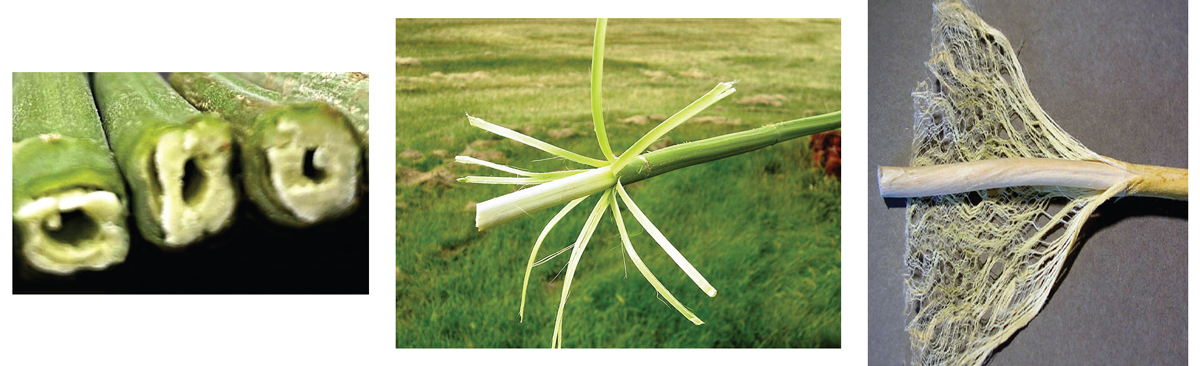
Once the plant is ready to flower, and before the fibers get too tough for textile applications, the fields are cut and the stalks lay on the ground to begin dew retting. This is a natural process whereby bacteria begin to degrade the pectin, which is the gummy substance that binds the fiber to the woody hurd — or center — of the stalk (See Figure 1). After retting, the stalks are baled and sent to a processor to be decorticated — a process that physically separates the fiber from the hurd in a manner similar to any bast fiber process. After decortication and refining, the fiber is ready to be degummed to remove the lignin “glueing” the individual fibers in bundles and ribbons. Extracting the lignin allows the fiber bundles to release the individual fibers during the next process — opening.
Figure 1: Hemp fiber is bound to the woody hurd at the center of the stalk with gummy pectin.
Developing The U.S. Hemp Industry: The Journey
Hemp is a natural fiber and as such, producing the best fiber for apparel and fashion uses is not an exact science. Carpenter has spent extensive time in China over the past 25 years learning about hemp farming and hemp fiber production, but knows he still has a lot to learn.
“It’s been a learning process here in the United States using the equipment available,” Carpenter said. “It’s been an adaptive process, and we have not always been successful!”
Cotton has enjoyed the benefit of decades of research and development in the United States, which along with the work the farmers do, means the United States grows the best and most consistent cotton the world.
To spin yarns, fiber consistency is imperative. Providing that consistency to the hemp industry is Bear Fiber’s biggest challenge.
To start, farmers need to grow the hemp variety that is best for textile fiber use as well as the best variety for the region in which they are based.
Encouraging U.S. hemp farming briefly led Bear Fiber into the hemp seed business. “Everyone wanted to grow European hemp varieties for us, and these varieties were not developed for textile grade fiber, or developed to grow successfully in the United States,” Carpenter said. “We were getting maybe 8 percent useable fiber from the stalks, whereas the Chinese had specifically been developing varieties for greater amounts of textile grade fiber that could be grown in a faster manner.” So, Bear Fiber began importing Chinese seeds, which was a whole new educational process that required forming a new business network.
Hemp is a hardy plant that can be grown in a variety of climates, although it prefers a temperate climate and fertile, loamy soil. “Honestly, we don’t yet know where the best place to grow hemp in the United States is,” Carpenter confessed. “But we are pretty sure where hemp can grow in 100 days or less and likely provide double digit textile grade raw fiber yield, which is what we are looking for. This also allows us to pay a fair price to the farmer or processor for the fiber.”
Carpenter believes there is a real opportunity for farmers, especially those in agriculture and textile producing states — such as Georgia, and North and South Carolina — where the spinning mills already exist. “However, we intend to be agnostic,” Carpenter said. “If the fiber is healthy and clean, we’ll ship it from any state in the union. It’s worth it.”
Bear Fiber currently is using textile hemp from North Carolina, Pennsylvania and Montana — where there are quantity processors that have fiber available to date. But the company also is working with newer processing operations in Missouri, Alabama, Texas, California and Oregon. “We want to help grow this industry and help create opportunity for the farmers across the country,” Carpenter said.
“Some states — including New York with a $10 million investment — have programs in place to advise and financially assist American farmers who risk growing this new fiber crop,” Carpenter continued. “But farmers have to pay bills just like anyone else, and if they can’t get real support, they can’t take the chance.”
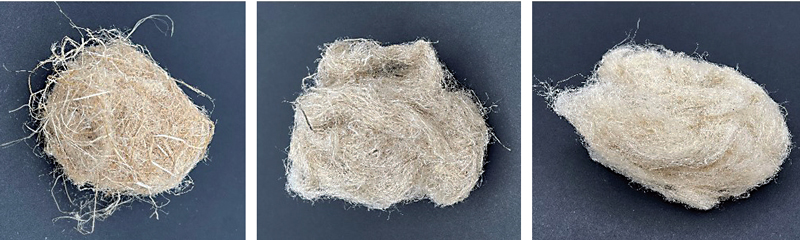
(left to right): Bast hemp fiber, refined hemp fiber and degummed or “cottonized” hemp
North Carolina has a fantastic advocate at NC State University by the name of Dr. David Suchoff, who is an alternative crops extension specialist in the department of Crop & Soil Sciences in the College of Agriculture and Life Sciences. Dr. Suchoff heads agricultural research stations and leads a national public/private hemp consortium. The goal of the consortium is to address many of the issues relating to the hemp industry through collaborative research with other institutions across the country. Suchoff also plans to expand hemp farm fiber outreach opportunities with emphasis on underserved farming communities.
Dew retting harnesses moisture that develops overnight to encourage bacteria growth. “That makes it harder to get good textile fiber from hemp grown in Montana where there is no dew,” Carpenter said. “But there are different varieties of hemp, and we are learning about techniques to promote bacterial growth for retting in geographic areas that don’t enjoy the same climate as say North or South Carolina.”
Decortication also is key step in hemp fiber processing to preserve the textile grade fiber. Any kinks or damage caused during decortication may weaken the fiber, which results in poor performance in downstream processing. “Great care has to be taken when decorticating textile grade fiber,” Carpenter said.
Bear Fiber’s Expertise
Circling back, one of Bear Fiber’s goals is to be the supplier of choice when it comes to high-quality textile grade hemp fiber. “Where Bear Fiber comes into play is we know how to separate the hurd and clean the fiber to where it needs to be so it can then be put through the wet processing of degumming,” Carpenter said. “The most important thing about this process is that raw fiber with any percentage of hurd must be cleaned and refined. Fiber with any percentage of hurd mixed in is not as valuable as raw fiber that is cleaner.”
Carpenter said in American hemp fiber processing currently, the raw fiber is anywhere from 1 to 6 inches long in bands or ribbons gummed together. Bear Fiber uses an alkaline process to degum the fiber. There are many methods available to degum hemp fiber — including boiling, electrification, acid and enzyme techniques — but Carpenter likes an alkaline process developed by the Chinese because it’s simple and cost effective. The end goal is fibers that are 1 to 2 inches long.
“We’re trying to achieve a uniformity in the degummed fiber so that it can be blended with other fiber from the United States,” Carpenter said. “Each bale is tested before degumming against a standard formulation, but we might have to adjust the alkalinity or the chemistry in some way if we need to lighten the fiber to achieve a more consistent fiber grade based on where the hemp came from and how well it was retted.”
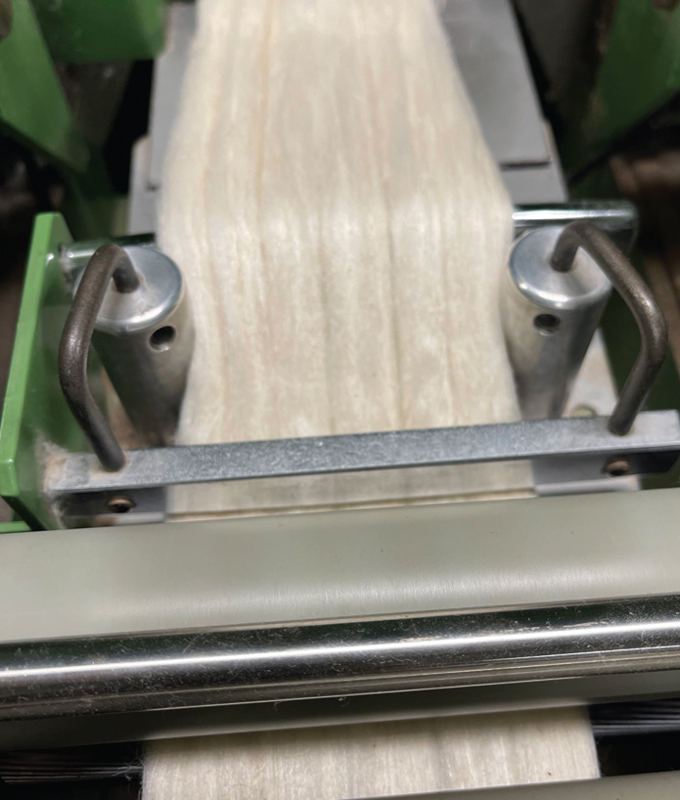
A hemp/cotton sliver on the drawing frame
Hemp fiber is valuable. Carpenter shared that currently, hemp fiber compares to alpaca fiber in price. “Right now, it’s still pretty expensive because everything that has come through our pipeline so far has been part of the development process,” Carpenter shared.
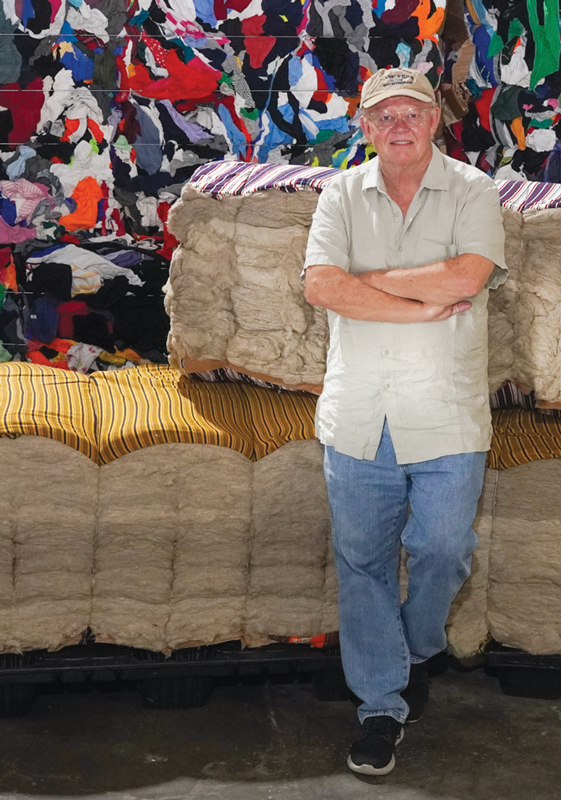
Carpenter has been busier than usual over the past several months. The company relocated within North Carolina from Wilmington to Morganton, to be closer to manufacturing partners. “We hope one day to grow into our own spinning and will focus on spinning natural fibers, recycled fibers and regenerative fibers” Carpenter said. “In Morganton, I’m surrounded by 120,000 pounds of recycled fiber. Material Return [a solution for custom circularity that works with manufacturers and brands to transform textile waste into new products], for example, is here in Morganton and it has a Smart Wool return program for socks. Bear Fiber looks forward to eventually blending innovative technical yarns comprised solely of natural, sustainable, recycled and regenerative fibers.
“The hemp fiber industry doesn’t really have a competitive environment yet,” Carpenter mentioned. “We haven’t produced enough fiber to make a difference in any market. To date, the only commercial products made using U.S. hemp and manufactured in the United States are Bear Fiber socks.” The socks are developed and knit in partnership with the Manufacturing Solutions Center in Conover, N.C.
“Our industry manufacturing partners have been receptive to hemp and a number of companies have been true first movers,” Carpenter shared.
Collaborative Approach, Partnerships Are Key
Carpenter has embraced a collaborative approach to growing the U.S. hemp industry. He has worked with brands, both big and small, and consults with and mentors anyone wanting to learn more about hemp and the opportunities it presents. “We all work together better than alone,” he said. “I always prefer to look for partners and establish relationships. We are all allies working together to create a market. I’m willing to help and share the knowledge I have in order to advance and grow this industry.”
While Carpenter is widely acknowledged to be a hemp “guru” of sorts, he does want to make it patently clear that he is not any sort of isolated Don Quixote character operating independently. “There is no way that one person could have achieved much without the help of dozens and dozens of people who believe that hemp fiber is an important and viable asset to the American textile and apparel industry,” Carpenter stressed. “It’s been a journey and I wouldn’t be where I am without the help I had along the way.
“I’d like to name and thank everyone, but there’s just not enough space in the magazine. For Bear Fiber, farmers, processors, spinners, weavers, knitters, finishers, the Textile Technology Center, NC State’s Wilson College of Textiles, VF Corp. and Vans all have been working to create a circular collaborative effort. We also would have been at a dead stop for months without processing help and fiber from IND Hemp — an amazing team that works with farmers to grow hemp out West and processes fiber, grain and hurd in Montana.”
“Guy Carpenter was the first person I turned to when I wanted to learn about Made-in-USA hemp, and he has continued to be a source of both technical and business knowledge as the Wilson College of Textiles and NC State University develop our position in growing, cultivating and manufacturing hemp,” said Dr. Andre West, director of the Zeis Textiles Extension for Economic Development at NC State’s Wilson College of Textiles. “Guy’s passion for a sustainable future led him to embrace hemp early on as a solution and build a unique knowledge base that has allowed him to mentor others as they build hemp-based products. He is grounded, knowing this is a long journey and a lifestyle change. And, he is playing his part to educate everyone that hemp fiber is a part of creating a better future for the planet and has a place in manufacturing textiles in the United States.”
One person who benefited from Carpenter’s willingness to mentor is Claire Crunk, founder and CEO of Trace Femcare Inc., a period care company that produces tampons using hemp and cotton fibers from fully traceable sources. “When I got my start in hemp fiber almost five years ago, I was a total neophyte,” Crunk said. “When I cold called Guy, he was gracious and clearly an expert, so right then and there, I asked him to be my mentor. Guy has been a consistent and selfless mentor since then — teaching, encouraging, and providing more than any conference or curricula ever could. He is one of our company’s most important partners, and I admire him both professionally and personally and am privileged to now call him a colleague and friend.
“As one of the first brands to sell products made from U.S.-produced textile-grade hemp fiber, we are proud that our work ultimately supports our partners, like Guy, in their success to provide textile industry quality hemp fiber at scale.”
A finished hemp/cotton blend yarn
Vans: Mainstream Interest In Sustainable Fibers Like Hemp
Brands are taking an interest in hemp too. VF Corp. believes “hemp has the potential of filling in some of the gaps in our fiber toolkit for brands and products that would like to utilize more natural fibers.”
“VF recently set ambitious goals for the reduction of greenhouse gas emissions utilizing science-based targets, and as one of VF’s largest brands, Vans is committed to supporting these goals,” said Emily Alati, director, Materials Innovation, Vans. “We believe supply chain innovations in natural fibers, including hemp, are necessary and if cultivated with sustainable agricultural methods and processed with lower energy inputs, it can be a competitive advantage to help VF reach those goals.”
According to the company, Vans has used hemp in its products for years, so supporting U.S. hemp agriculture and textile processing also aligns with its consumer and supply chain needs. Vans is currently sourcing hemp fiber from North Carolina in small quantities and hopes to increase that volume over time.
“We are also supporting those hemp farmers in their transition to regenerative agriculture practices to reduce the overall environmental impact of hemp farming,” Alati said. “Ultimately, we are eager to utilize regeneratively grown and U.S. hemp fiber while supporting minority farmers. Long term, we hope to see all VF brands utilizing domestic industrial hemp fiber and textiles for various end-uses across our global markets.”
Vans’ collaboration with Bear Fiber benefits both companies. “The relationship is based on expertise, trust and results,” Alati said. “Bear Fiber has demonstrated that hemp fiber suitable for short staple spinning can be grown and processed entirely in the United States. Its relationships with textile universities, labs and processing partners have led to commercial textiles in a relatively short time span.”
For Bear Fiber, the support received from VF Corp. and Vans starting some two-and-a-half years ago has been incredibly important. “You have a lot more credibility when you walk into a room with people employed by one of the most important brand companies in the world who say ‘we are behind hemp, we think hemp is important and we think this is the future,’” he stressed.
Bear Fiber currently is producing fabric for Vans. The yarn is spun by National Spinning Co. Inc. at its Whiteville, N.C., plant; the fabric is woven by Central Textiles Inc., Central, S.C.; and finishing is performed by Mount Vernon Mills Inc., at its facility in Trion, Ga.
Bear Fiber offers socks made using U.S. hemp that are developed and knit in partnership with the Manufacturing Solutions Center in Conover, N.C.
BFFs: Hemp And Cotton
Hemp is also seen as a potential competitor to cotton, which at times, hampers adoption of the plant for farming and textile use. Carpenter wants to stress that he doesn’t see hemp as a competitor or replacement for cotton and just wants to sell the value of another fiber crop. He sees the two as complementary fibers — best fiber friends (BFFs) — that can help both the farmer and the textile industry. “We are not asking farmers to grow hemp instead of cotton,” he noted. “We are asking them to grow it along with cotton.
“We want to replace 50/50 cotton/polyester blends with 65-percent cotton/35-percent hemp,” Carpenter continued. “We export our cotton everywhere because it’s of the highest quality. One day I hope to be exporting U.S. hemp fiber because it’s sought after for its quality. And the opportunity for hemp blended with U.S. cotton is tremendous.”
Carpenter considers Bear Fiber’s perseverance its greatest asset. “We know yarns and fabrics can be made to meet the quality standards that the brands and consumers are looking for because we’ve been doing it for 25 years in China.”
Ultimately, Carpenter wants what is best for the U.S. fiber industry and the U.S. textile industry.
“I want to help grow the hemp fiber industry into the American textile, apparel and fashion industries,” Carpenter said. “I think an American hemp fiber industry not only can provide consumers with better garments that last longer and feel better but can also be a huge benefit to small farmers and fiber farmers who are already growing cotton.
“The only competition we have is China, and we’re going to be better than them,” Carpenter predicted. “Consumers today have a heightened awareness of natural fibers and sustainability, and are demanding better choices. It’s up to the U.S. textile manufacturing industry to take advantage of this opportunity, to innovate and promote from the ground up our own domestic value chain. In the United States, we’ve already got the best cotton in the world, and that’s a huge advantage. But you know what? Hemp makes it better!”
1 factor to enjoy for in the next Congress: legislative motion on 340B.
Driving the news: Local community wellbeing centers want Congress to halt drugmakers’ constraints on the federal outpatient discounted drug plan at contract pharmacies up coming calendar year. But other stakeholders, which include hospitals, are not convinced a legislative answer is vital but.
Why it matters: Hospitals say introducing laws on 340B threats opening the system to unwelcome legislative adjustments, while group health centers say they require intervention quickly to preserve clinic doorways open up.
“We are possibly the lone wolf out of absolutely everyone who is absolutely beating down Congress’ doorway and inquiring for a legislative resolve in 2023,” Vacheria Keys, director of regulatory affairs for the National Association of Community Well being Facilities, told Axios.
The backstory: Considering the fact that 2020, 18 pharmaceutical corporations have placed restrictions on when providers can use 340B discounts at contract pharmacies.
The Biden administration has questioned quite a few of the corporations to get rid of their 340B limits and even issued warnings of fines if businesses never comply. Five drugmakers have sued in excess of those people warning letters, and appeals are pending in three federal circuit courts.
Hospitals, neighborhood wellness centers and other 340B-lined entities say the procedures are unlawful and threaten affected person access, when pharmaceutical organizations sustain the limits improve 340B system integrity.
The Nationwide Affiliation of Community Wellness Facilities desires to see legislation to quit the contract pharmacy constraints on all provider kinds next year, Keys said.
She designs to press for language that would require drug makers to make 340B prices out there to vendors without having any situations. NACHC has not identified legislative sponsors for the monthly bill nonetheless, Keys stated.
The organization hopes 340B legislation could pass as a stand-by itself bill, but attaching it to foreseeable future work on insulin expenditures could be yet another selection, Keys extra.
Yes, but: Healthcare facility groups aren’t completely ready to bounce on board with NACHC’s approach.
Aimee Kuhlman, vice president of federal relations at the American Healthcare facility Affiliation, claimed she couldn’t remark on NACHC’s certain congressional asks, but stated, “We feel that HHS has the authority that is essential.”
“I will not believe we are at the point still of expressing that legislation is required. I consider we require to see wherever the court conditions go.”
340B Well being, a lobbying group symbolizing hospitals and well being devices in the application, did not right respond when requested whether it supports a legislative option future yr but reported it appears to be like ahead to continuing its Capitol Hill advocacy.
Truth check out: PhRMA just isn’t going to enable Congress reduce 340B discount limits without a fight. In actuality, the pharmaceutical marketplace lobbying group wants much more restrictions and accountability checks positioned on the software.
To commence, PhRMA would like to see Congress far better define 340B clients and revisit eligibility necessities for hospitals and off-web page clinics, reported Nicole Longo, senior director of community affairs at PhRMA.
The application is “so broken” that PhRMA is open up to talking about any solutions on how to change it, she said.
What we’re watching: Irrespective of how protected entities enjoy their cards in Congress, we could see oversight hearings on 340B in the new Republican-controlled Household.
The Vitality and Commerce Committee is open to having a crucial glimpse at the system, explained Chris Krepich, spokesperson for the committee’s Republicans.
Congress may well also return to an ingredient of a bipartisan 2021 340B bill that would generate a nationwide clearinghouse to avert copy Medicaid savings in the application, claimed Emily Jane Prepare dinner, a health and fitness treatment law firm at McDermott Will & Emery.
Alternatives for coal’s carbon and chemical houses are expanding, revolutionizing the way in which we check out this pure useful resource. A new carbon economic climate is on the horizon, and it is previously proving to be a gamechanger in the United States, boosting the regional financial system in Wyoming.
Wooden has partnered with the College of Wyoming (UW) University of Power Assets (SER) and Atlas Carbon to style and design a coal refinery field demonstration challenge around Gillette, Wyoming. The site is being produced and operated collaboratively to create and showcase a sustainable coal refinery system as nicely as product systems, at pre-business scale, employing Wyoming Powder River Basin (PRB) coal.
UW SER’s Heart for Carbon Seize and Conversion (CCCC) has developed a thermochemical system technology which integrates thermal coal solvent extraction and rapid thermal-pyrolysis processing- a vital aspect of the carbon engineering method and the course of action all-around which this task is centred. The technological innovation effectively decomposes coal to advantageous liquids and solids that can be employed in a range of useful, non-strength products and solutions these types of as building and development products, asphalt items, and agricultural soil amendments. To day, the condition of Wyoming has invested above $30 million on these jobs.
“In the up coming period of web site demonstration, the pyrolysis part of the technological innovation will be put in to make larger sized volumes of coal char that can then be used to manufacture these products, with hopes to include the solvent extraction portion of the process in buy to completely integrate the technology,” stated CCCC Interim Director Trina Pfeiffer.
To kick off the project, Wood done a Period 1 engineering review for web-site works, as well as a corresponding feasibility research which integrated UW’s coal refinery technology to showcase a initially-of-a-type area demonstration. With ground-breaking now finish, the novel coal-processing know-how web page will be found adjacent to the present Atlas Carbon, LLC activated carbon production facility at Fort Union Industrial Park, operated by Wooden, allowing for the functions perception, coal-dealing with preparing know-how, and safety capabilities of the Wooden team to be leveraged on both web pages. The Wyoming Innovation Center is also positioned nearby, generating this an perfect locale for discipline demonstrations.
“Our group has experienced enormous success performing with Atlas Carbon to update their activated carbon production facility and enhance operations and protection initiatives on web-site. We’re enthusiastic to mature this marriage additional by using the next phase as we do the job together in a new partnership with University of Wyoming. Our groups have planet class engineering and functions expertise, and we are prepared to aid generate ahead a new carbon economic climate in the state,” reported Nicholas Pierson, Vice President of Operations and Servicing at Wood.
Frank Levy, Atlas Carbon CEO and Chairman explained, “The new pilot facility will enable Atlas Carbon’s ongoing enhancement of activated carbons manufactured from higher-good quality coal as a feedstock. A lot of of our products are currently employed for air and h2o purification, but this venture showcases the commencing of many far more options for Powder River Basin coal in Wyoming.”
On completion, this coal refinery area demonstration project will assistance to guide the way in the evolution of a new carbon financial system, showcasing the selection of opportunities derived from Powder River Basin coal to probable sector and commercial stakeholders even though boosting Wyoming’s economy as the state revolutionizes carbon management.
“We are very pleased to continue on and mature our presence in Wyoming, at the heart of the Powder River Basin, supporting the point out in this revolutionary system of turning coal into worthwhile nonenergy solutions. This collaboration with College of Wyoming and Atlas Carbon aligns with Wood’s pursuit of future-completely ready, innovative technological know-how and enhances our ongoing research with the university to build extra industry answers,” claimed Pierson.
Wood is thoroughly dedicated to serving to clientele meet their carbon administration and carbon motivation ambitions. With our extended scope of answers and strong marketplace base, we have a broad perspective across the value chain for vitality, means, and manufacturing. The latest pace of adjust in technologies, like these that the University of Wyoming University for Power Resources’ Center for Carbon Seize and Conversion are bringing to lifetime, is transforming how our planet operates in the most innovate and surprising strategies. Wooden is happy to generate and foster partnerships like this 1 with UW and Atlas Carbon about the world, utilizing our experience to enable navigate the worries of carbon management though constructing prosperous, sustainable amenities across industries.
To master extra about Wood’s carbon administration operate click right here. To see our carbon dedication, simply click here.